• 18. Kars vs. Bicycles – getting acquainted with Turkey and its legendary shepherd dogs

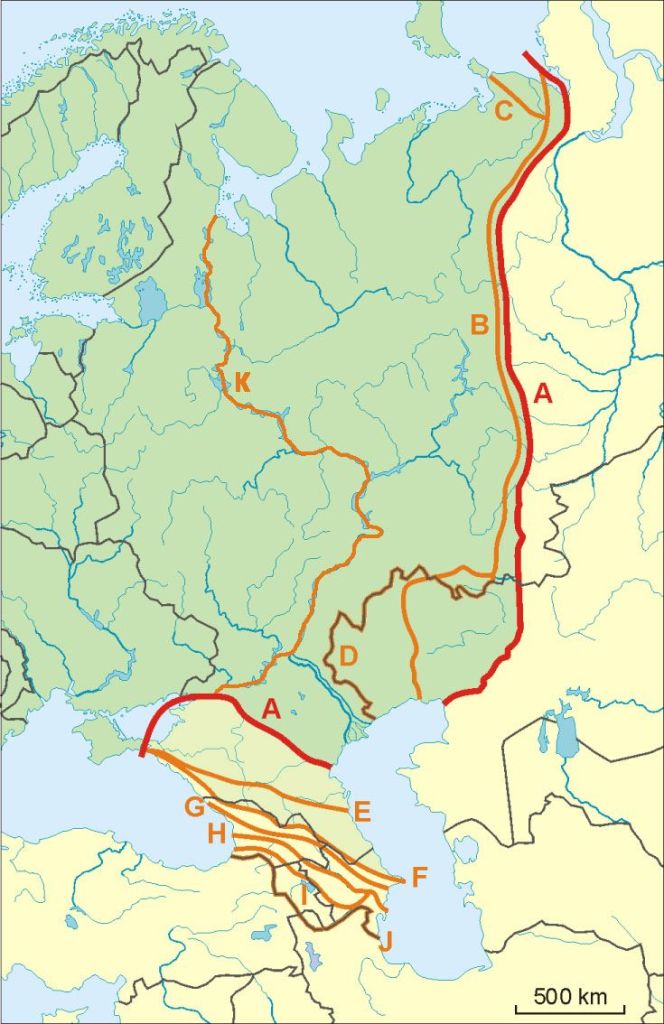
    Turkey seems like quite a big place after spending time in the Caucuses. If you combined Georgia, Armenia and Azerbaijan into one country, Turkey would still be over four times the size (also, good luck trying to govern that imaginary country – it lasted only 36 days when they gave it a go in 1918). Even the shortest route from the Georgian border to Istanbul would be over 1,500km, but also potentially quite dull from a cycle touring perspective.
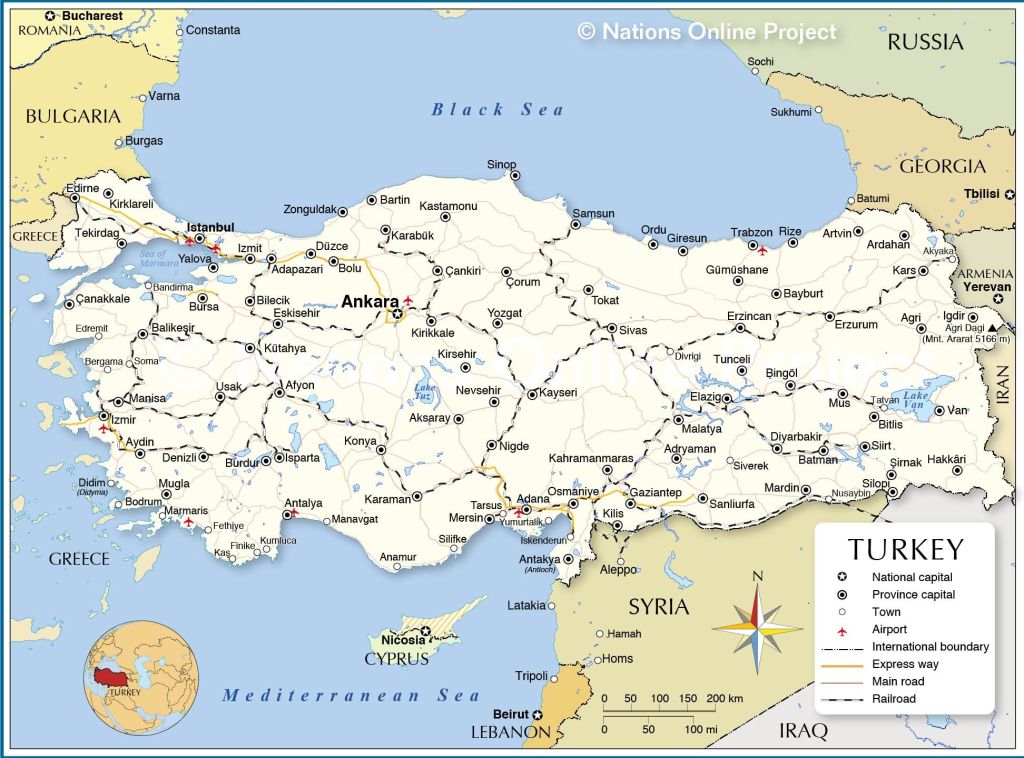
    The Republic of Türkiye
    (credit: Nations Online Project)

    As the land connecting Europe to the Middle East and straddling both the Mediterranean and Black Sea, Turkey has for a long time been where East meets West. Alexander the Great, the East Roman Empire, and the Ottomans have all made their mark in what is now the Republic of Türkiye, where the capital Ankara is eclipsed by the behemoth that is the city formerly known as Constantinople, Istanbul.

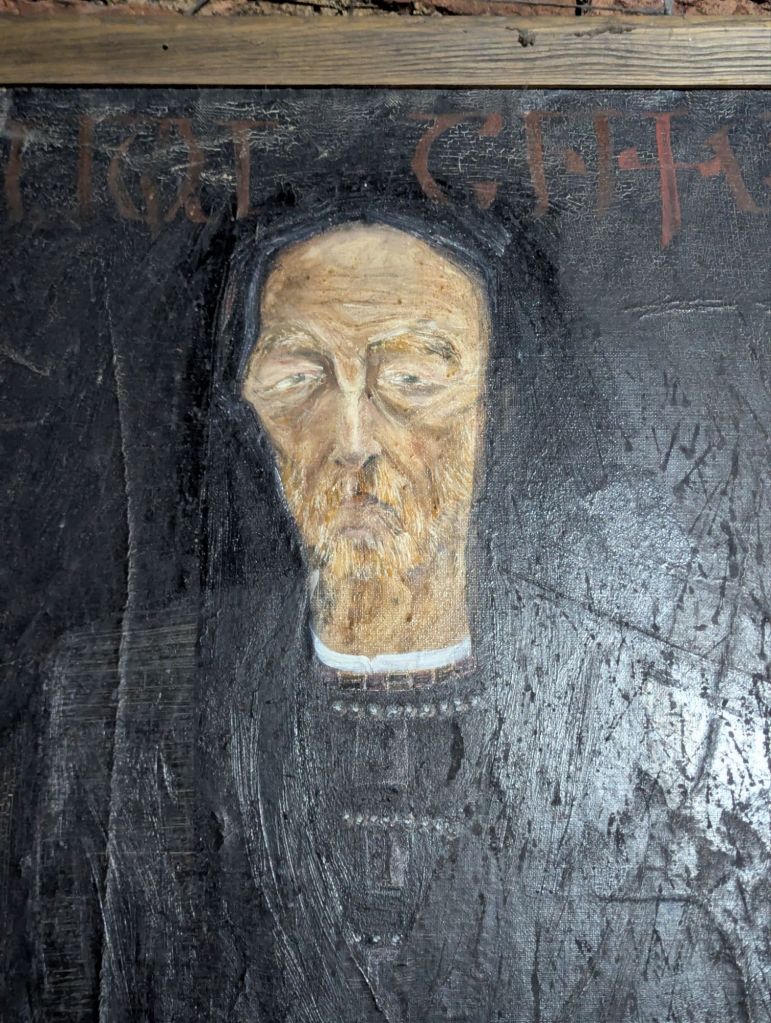
    Turkey is also one of those places where it’s quite common to come across portraits of glorious leader, but he’s not alone. There are two men whose faces crop up quite a lot in this country:

    • Mustafa Kemal Atatürk: the founder of modern Turkey in 1923 (died in 1938)
    • Recep Tayyip Erdoğan: the current president of Turkey (alive)

    I can’t claim to have known very much about either of these people before entering Turkey, but with six weeks to go before being allowed back into the EU, I was about to be immersed in this complex and politically volatile country, so there’d be plenty of time to learn.

    Over the border

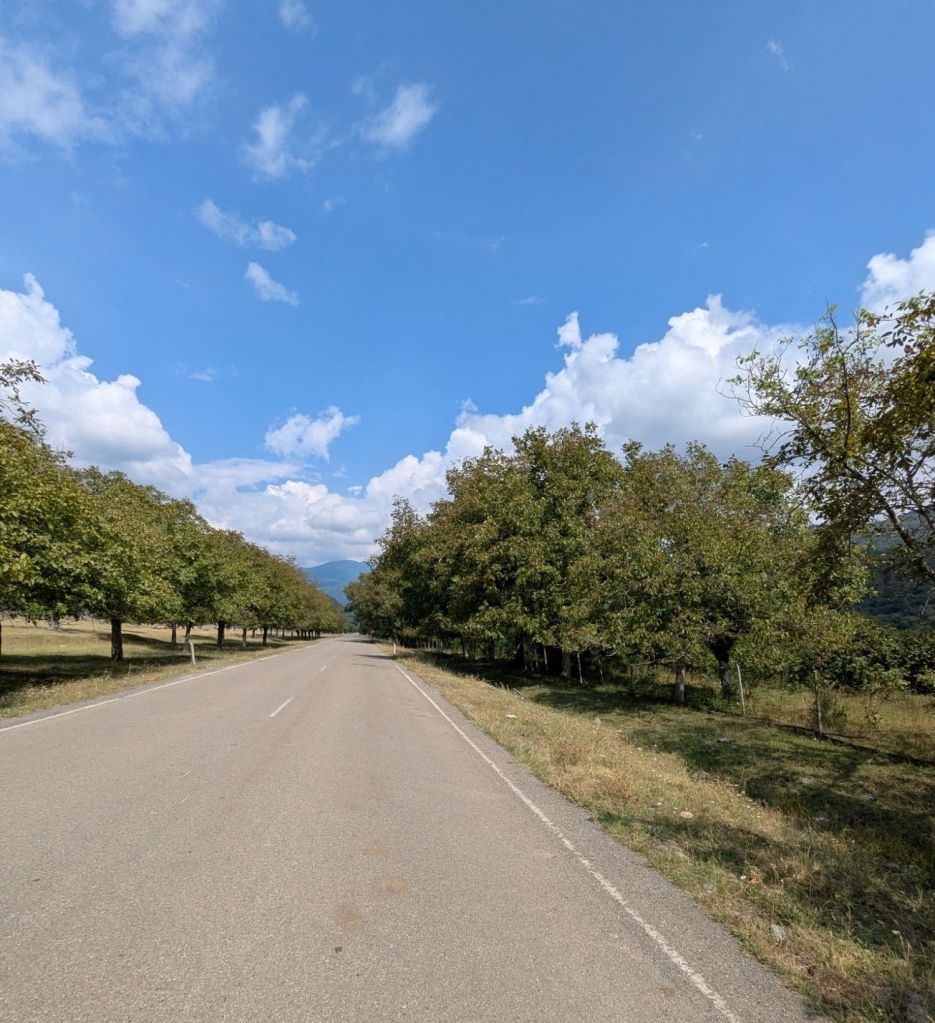
    The rumours of Turkey having much better roads than Georgia were absolutely true. I’d gone from weaving between giant water-filled potholes on a glorified dirt track to a pristine dual carriageway, with a generously wide ‘shoulder’ of tarmac outside of the white line – ideal for cycling. That said, the road was so quiet by 7pm you could cycle down the middle of the dual carriageway doing a no hander whilst flapping your arms pretending to fly, if it tickled your fancy.

    The sun had set and the cool evening air was oscillating to the chorus of crickets in the long grass. The Islamic call to prayer rang out from loudspeakers of distant mosques, echoing through the valley and sliding slightly out of sync by the time the words reached my ears.

    It had been an eventful day, but also quite a long and energy sapping one, so rather than mess around pitching a tent in the dark my plan was to roll into the nearest town and find a hotel – a simple task in Armenia, but Turkey would not always make things so easy. For a start, booking.com – which is stacked with B&Bs in Armenia and Georgia – is blocked in Turkey, and at the time I didn’t realise you can circumvent this by using a VPN, so I resorted to Google Maps.

    Çıldır isn’t really designed for the passing tourist, it is a small provincial town and eerily quiet at 8pm on a Tuesday evening. I stocked up on snacks from the one shop that was still open, concluded there was no accommodation in the centre that wasn’t either falling to pieces or simply mislabeled nonsense on Google Maps (not uncommon in the Caucuses), and headed for what seemed to be a genuine hotel a few kilometres out of town towards Çıldır lake. The absence of lights gave a very ‘closed vibe’ on arrival, but to my relief Lake Çıldır Lodge was very much open. Quite swanky by cycle touring standards, but at more than double the price of B&Bs in Armenia, I knew the tent would have to make a comeback sooner rather than later.

    Lake Çıldır

    Judging by the silent hallways and empty restaurant at breakfast, I was the only guest in Çıldır Lodge that night. I’d heard wealthy Turks come to Eastern Anatolia on the train from Istanbul, but perhaps they don’t always make it out of the cities and skii resorts into the smaller towns and villages. With no other guests to distract them the staff made me feel like a guest of honour, with the smiley receptionist insisting on helping to retrieve my bike from the BBQ area despite her obvious phobia of the frogs that had emerged from a nearby pond, shrieking as one leapt from the long grass onto the path. Dedicated hospitality.

    With absolutely no plan whatsoever in place for how I would cross Turkey, heading for the nearest city to take stock seemed like a sensible option. I wanted to generally avoid the Black Sea coast where possible (having heard too many stories of how unpleasant this route is for cycle touring), so I looked for somewhere inland – Kars was a day’s ride away around 80km south of Çıldır, including a gravel section that follows the west bank of lake Çıldır.

    Setting off at the leisurely hour of noon in modest temperatures, about four minutes into the ride a plume of smoke caught my eye. It was emerging from an area of land beside the road but obscured from view, so I pulled over to try and see what was burning.
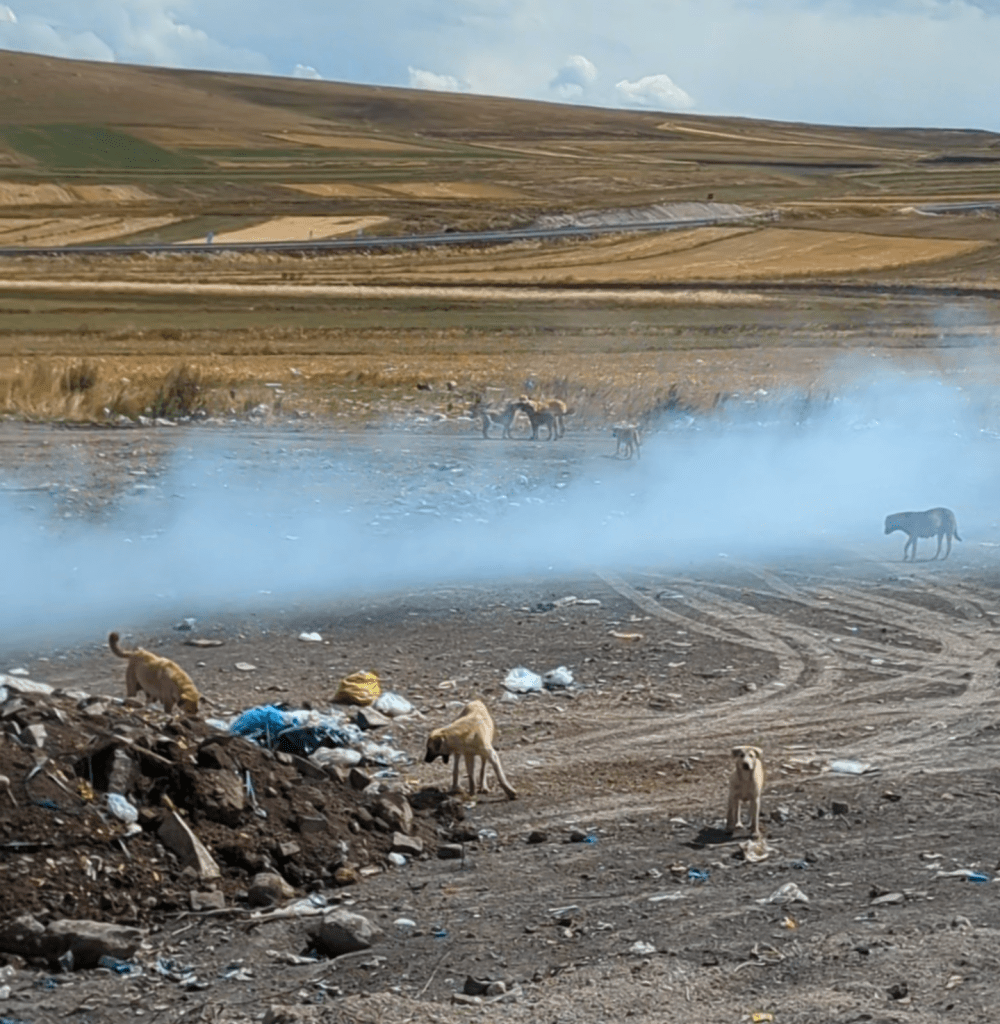
    Dogs foraging amongst the waste at an ‘informal’ landfill site, which also happens to be on fire

    You don’t really get proper ‘dumps’ anymore in Britain – an area of land set aside for dumping rubbish, with no staff or systems in place to contain the leaching fluids or noxious odours. Whether the waste at this site caught fire by accident or was being burnt to make room for more rubbish, who knows, but the smoke can’t be doing much good for the local air breathing population (especially that one dog going full silhouette in the fumes..).

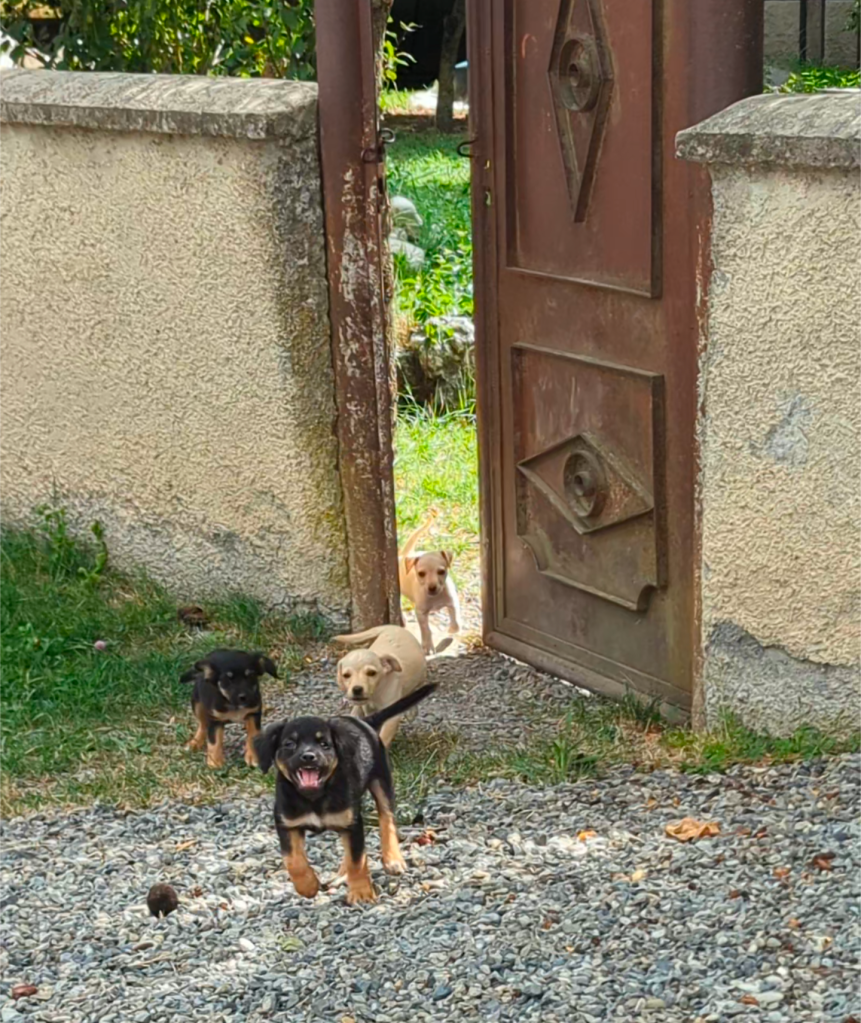
    Not quite the introduction to Turkey I was expecting, but I was relieved the two dozen resident dogs didn’t seem overly protective of their adopted home. The pack were mostly rummaging for edible scraps amongst the smouldering waste, with one ambitious (and presumably quite peckish) mutt taking its chances on the bloated carcass of a dead cow.

    Lake Çıldır looks quite small on a map of Turkey – it’s that little blob in the north east corner on the map above. I expected something along the lines of a Derwent Water, but Çıldır was over twenty times the size – as long as Windermere but much broader. The gravel started off in good shape, but it often degraded into awkwardly large loose stones that jolt the bike in unwanted directions.

    Not long after joining the gravel track my presence caught the attention of a large dog that was laying in the yellow grass beside the road. It had a creamy-yellow coat fading to black around the nose, cropped ears, and a booming deep bark – all hallmarks of the infamous Turkish shepherd dog breed: the Kangal.
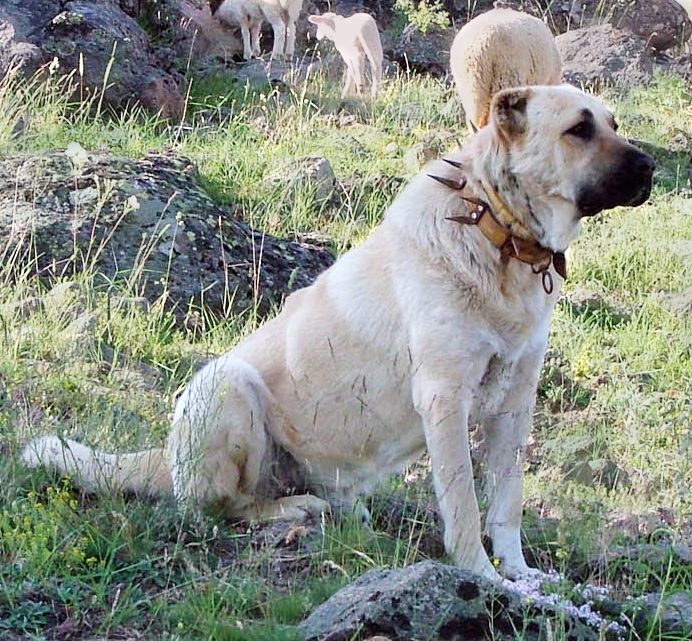
    A quintessential Kangal shepherd dog (credit: Wikimedia)

    Kangals

    Said to have the most powerful bite of any dog, these fearless guardians have been bred to fight off the likes of wolves and anything else they consider a threat to the flock. Kangals often have cropped ears and wear collars with 3-4″ long steel spikes around their neck, ostensibly to defend against wolf bites, but with the added bonus of making them look really quite intimidating to any prospective sheep rustlers. Learning to accept the inevitable confrontations and deal with Kangals (and other breeds of shepherd dog) is an essential Scout badge for any cyclist passing through Turkey.

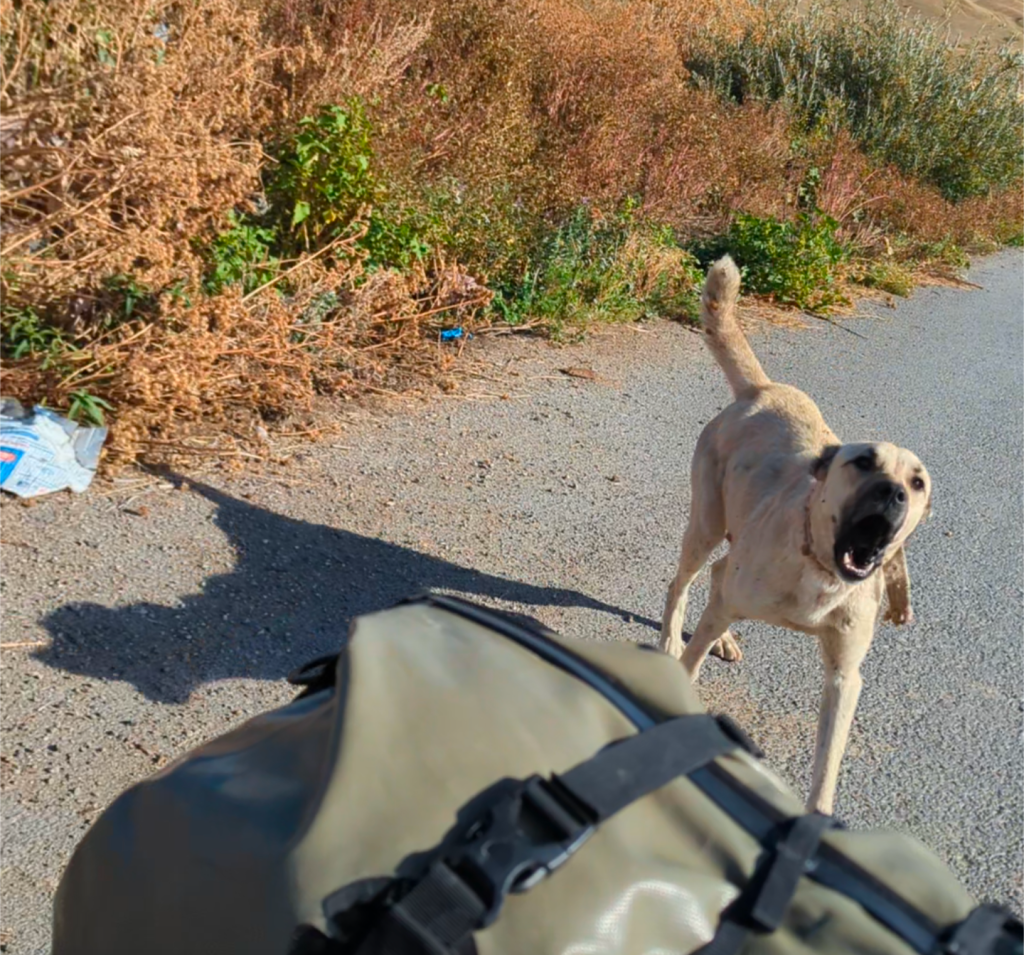
    The dog was not best pleased by my arrival, communicated quite clearly by the enthusiastic and booming deep barks being broadcast from the roadside protest. It looked like quite an old dog, perhaps retired from duty given the notable absence of any sheep around, maybe this was more ‘grumpy old git’ behaviour than active shepherding. On this occasion I tried the Keep Calm & Carry On technique, which is to say I ignored the dog altogether (no speeding up, no shouting, no stopping).

    If any aeroplane landing you can walk away from is a good landing, then any Kangal encounter where you don’t get bitten is a good encounter: this was a good encounter, but there was room for improvement.

    Lake Çıldır to Kars

    Leaving the lake behind I was once again onto beautifully smooth tarmac roads, winding and weaving through the high mountain plateau. The city of Kars is at a lower altitude than Çıldır; rather than follow a long sequence of hairpin turns, the road becomes like the main drop on a rollercoaster and simply makes a beeline for the lower level – add in a tailwind and you’ve got the recipe for going a little faster than usual. I clocked over 70km/h, which on something so comically un-aerodynamic as my loaded bicycle, is quite the white-knuckle experience.

    Sloped haystacks in the village of Taşköprü

    The weather had been overcast but dry for most of the day, until around 3pm the heavens opened and a heavy downpour rolled in. Pulling off the busy road and stashing under some trees along a riverbank to eat lunch, I noticed several dogs of varied magnitude patrolling the vicinity of a nearby farmhouse. Sure enough, as I began to walk the bike back towards the road to depart, the little yappy one spotted me and raised the alarm.

    Within seconds an untethered Kangal leaps up onto the farm’s dry stone wall then down onto the road next to me. I don’t know if it was the excessively aggro barking and snarling, or the fact it wasn’t even a shepherd but just a guard dog allowed to run amok, but I was left feeling pretty annoyed at this mutt. As we approached the end of the street around 20m from the farm, the vigour began to drain from its bark and the dog began to lose confidence in its conviction. I swung around and summoned the energy of my old secondary school’s deputy head and de facto Chief of Justice: Mr Dix, and bellowed:

    “Will you just F**K OFF!!”

    To be fair I don’t think Mr Dix used to swear at students, but his full volume dressing downs were the stuff of legend. The Kangal instantly backed away like a family dog caught shredding its master’s socks, followed by the smaller dog. The two proceeded to potter around sniffing the floor as if nothing had happened. Would it have still backed off if I’d yelled earlier, when we were closer to the property? I have no idea, but it felt good to let off some steam.

    The city of Kars

    It had been a while since I’d ridden through a city, which always requires some extra vigilance amongst the weaving scooters, swinging car doors, and drivers pulling out regardless of whether it was a ‘good time’ to do so. It began to feel quite claustrophobic in the crowded city centre streets, so I left behind the street vendors and traffic and made my way onto the open plaza that sits below Kars Castle; when arriving in a new city it’s worth finding a peaceful corner to sit and gather yourself, especially after a long ride.

    The hotel I’d booked was one of the cheapest on booking.com (accessed with a VPN), at about £18 per night. Always a gamble going for the cheapest: the building was in need of renovation with weird quirks like the only power socket being 4 feet up a wall, and the shower head blasting off as soon as the water began to flow (transforming into an out-of-control hose & spraying water in all directions). The hotel also happened to be next door to a substantial mosque, where the Fajr early morning prayer rang out from loudspeakers long before my alarm clock.

    The cheerful trio of women working reception more than made up for the hotel’s flaws, where I was plied with small plastic cups of chai whilst they practiced their English on me and I waited for the rain to stop.
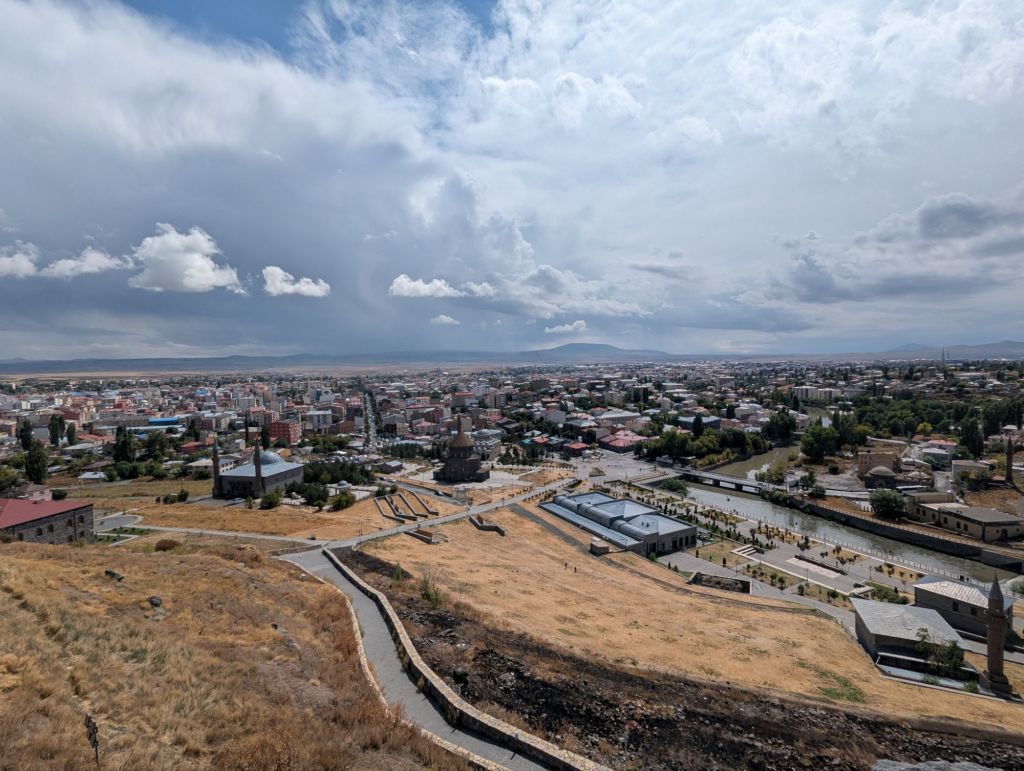
    Looking back towards Kars from the castle

    Kars is far from an ultra modern city but compared to the surrounding small towns and villages it has many more western comforts to offer. There are coffee shops, corporate fast food, and good sized supermarkets. The city also has an abundance of cheese and honey shops flogging the local produce, so many in fact I wondered how they made money given the lack of visible customers.

    If you want a cosy café to sit and drink tea in Kars then you can’t go far wrong with Çayloveyou Cafe, where I amused the local punters by trying to eat a handful of sunflower seeds without shelling them first (a bit like eating splinters of wood).

    One of the more unsettling sights on the streets of Kars

    One of the errands on my ‘to do’ list whilst in Kars was to come up with a route plan for getting across Turkey. Istanbul would undoubtedly be the final destination, but rather than just follow the Black Sea coast the prospect of heading deep into central Anatolia seemed more appealing, especially if the route could pass through the bizarre, fairytale-esque rock formations of Cappadocia.

    An Irishman I’d been sipping tea with back in Çayloveyou café asked if I planned to visit Ani – an abandoned Armenian city about 40km east of Kars. The fact that this part of Ottoman Turkey had a thriving Armenian community until the genocide had rarely been far from the forefront of my mind since entering Turkey, the landscape is more or less identical to the Armenian Highlands but the society is thoroughly Turkified. Even though Ani had been abandoned for centuries by 1915, the prospect of walking around an entire city in ruins felt like one visual metaphor step too far for me.

    There would be no trip to Ani on this trip then. Instead, the plan was to briefly head north again to get out of Kars and follow the back roads until I reached the D060, then start heading west towards the town of Göle.

    A rocky police encounter

    Following the breadcrumbs on my satnav, I weaved past a strategically placed block of reinforced concrete in the centre of the road and slowly made my way up a painfully steep bank. It hadn’t quite twigged yet, but there was a stark contrast emerging between the lush green gardens of the fenced-off detached residences to my left and the wasteland of broken concrete and dumped rubbish I was cycling through. A young alsatian was bouncing up and down on its hind legs from behind the tall metal perimeter fence, and its police officer handler gestured that I should come through the electronic gate into the compound.

    “We were surprised to see you there, that road is closed. Nobody uses that road.”

    “It’s closed? Oh, erm…üzgünüm?!

    Still unsure if I was in bother or not, it seemed wiser to apologise rather than get into an argument about the need for clear signage in such circumstances.

    It soon became clear I was in no trouble at all when the chai began to flow and I was presented with a salted baked potato with a core temperature approaching ideal conditions for nuclear fusion. The compound contained lodgings for senior military staff based at the nearby barracks, and guarding the place seemed to involve an awful lot of not a lot, where impromptu conversations with fluorescently clad Brits can break up the day nicely. Learning I studied geology, the younger cop went into the gatehouse and returned with a glossy black lump of volcanic glass.

    Obsidian, from this region“, he explained whilst placing the stone into my hand. Completely failing to explain in my customary mish-mash of Turkish, English and body language that lumps of rock are a bit too heavy to carry home as a souvenir, I popped it in the handlebar bag and waved my new friends farewell.

    A lump of obsidian volcanic glass – not the most lightweight of souvenirs

    How many dogs is too many dogs?

    The road out of Kars was a single carriageway that slowly wound its way into progressively more and more remote countryside. This is sheep farming country, where the jingle jangle of bells is an integral part of the soundscape as the shepherds lead their flocks up and down the hills in the endless search for good grazing.

    There are farms too of course, typically quite small and family-run, often spaced within only a stone’s throw of one another. With farms come farm dogs, and they were in no short supply in this particular corner of Turkey. After a few relatively ‘easy’ encounters where the dogs barked at me but never really got close, the route deviated off the ‘main’ road up towards a remote looking valley, where just beside the road on the right hand side there was a farmyard.

    Clockwise from top left: Dopey, Psycho, Stalker, Weenus

    There were four dogs that I could actually see, with one particular mutt (Psycho) appearing twice from different angles in the collage above. To find yourself completely surrounded by barking dogs is quite an unnerving experience, but it didn’t take long to tune into the group dynamics and conclude that the risk of becoming Pedigree chum was actually quite low.

    • Dopey, stranded in the long grass like a wind-fallen lemon was wagging its tale and just seemed happy to be part of the action.
    • Weenus was following me but very half-heartedly, and soon gave up. No passion, no commitment.
    • Psycho was showing the real aggression, and it wasn’t even a Kangal (Akbash are the second most common shepherd dogs in Turkey). Being held back by a metal chain, it’s hard to know whether the obscene bloodlust on display would have sustained had the chain snapped and it could actually reach me.
    • Stalker was the most persistent mutt of the pack, naturally. A fairly young Kangal, Stalker continued to follow and bark at me for the best part of two minutes. It wasn’t until I stopped dead and lunged in its general direction that the stalking desisted and no restraining order was required.

    Although it never really felt like I was in serious danger, having to deal with so many unleashed, powerful dogs that are trained from birth to intimidate strangers was beginning to become quite tiring…and this was only the second full day of cycling in Turkey! But this was a particularly rural section of hill farms and tiny villages, surely the main roads will be more sheltered in this regard, surely!?

    Come for the chai, stay for the chicken

    The road was now becoming a gravel path as it zig-zagged up the hillside towards a small lake. I passed through Gölbaşı – one of countless tiny farming communities in the region where residents scrape out a living from sheep farming, beekeeping and whatever else they can squeeze out of the arid land at over 2,100m above sea level.
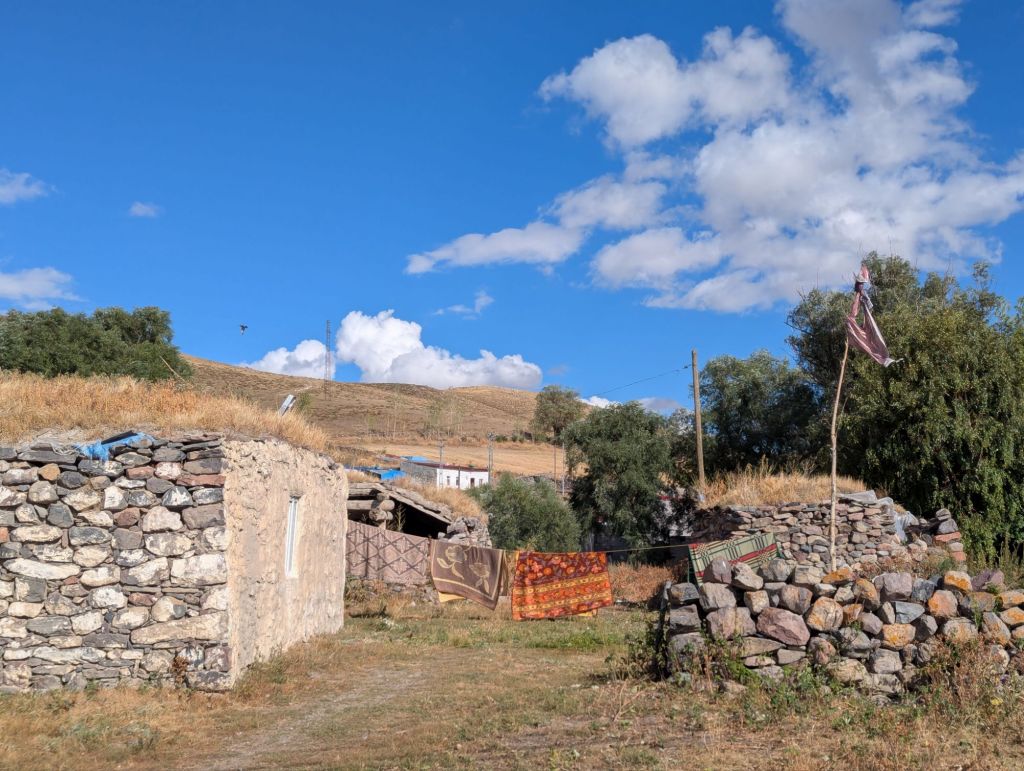
    Rug cleaning day at a village in rural Kars district

    Still in my saddle but riding slowly, an elderly man stood in the garden of his white bungalow caught my eye and waved at me to come over. In stark contrast to being castigated by a pack of territorial dogs, this was the warm & hospitable side of Turkey. Anticipating a cup of tea, my expectations were blown away when a plate of roast chicken, bread, honey and cheese was served up by his wife, who vanished back into the cottage as quickly as she had appeared.

    A small flock of ducks huddled beneath a leaking tap to paddle and sip from the puddle below; a very pregnant Border Collie wandered into the garden and lay down to watch me eat the roast chicken, with hopeful eyes.

    “Not my dog, village dog.”

    Gölbaşı was totally serene that evening. The breeze had succumbed to stillness, and the setting sun was painting the hillsides with warm shades of amber, burnt orange and pink. I said my goodbyes to the man and his wife and began the search for a camping spot. I headed for the slightly busier road to Göle, where after a few kilometres I came across some flat ground not far from the road but just about out of view of passing traffic. By 10pm the hillsides were deserted, leaving just the hum of insects interspersed by the faint barking of dogs from a village up the road.

    At this altitude with clear skies it was going to be a chilly night; thankfully, a previous plan to send all my cold weather clothing home in a parcel when I got to Azerbaijan had been scuppered by an aversion to the faff of international post. I put on my merino wool pyjamas, cotton jogging bottoms, synthetic fleece, and laid my down jacket on top of the sleeping bag like a blanket…cosy even at 3°C.

    ———————————

    PHOTOGRAPHY: Kars
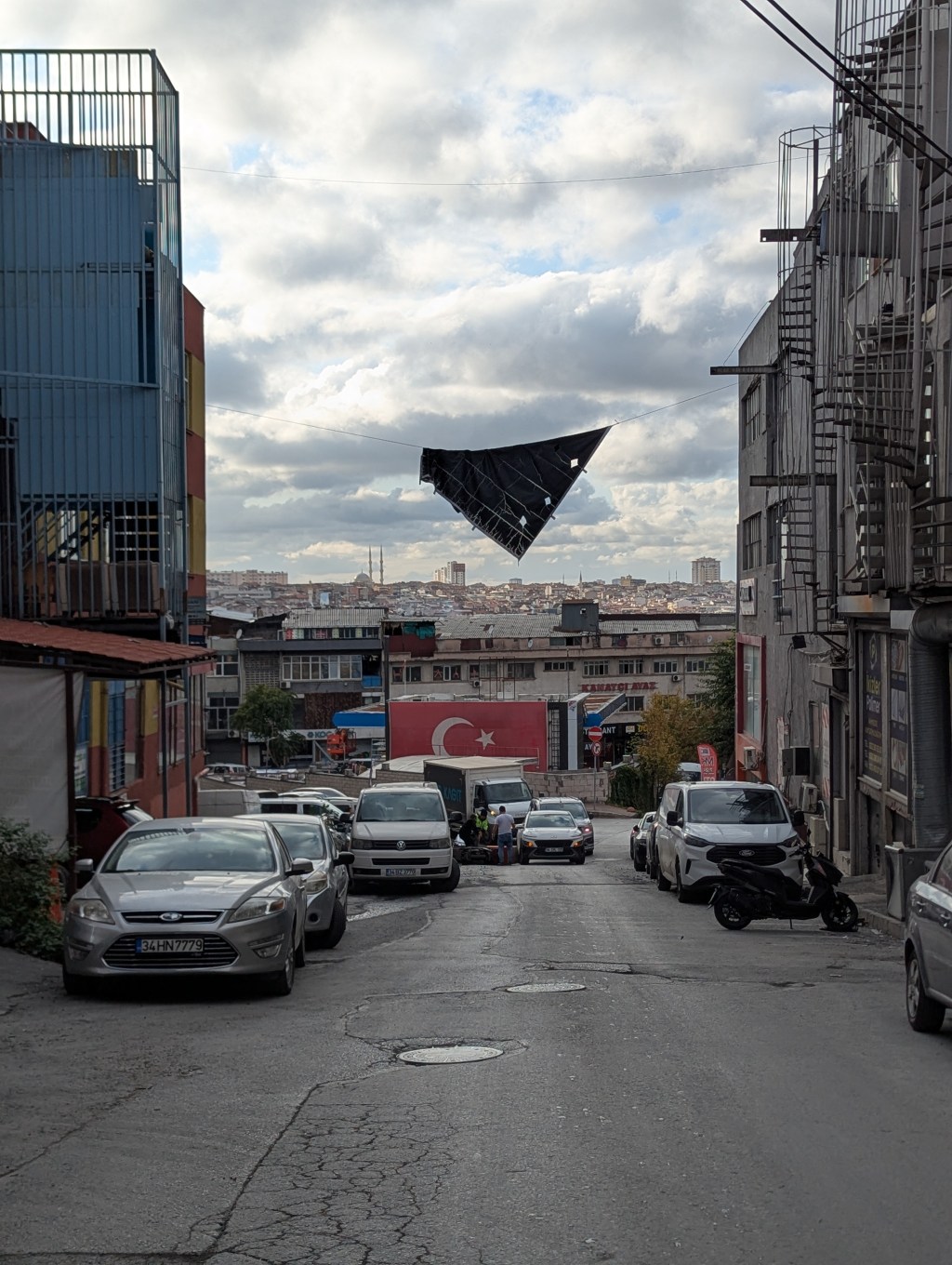
  • A walking tour of Vatan: Istanbul’s inner city plastic recycling neighbourhood

    Whilst I was travelling through Turkey, a three-part podcast was released called Boy Wasted, investigating the death of a young Afghan refugee in an Istanbul recycling facility and the murky underworld of Turkey’s import-driven plastics recycling industry. It has for several years struck me as odd that Turkey has become such a major destination for our Great British Plastic Waste – so in a brief diversion from the main blog, I decided to venture off the beaten track and see some of this mysterious world with my own eyes.
    ————————

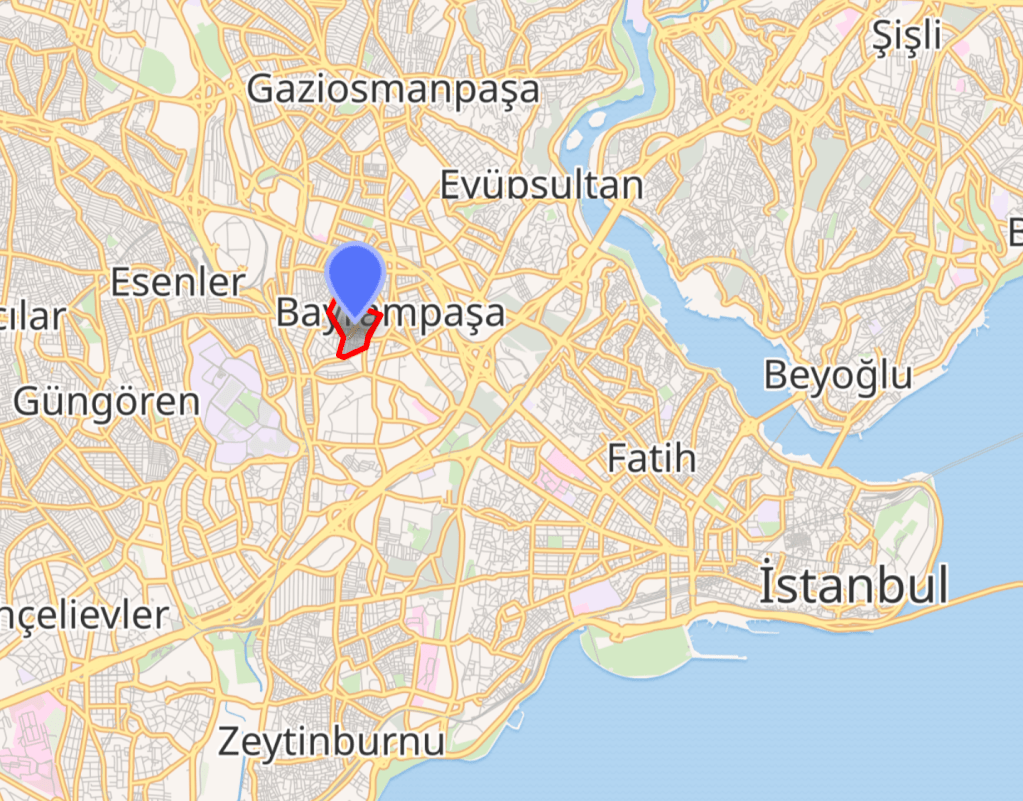
    I’m going to go out on a limb and guess that you have never heard of Vatan. It is quite a small neighborhood in Istanbul’s Bayrampaşa district, around a 45 minute bus ride out from the bustling spice bazaars and grand mosques of central Istanbul on the European side of the Bosporus.
    Vatan, a small fragment of Istanbul’s dizzying urban sprawl (credit: Wikimedia)

    Vatan is unlikely to feature in any Top 10 Istanbul Must See travel blogs or be pictured on a box of Turkish delight. The closest most tourists will get is the city’s main bus station, around a kilometre up the road at Esenler. That’s because Vatan is very much one of Istanbul’s inner city industrial neighborhoods.

    Something in the air

    Back when I was 12 years old, my friends and I would often walk through parks and green spaces in my home town of Billingham, northeast England. Every now and then we’d spot a ‘parachute’ on the floor – nothing to do with skydiving, these were two litre plastic bottles with the base cut off and a carrier bag attached in its place. I was told they were an elaborate form of glue sniffing: pour your adhesive of choice into the device then huff on the mouthpiece until the VOCs and oxygen deprivation deliver the desired buzz. I can’t tell you exactly what it’s like to parachute because I’ve never taken the leap, but just breathing the air in Vatan might not be too far off…the head rush comes on within seconds of stepping off the bus.
    It’s not the smell of glue that fills the air on the streets of Vatan, but the heady aroma of molten plastic. The neighbourhood is a hub of small-scale industrial operations – especially plastic recyclers and manufacturers (along with an abundance of car repair garages).
    In the Boy Wasted podcast, their investigations focused on Cebeci – another industrial district on the northwestern outskirts of Istanbul, another recycling hub where Arifullah Fazli’s body was discovered. As well as being on the edge of town, Cebeci has good links to the motorway, making it an ideal destination for imported plastic waste brought in by the truckload.

    Vatan is a fair bit closer to the city centre than Cebeci, where its narrow streets make it less suited to the large trucks that tend to bring in unsorted waste from the ports. Instead, Vatan seems to be where the plastic waste ends up once it has been sorted by polymer and colour – a labour intensive process that becomes more economically viable when costs like salaries, health & safety, and environmental controls can be kept to a minimum. Its inner city location also makes Vatan a more convenient delivery point for the so-called ‘informal’ sector: men who push trolleys full of items fished out of bins to be sold on the recycling market.

    Street-level recycling collections in Turkey: a man manually sorts through bins of general waste

    Into the alleyways

    Turning off the main road and down the grubby side streets of Vatan, traces of waste management began to emerge. The same men I had seen rummaging through the city’s bins for items of secondary value were now emptying their trolleys down grime coated alleyways into decrepit industrial units. Tipping the collected material is a two person job; I watch a grown man scold his juvenile accomplice as he fumbles and drops his end of the awkward load.

    It’s not just plastic bottles pulled out of litter bins coming through the factory doors. A young man in a red hoodie yells to the driver of a small truck as he starts to unload his vehicle. The truck is piled high with smashed up black plastic fruit crates, a mass of splintered polymer that had begun to clog the building’s input chute. You have to watch out for these chutes along the alleyways: without due care & attention, you might find yourself plunging uninvited into a waste reception hall.

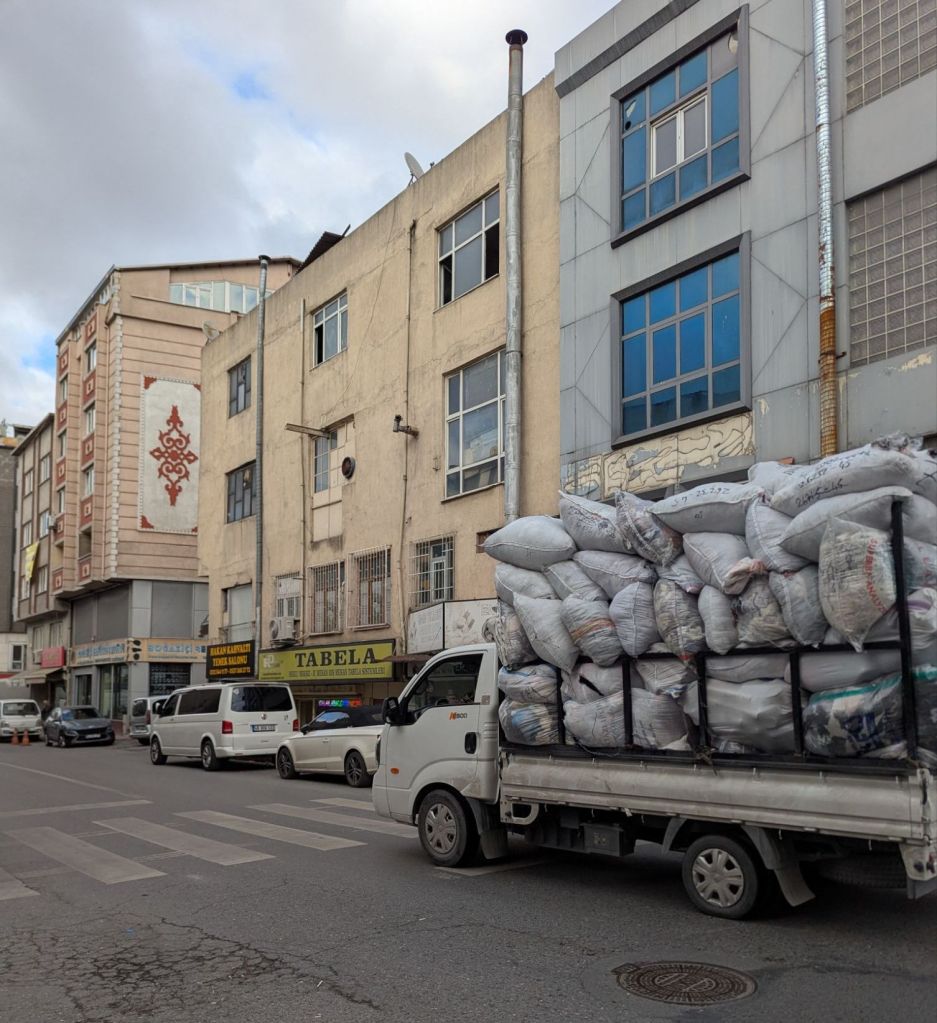
    A lorry en route to deliver feedstock in Vatan, Istanbul

    A small truck whizzes past down the main road that meanders through the centre of Vatan, its load stacked precariously high with bulging white sacks. The contents look relatively soft and pliable, and I wonder if it might be sorted plastics coming out of the plants at Cebeci, but it’s impossible to tell as a passive bystander.

    Just off the high street, a pile of black bin bags lay on the floor next to a large bin. They’ve been stuffed with partially molten shoebox-sized blocks of black plastic, seemingly rejected midway into the melting process for some reason. Up another street, there’s a smorgasbord of dumped rubbish strewn beside a wall: everything from plastic bags, bottles, pots tubs & trays, even a Fiat car bumper thrown in for good measure. The floor is covered in thousands of small, multicoloured fragments of plastic – something you see all around once you get your eye in, although not usually quite this bad. A shallow stream of water flows onto the street from a nearby garage, carrying the smaller fragments along with it.

    All shapes and sizes – mixed plastic wastes on the road in Vatan

    Plastic that enters these facilities and passes the initial quality check is put through a sequence of processes to grind, decontaminate and refine the material into granules, which is sorted by colour and polymer type then sold to manufacturers. One of the local outfits was making everything from door knobs to dining room tables although they seemed to specialise in trolley wheels…the principal mode of transport for local recycling collections.

    Local impacts, global dilemma

    It is an unfortunate truth that pretty much everywhere you go, people drop all kinds of litter and dump all sorts of rubbish. Glass bottles, metal cans, sheep carcasses – almost every waste under the sun can be spotted at the roadside from time to time. However, it is plastic that consistently gives the impression of getting absolutely everywhere (..even before you consider micro-plastics). It is a remarkably useful, versatile but also complex group of materials, and one that eludes meaningful levels of recycling whilst continuing to infiltrate the natural and agricultural systems we rely on, where the long term ecological and health impacts remain poorly understood.

    Developed countries with relatively effective recycling infrastructure for other materials have relied on exporting waste plastic to parts of the world where health, safety and environmental standards consistently fall short of what the exporting companies (and their clients, including local authorities) would rightfully expect in their own domestic operations. As is often the case with waste management, the burden on importing countries is levied disproportionately onto the poor: the people who work in and live beside waste facilities. In Turkey this is often the refugee population.

    It’s hard to overestimate the significance of Turkey when it comes to migration. As the geographic gateway between Europe and the Middle East along with the civil war in neighbouring Syria, Turkey has become the world’s second largest host nation for refugees. Although the majority of Turkey’s c.3 million refugees are from neighbouring Syria, anecdotally it seems that Afghans – a recent target of Turkish authorities for deportation – are over represented on waste sites.

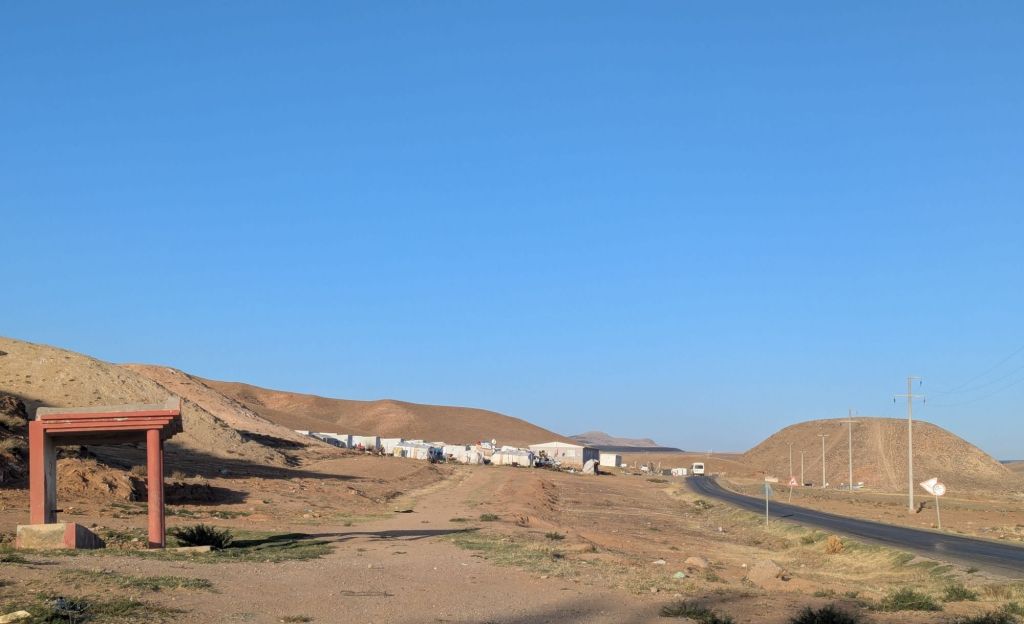
    A roadside camp for seasonal agricultural workers near Lake Tuz – Syrian refugees have become a major source of cheap seasonal labour in Turkey

    The UK has been a long established exporter of plastic waste, even leading the world in sending material to Turkey in 2023, but it’s not the only one. Over half of the EU’s waste has been exported to Turkey since 2018 after China decided it’d had enough of being the world’s dumping ground and closed its doors to waste imports. When it comes to plastic recycling, domestic markets tend to skim off the cream, leaving the bulk to export markets. Exports go to where the market dictates – and whilst energy costs play their part – for mixtures of materials that require manual sorting there’s a ‘race to the bottom‘ effect where material flows to whoever can get away with the cheapest labour, worst health & safety, and least environmental controls. Vietnam, Malaysia and Indonesia have also become major importers in recent years.

    This is far from an easy problem to solve. People can reduce their plastic use here and there, but consumers will never solve this on their own, especially where plastic alternatives are either hopelessly sub-par quality or prohibitively expensive. The 2025 United Nations negotiations to agree a global treaty to reduce plastic pollution failed because countries couldn’t agree whether to reduce virgin plastic production or instead focus on improving recycling, with oil producing nations being less enthusiastic about the proposals that require producing less oil [insert ‘surprised Pikachu face‘].

    If humanity can’t bring itself to cut down on plastic production and consumption, then bringing an end to waste plastic exports and taking ownership of waste generated in our own countries seems like a reasonable alternative in the meantime. Whether we will be able to recycle that waste or not is another question.

  • 17. A journey into the volcanic and ancient Armenia

    Route planning is a savoured pass time for some and a necessary evil for others. I enthusiastically fall into the former, but it can occasionally induce a headache when the ‘perfect’ route in your mind collides with the constraints of our imperfect world. Armenia has an abundance of such constraints.

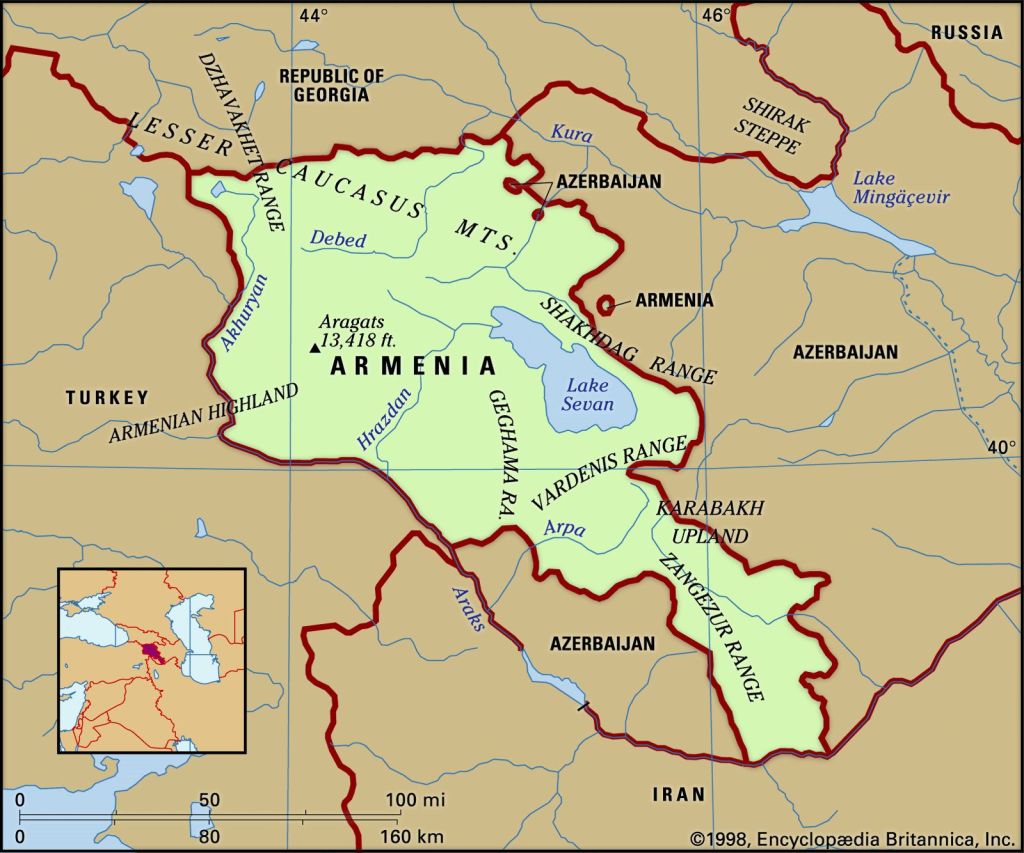
    The majority of Armenia’s borders are with Azerbaijan and Turkey, both of which are closed

    So from Georgia, unless you plan on entering Iran, Armenia is a bit of a cycling cul-de-sac. My ideal route would have headed out of the capital Yerevan and crossed into Turkey just above the northernmost tip of Iran, but clearly that was not an option. Instead, I would enter Armenia from the east and eventually exit back into Georgia in the west.

    Escaping Tbilisi for the border

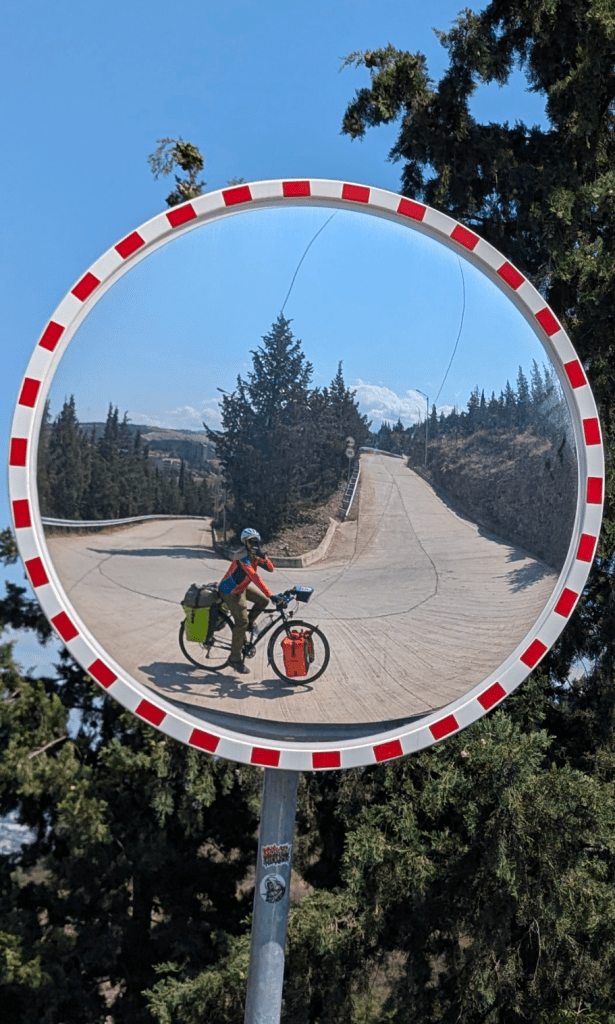
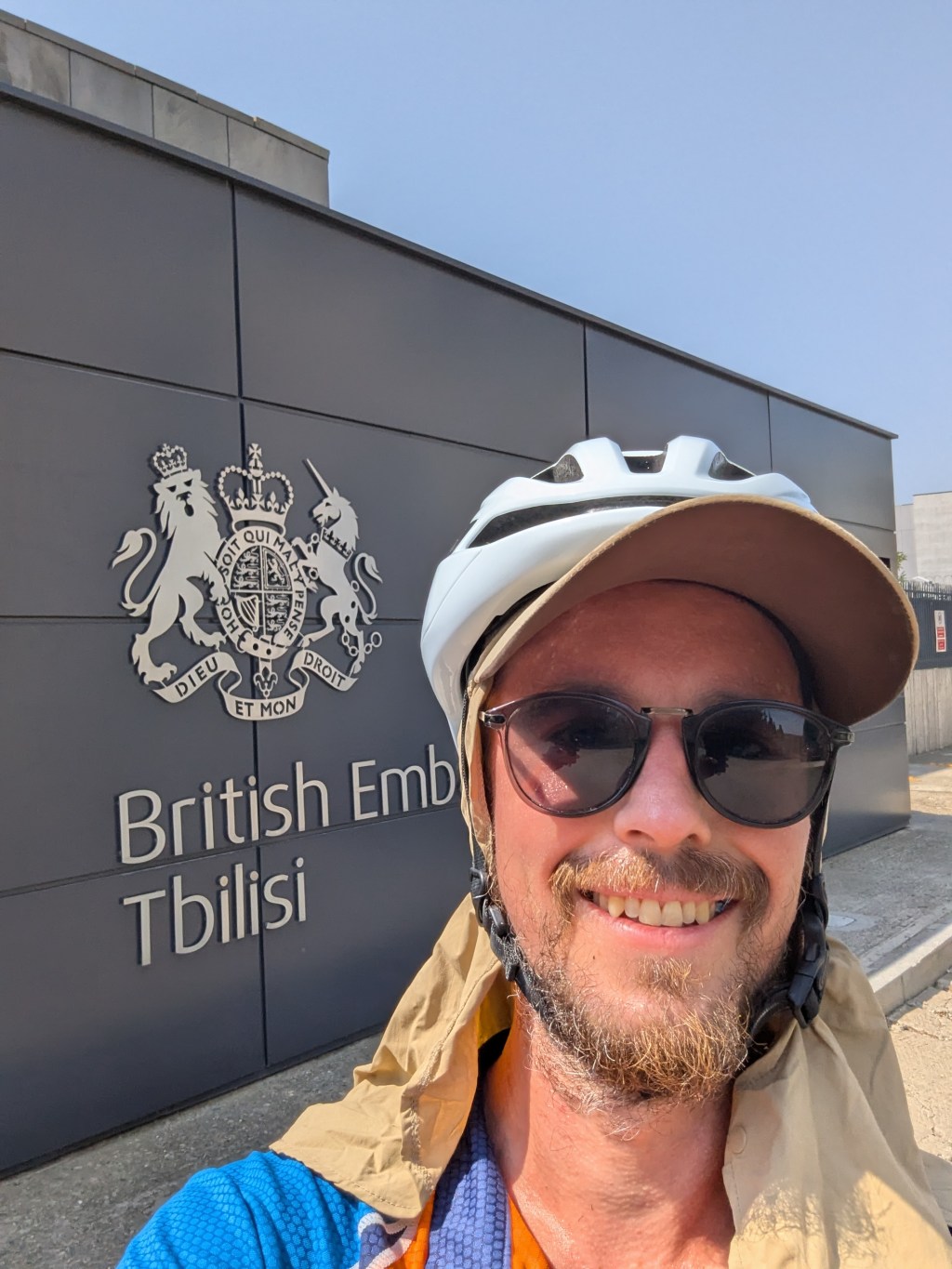
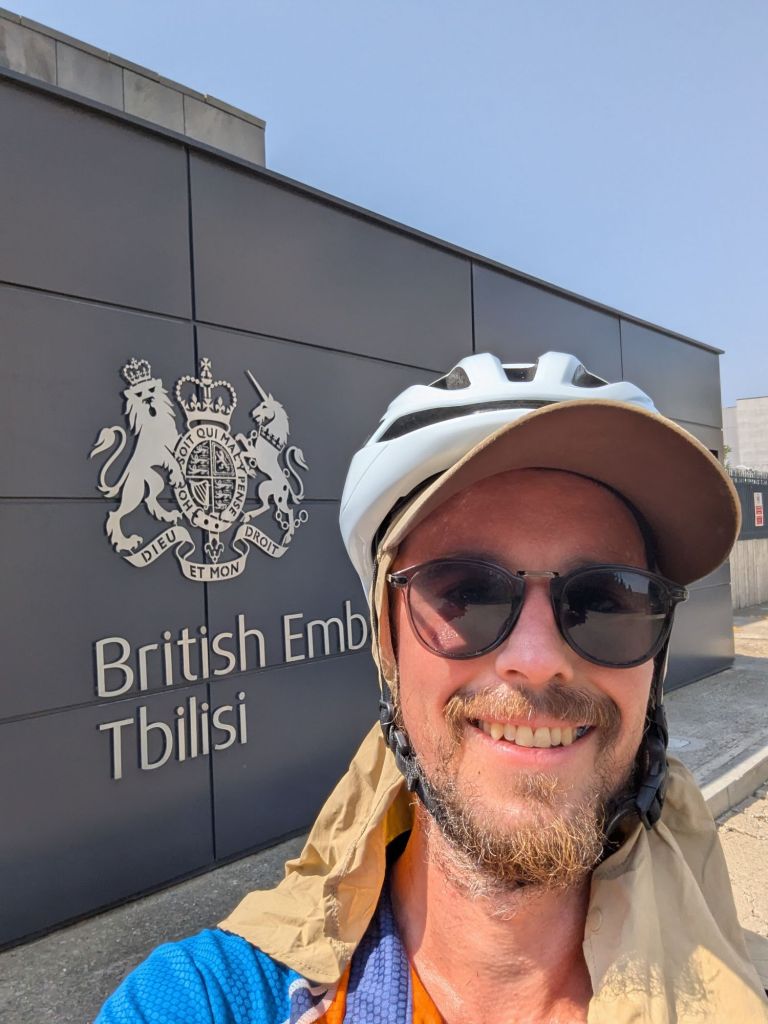
    Getting into Tbilisi was such an ordeal it culminated in calling upon an emergency taxi. This turned out to be so cheap and easy it was tempting to repeat the procedure on my way back out. Concerned I might be morphing into a lazy slob after seven days out of the saddle (and numerous McDonald’s) I closed the Bolt app and rode my way out of Tbilisi following the sadistically steep concrete road that rises out of Ortachala district, past the heavily fortified British Embassy, and on to the exclusive Tbilisi Hills gated community and golf course. The switchbacks here rise up to 20%, so be prepared to push!

    Reflecting on the climb to Tbilisi Hills

    You’d best savour the panoramic car park views at the golf club because all that hard earned altitude is about to rapidly surrender when the route descends to join the main road between Tbilisi to Armenia. The highway is mainly downhill, mostly straight and makes for quite a swift ride – it is also packed with lorries, vans and cars hooning their way between the two capitals, so not exactly the most peaceful of journeys, but when it comes to border crossings the choices are often limited. There are one or two stretches where you can slip off the main road onto an adjacent side road to take respite from the traffic, just try to ignore the piles of dumped construction waste and bloated carcasses of fallen livestock.

    Border crossings always come with a hint of anxiety, I think it’s how the border officials like it. It’s fair to say my anxiety levels were running a tad higher this time due to the fresh stamp in my passport from Armenia’s long-time nemesis, Azerbaijan. Sure enough, the Armenian border official flicked through my passport and gave me a stern look.

    “Why were you in Azerbaijan?”

    I glanced down at the bike then back at the militarily dressed man, and tried my best not to sound sarcastic:

    “Tourist. I’m travelling through the Caucuses on the bicycle“.

    It’s almost tempting to come up with some lame excuse for why you chose to visit Azerbaijan – ‘It was the only flight available, honest‘ – but it’s really not necessary. I reckon the Azerbaijan trip landed me with a few extra questions (e.g. ‘Do you have a hotel booked?’, ‘Do you have any friends in Armenia?’, erm…are you my friend?), until eventually he handed back my passport.

    Welcome to Armenia“.

    As usual, the anxiety was just a waste of adrenaline.

    You enter Armenia into a cluster of grocery stores, kebab shops and roadside guesthouses, making it a natural spot to bunker down for the night. Fresh from a week in Tbilisi the prices seemed cheap too; you can’t go wrong with £1.96 for a chicken kebab**. Trying to work out the ‘real’ cost of everything priced in Armenian Dram bamboozled me at first too, since most transactions run into the thousands (Tip: instead of dividing by 500, multiply by 2 and remove the last 3 decimal places to convert to Sterling).

    **fair enough, several things could go wrong with a £1.96 kebab

    The Soviet Canyon

    Keen to maintain a reasonable distance from the border with Azerbaijan, I followed the road that heads south-west into Armenia towards the town of Alaverdi.

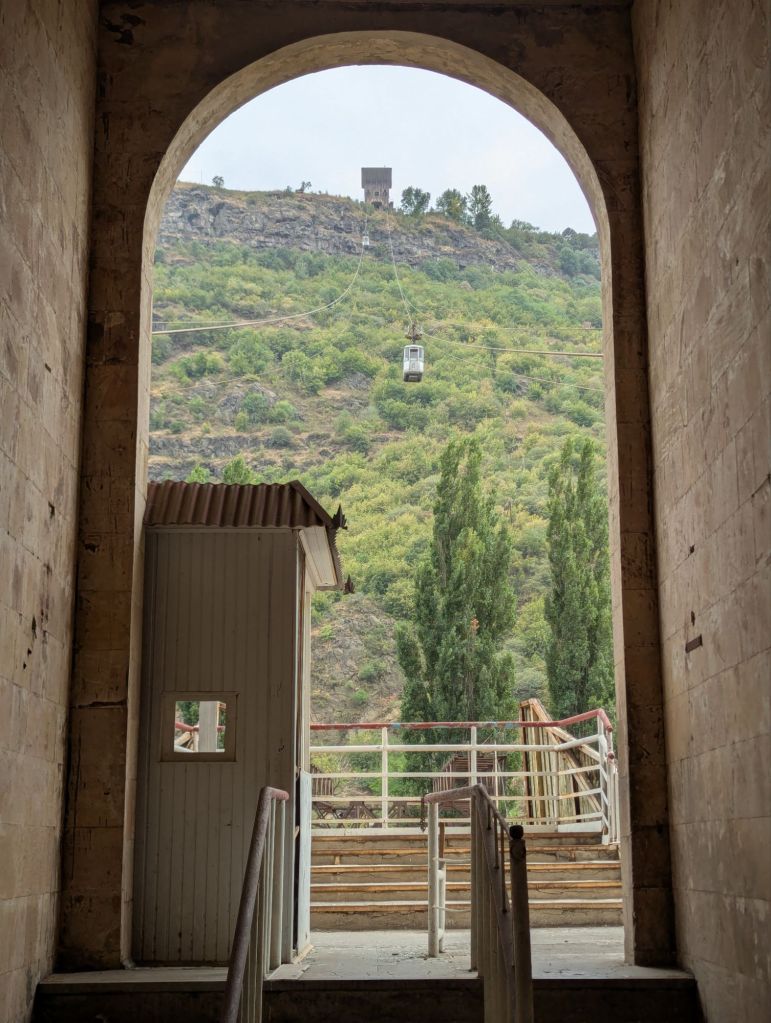
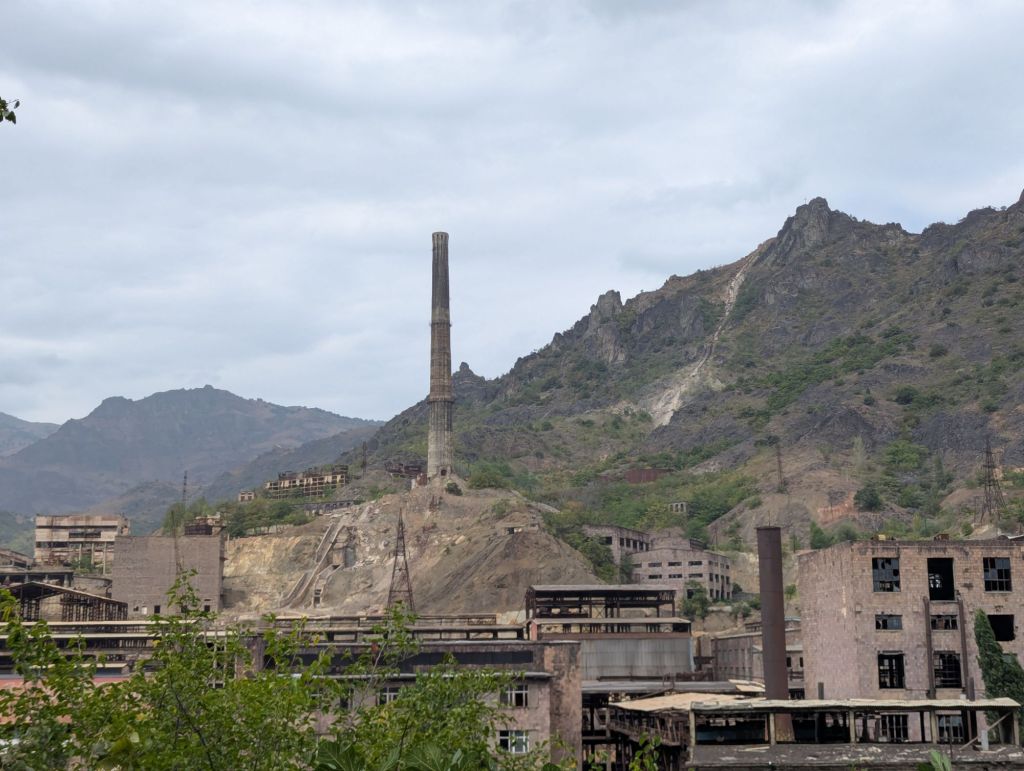
    The road meanders alongside the area’s main river, the Debed, which has slowly eaten away the surrounding rock formations to set itself at the base of a deep canyon. Clearly this was an important area of mining activity in the Soviet days: the gorge is littered with the ghostly shells of abandoned industrial buildings, crowned by a (somewhat surreal) abandoned cable car rising out of Alaverdi up to a neighbouring town above the gorge.

    The dangling cable cars of Alaverdi
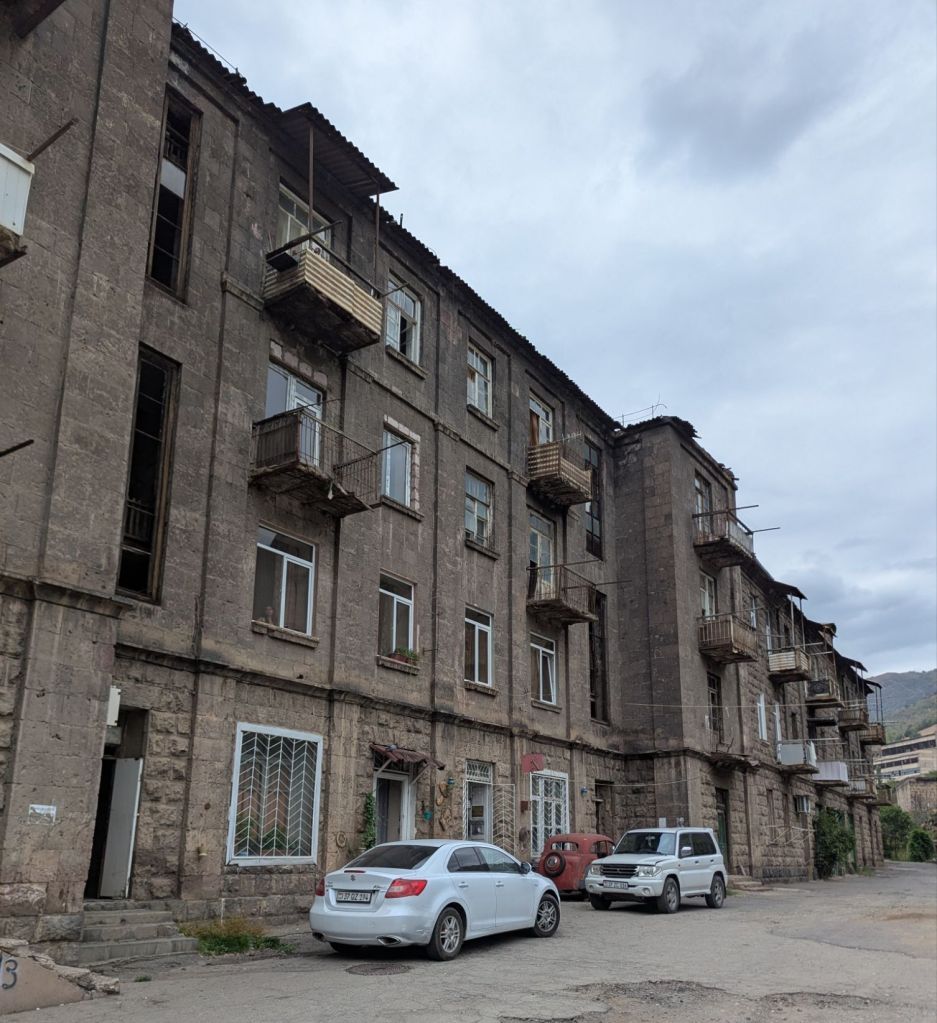
    Vintage Soviet housing blocks
    The emissions stack still towers above derelict industrial buildings

    There were echoes of my native Teesside’s deindustrialisation in Alaverdi. They have been mining copper in this area since the 18th century, with industrialised extraction expanded under the USSR. I don’t know what sort of state the place was in when the Soviet Union collapsed, but there clearly hasn’t been much in the way of investment since then – much of Alaverdi is like a ghost town.

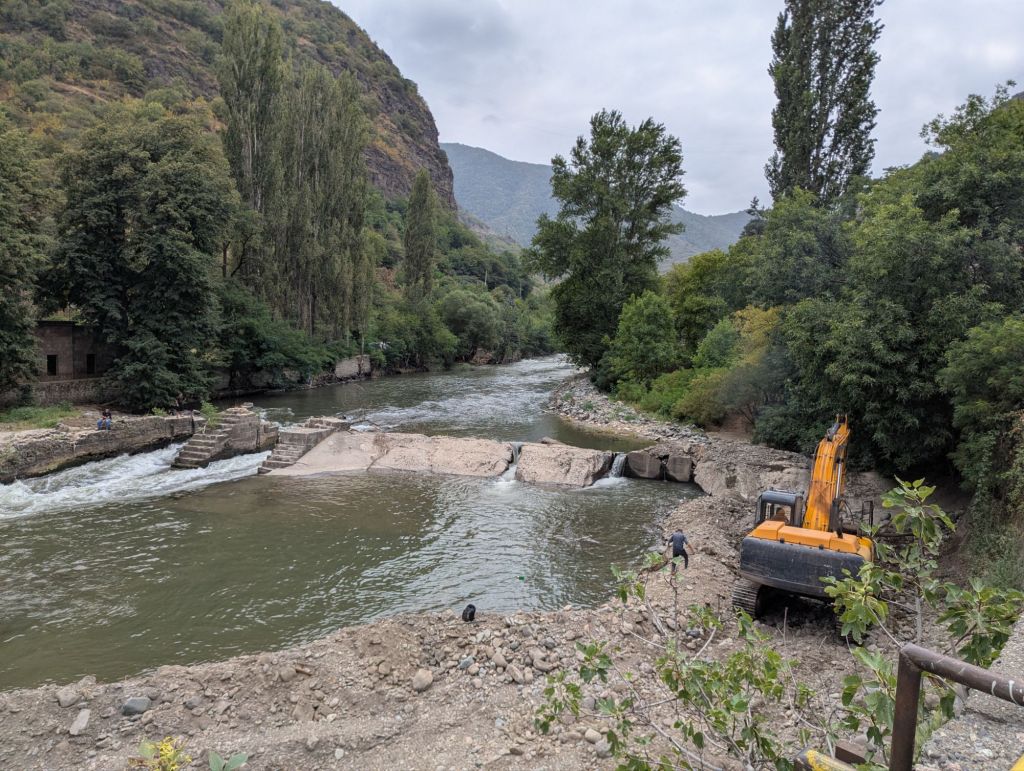
    Remains of the old concrete weir in central Alaverdi, possibly one of the old hydro power units?

    I amused myself over lunch by watching a local man trying his luck with a spot of fishing along the riverbank. He was getting progressively more agitated by the nearby JCB driver whose unenviable job was to excavate said riverbank. It was all quite Laurel & Hardy; I half expected the fisherman to fall in during a heated exchange, only to be mercifully scooped back onto dry land by his adversary.

    Joining Forces

    On the way out of Alaverdi I stopped by an austerely stocked local shop and picked up a small plastic cup of Rolls-Royce branded instant coffee with a foil lid (quite a luxury brand to rip-off for such a non-luxury item). It was here I bumped into a blonde haired man dressed in a luminous yellow t-shirt, red shorts and a sunhat…not exactly on trend with the local men’s fashion, he was a cycle tourist of course.

    “I saw all of your Ortlieb bags and thought you might be a fellow German!”

    Most of the friendliest cycle tourists I have met so far have been Germans, and Jakob was no exception. He had also just ridden and wild camped his way across Turkey to reach the Caucuses – something I plan to do in reverse. Both heading south into Armenia, we agreed to ride together.

    One benefit for the younger and stronger riders who ride with me is they usually dial down the pace, so their legs end up feeling fresher at the end of the day. Meanwhile mine feel just as shot as ever, but I do enjoy the chat between gasps for oxygen at >2,000m in the Armenian highlands.

    We were heading to Lake Sevan. This is a seriously big lake – over three times the size of Lough Neagh in Northern Ireland – and about as close as you’ll get to the seaside experience in landlocked Armenia. To get there we would have to negotiate a couple of fairly hefty mountain passes via the popular Dilijan National Park. First though we rode through fading evening light (and an giant swarm of flies on one particular descent) to the small city of Vanadzor, where we bore witness to the spectacle of a man breaking up a fight between rival street dogs using a taser. In his defence I don’t think he actually zapped any of them; the deafening crackle was enough to send dogs scarpering in all directions.

    With a family video call lined up I checked into a small B&B with WiFi. Jakob showed his youthful grit and opted to camp at a BMX jump track on the edge of town.

    Lake Sevan

    As you climb out of Vanadzor heading for Dilijan the countryside becomes increasingly green and lush, with rolling grassy fields sandwiched between densely forested hillsides – a stark change from the more arid terrain that surrounds the Debed gorge.

    Jakob setting pace on the leafy ascent out of Vanadzor

    There are two major descents along this route: down into the town of Dilijan, and then final delivery to the northern shores of Lake Sevan. For us it was a reminder that a strong headwind – annoying as it may be – is preferable to being blasted from the side when going downhill fast.

    The Dilijan descent was still great fun, just a bit slower than it would otherwise have been. The ride down to Lake Sevan was another matter: as if the relentless side winds weren’t enough to keep us on our toes, we turned a corner to find the road ahead chock-a-block with cattle. Tempting as it may be to go for that gap between Daisy’s gormless face and Buttercup’s manure splattered arse, sometimes you just have to bite the bullet and grind to a halt on a descent, no matter how much blood, sweat and tears was invested in that momentum.

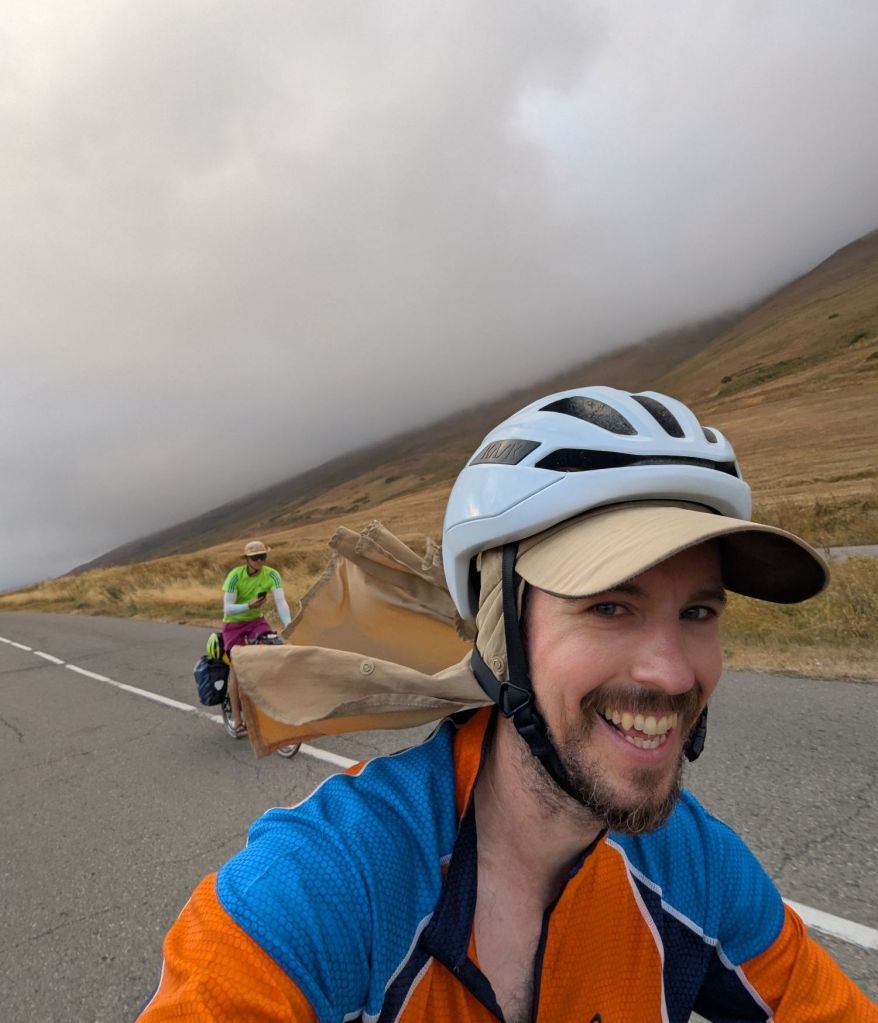
    The hat in full flap – once mistaken for a blonde mullet

    Like the trucker, the delivery driver, the traffic cop – the cycle tourist spends a great deal of time out there on the road. After a while you come to appreciate a good service station, and the one when you arrive at Lake Sevan is an absolute corker, especially the food hall. You don’t see fresh rainbow trout kebabs on the menu at Hartshead Moor on the M42, you’re lucky if Starbucks has any toasties left.

    Our intention was to wild camp along the north shore of Lake Sevan, settling for a BBQ area equipped with metal picnic tables, a haunted looking toilet, and resident dog that would appear from time to time before vanishing back into the darkness like a phantom. So perhaps not the wildest of wild camping, a feeling confirmed by the £5 a night fee we were charged by a couple of impressively drunk site attendants. I was just happy they didn’t want to share our Dilijan lager…we only had a litre between us!

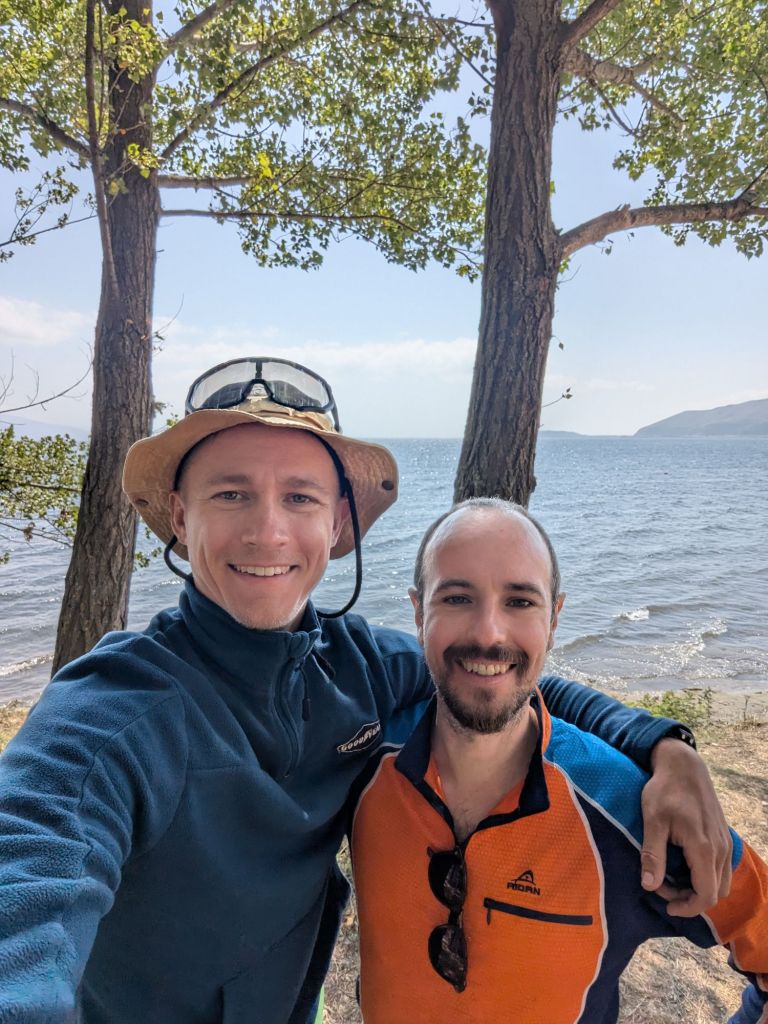
    Happy campers – Jakob and yours truly before parting ways along each side of Lake Sevan

    It was here we parted ways. Jakob’s plan was to take the quieter east coast of Lake Sevan and delve into the southern region where Armenia narrows between Azerbaijan and its Nakhchivan exclave. I would head for the capital, Yerevan, via the town of Hrazdan to get off the main road…but not before calling by the (imprecisely named) Sevan Island.

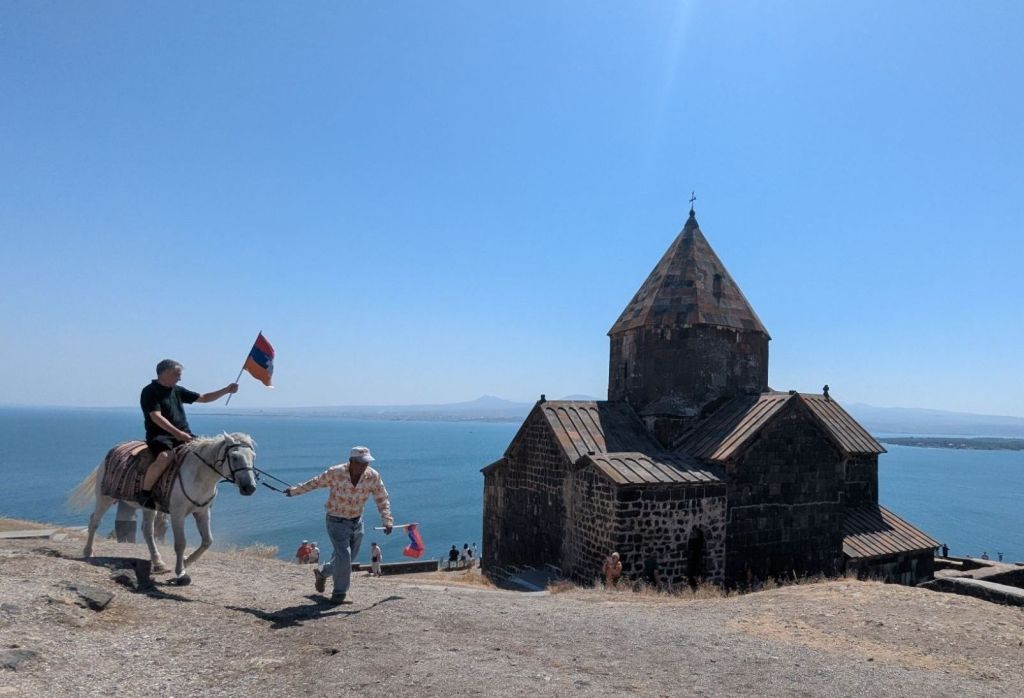
    A tourist waves the Armenian flag outside the 9th century Sevanavank church, Sevan Island

    Sevanavank is one of the smallest churches I’ve set foot in. It is also one of the darkest, with barely anything that could be described as a window…perhaps the odd slot in masonry here or there. The main source of light comes from the table where long Caramac coloured beeswax candles lit by worshipers slowly arch over and melt away into the tray of liquid wax. Like in Georgia, it was clear they take their faith seriously in Armenia, certainly when inside the walls of a church.

    The road to Yerevan

    Of all the countries so far, Armenia is the first where I couldn’t have named the capital city before this trip.

    I suppose Baku has the F1, whilst Tbilisi has been more western focused since Soviet independence. Unlike Georgia and Azerbaijan, Armenia is a member of the Eurasian Economic Union along with Russia, Kazakhstan, Kyrgyzstan and Belarus – so from an economic perspective the Armenians have tended to look more to the east, at least until recently anyway.

    If you don’t know much about a country then getting to the capital is a good place to start learning. I also wanted to consult a dentist about the gaping hole in my molar following the Helsinki Filling Disaster of July 2025, a chore I had managed to delay for nearly six weeks.

    A fellow appreciater of salted peanuts

    My route would follow the Hrazdan River as it winds its way from Lake Sevan through a sequence of towns, villages, reservoirs, and a cascade of seven aging hydroelectric power plants, before arriving in Yerevan almost a vertical kilometre closer to sea level.

    The road coming out of Sevan city started out perfectly: a freshly laid surface, sparse traffic, and protection from the northerly wind that was beginning to pick up. The shelter wouldn’t last long; I turned a corner onto an exposed stretch of straight road surrounded by vast, empty fields without a hedge or wall in sight. The wind was whipping through a natural gap between the parched, treeless hills before surging down the rounded slopes and hitting me at 90° square.

    The sheer weight of my loaded touring bike gives a lot of stability against side wind, but this was just silly. A perfectly consistent wind would be ok – you can just lean into it – but mother nature rarely offers such luxuries. The wind is a chaotic, unpredictable lottery of air flows: brief moments of calm are followed by monster gusts, and you never quite know what’s coming up next. When the big gusts can send you flying into the gutter or under a lorry, it’s probably time to get off and push.

    On this occasion the badly exposed section was only around 500m long, so I was quick to hop back in the saddle, and it wasn’t long until the road turned south. The wind that had been trying to kill me was now in my sails.

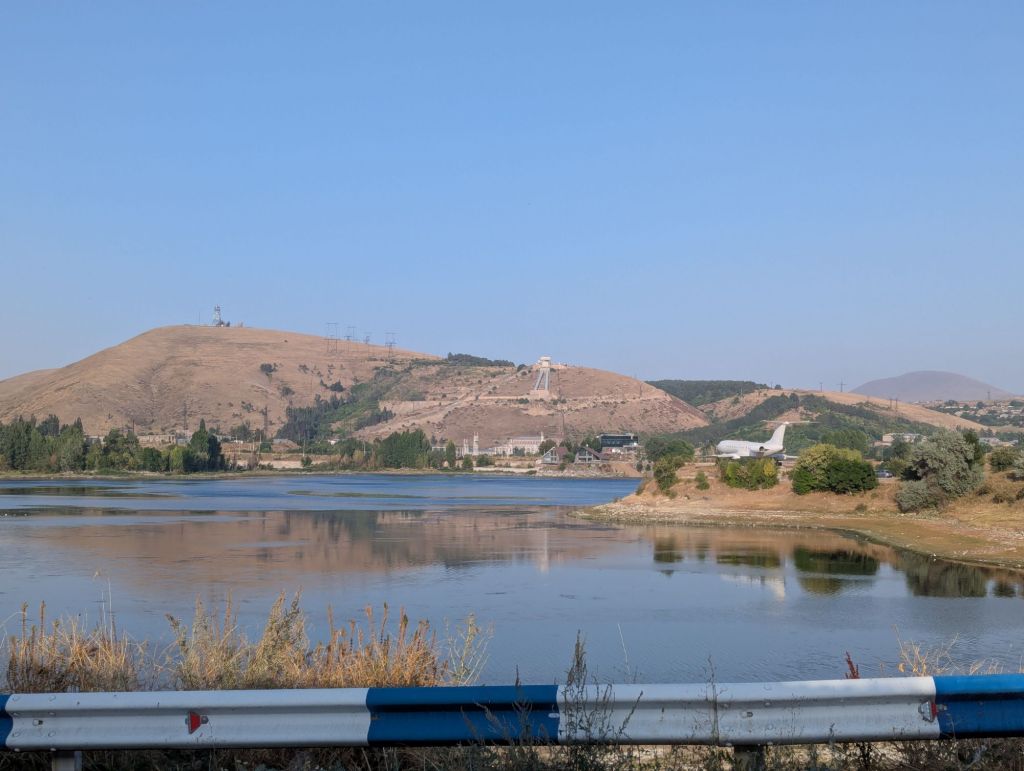
    Hrazdan Reservoir – spot the incongruity
    It’s a bit odd, but maybe that’s what unremarkable reservoirs need – giant ornaments

    Stopping for a coffee break in Hrazdan I scanned booking.com for a suitable guesthouse that night, leaving a short ride into the capital the next morning. The small town of Bjini was about the right distance away, and BjiniHouse checked all the right boxes for a B&B – cheap, peaceful location, clean.

    Many of the guesthouses in Armenia offer reasonably priced evening meals, BjiniHouse being a particularly good example. Expect fresh salads, meat stews with rice, even grilled rainbow trout (in this case fresh from their own trout farm in the garden), all with big plates of bread on the side so you never finish hungry.

    My garden view bedroom at BjiniHouse

    The next morning continued fairly unremarkably until my route turned off the main road just south of Nor Hachn onto the quiet back roads through a relatively undeveloped wedge of land along the river. I ended up on a gravel track that ran alongside a major gas pipeline (operated by Russia’s Gazprom – much of Armenia’s energy infrastructure is Russian owned). There was a variety of dumped rubbish, the occasional angry dog, but virtually no traffic considering how close it brings you to the city centre – maybe the locals knew something I didn’t?

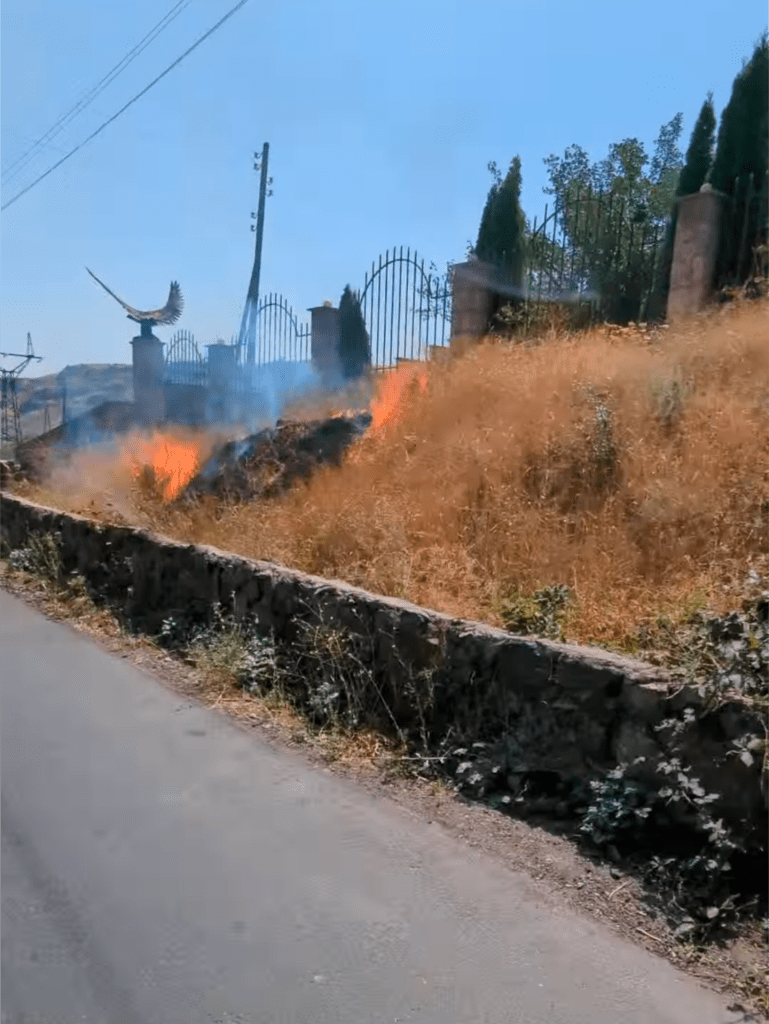
    I did encounter one particular hazard along the way, one that had been concerning me as I moved further into Armenia – fire. Wildfires are always a possibility in such arid climates, and I’d previously spotted what appeared to be one in the distant mountains as I rode towards the border from Georgia. Descending into the Hrazdan valley, I glanced ahead and noticed that one side of the road seemed to be much more on fire than usual – the bank was covered in the same dessicated yellow grass that blankets this country in late summer, and it was ablaze.

    A grass fire crackling away near Getamej

    Looking around me for anything more serious, it was clear the surrounding terrain had been scorched black; the fire had clearly been working its way around the valley. The active burn area was pretty small for this fire, and the heat was quite tolerable from the road, surely this wasn’t Pudding Lane in the Great Fire of Yerevan?

    Yerevan

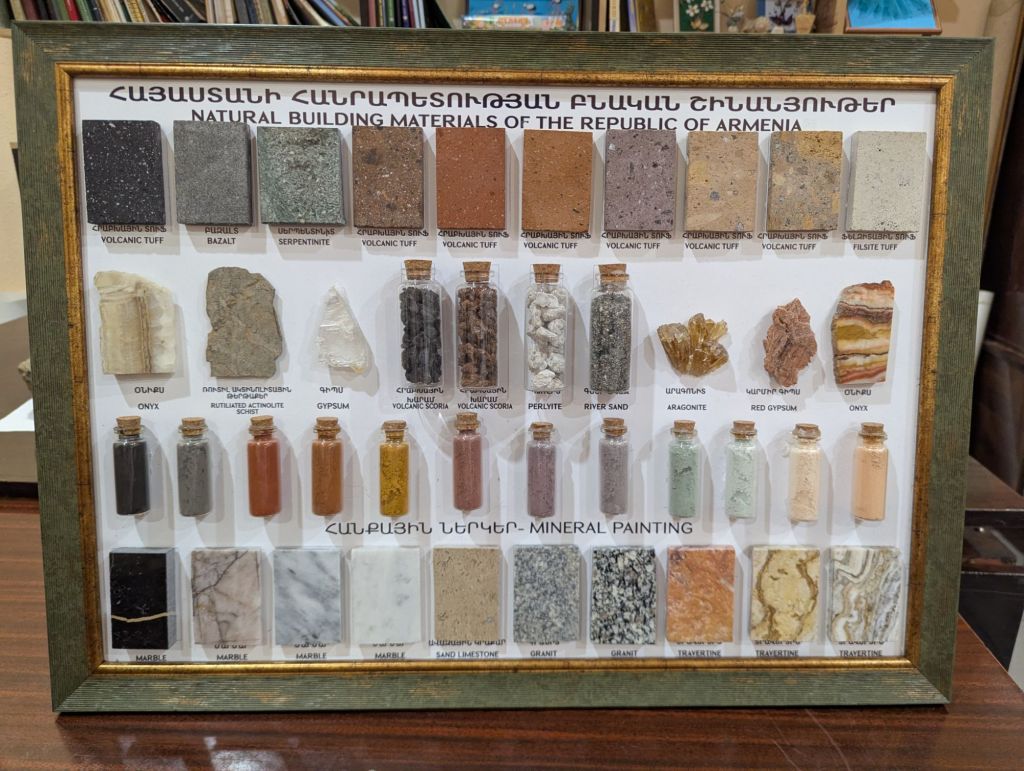
    Armenia is mostly quite tolerable in the summer since so much of the country occupies cool high altitude plateaus. That is until you get to Yerevan, where the ‘urban heat island’ effect seems to be turbocharged by the ubiquitous stone masonry. Maybe Aberdeen would feel the same if it was 38°C for weeks on end..

    The palette of Armenia’s volcanic building blocks (Geological Museum, Yerevan)

    Heat aside, I quite like Yerevan. It’s not as bonkers or edgy as Tbilisi, and apart from having too many cars trying to squeeze their way through the city centre it has a relaxed, laid back atmosphere.

    The temporary fillings I had relied on since my amalgam filled molar crumbled in Helsinki were failing to stay in place for much longer than a day. Sifting through the reviews of local dental clinics doesn’t tend to be top of my list when arriving in a new city; Yerevan feels like the sort of place you can find a skilled dentist, but I didn’t fancy having to pull out Google Translate with mouthful of latex gloved fingers and implements, so at least a little bit of English was important too. Despite the occasional scathing 1 star review, I booked an appointment with what seemed to be the expat favourite: Yerevan Dental Clinic.

    Dental appointment sorted, I could relax, soak up the city and visit a few museums. The History Museum is a pretty good starting point for ignoramuses like me who turn up in Yerevan with almost zero prior knowledge of Armenia. Attempting to summarise the rich history of this country is outside the scope of this blog, but interestingly it was the first country to adopt Christianity as the state religion at the turn of the fourth century.

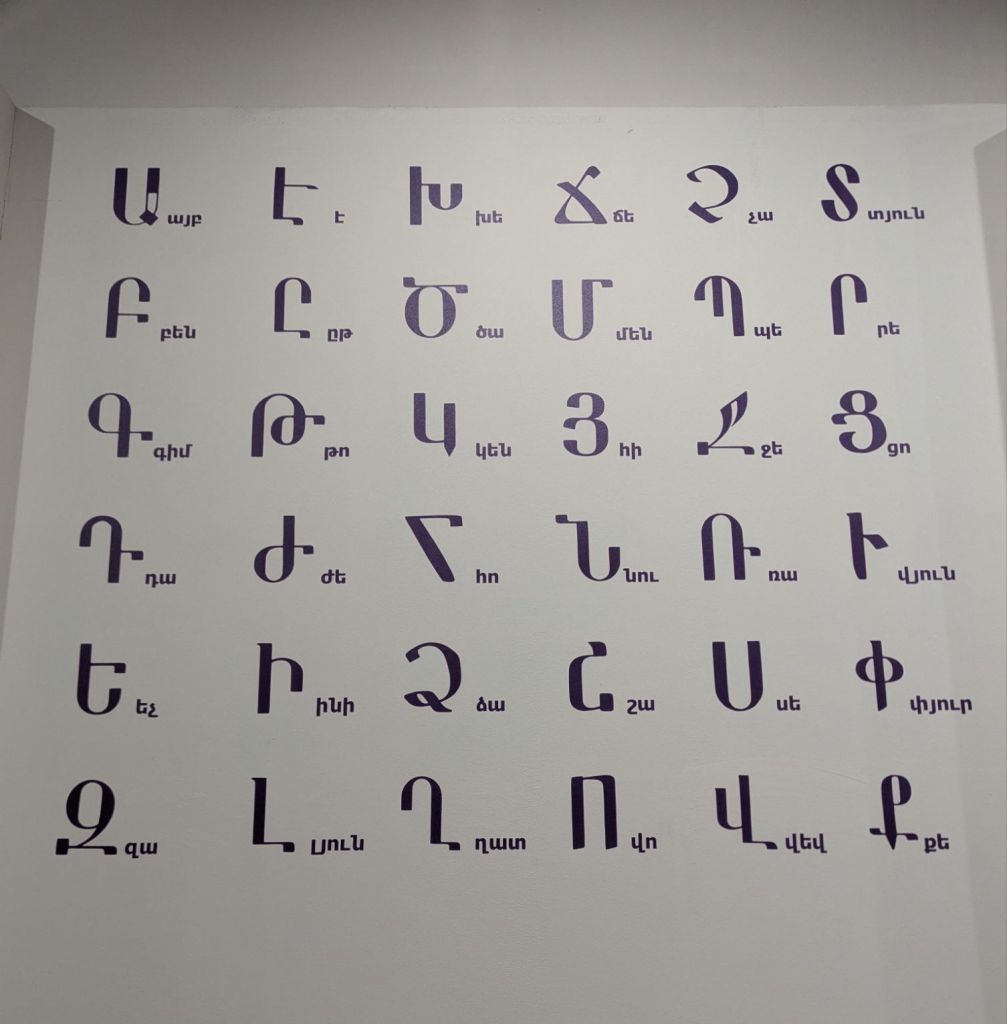
    The Armenian alphabet, invented by one man in the 5th century. Beautiful script, even if it does sometimes resemble plumbing

    Outside of the city centre on top of a hill past the abandoned Hrazdan football stadium is the genocide memorial complex. Getting to the museum is quite a long and difficult journey on foot (as I found out on the way there), so it is best to take a taxi or public transport. The complex has its own very informative museum for this tragic but important aspect of Armenia’s history. It is hard to underestimate the impact this event had on the demographics of communities across the Ottoman Empire and what would become the republic of Turkey.

    ——

    My hostel was in a lively corner of the city, and I couldn’t resist popping into The Beatles themed pub around the corner. It was a Friday night and the place was absolutely packed out: not like the Cavern Club in Liverpool with everyone wedged on the dancefloor like sardines in a claustrophobic cellar – this was table service only, with drinks served in a brightly lit mock London pub. It was quite odd, but far from unpleasant. This is no tourist trap though, the locals love it, especially when Hey Jude comes on.

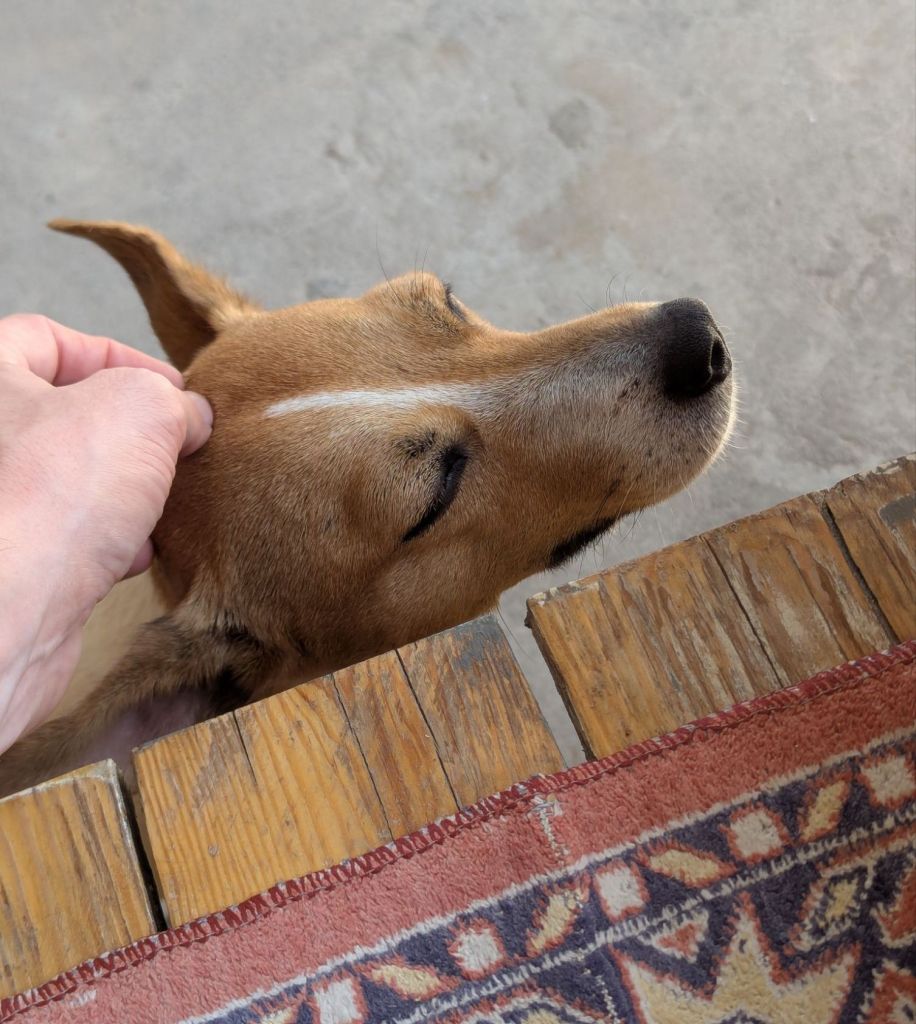
    The resident dog at Kondi Hayat café, located in someone’s house in the narrow old streets of Kond

    The dental appointment soon came around and I shuffled back into the reclined chair.

    “With the size of that hole I’m surprised you don’t have pain!”

    It was true: the hole in my tooth was gaping, but it wasn’t painful at all. The plan was to fill the hole with a composite (not the usual amalgam they reach for in Britain ), and it would require a fair bit of drilling, scraping and poking around.

    In all honesty I don’t really mind going to the dentist; perhaps I was too relaxed given the man had to keep prodding as I began to drift into sleep, closing my mouth in the process. It did take a long time though, in my defence.

    “Wait three hours before solid food”. With that parting instruction (and parting with £40) I was done.

    By the next morning I could chew soft food, but anything hard was still a bit sore. Dr Internet reassured me that this was quite normal and I should wait 2-3 weeks. I’m typing this over four weeks in, so what’s the verdict?

    Well, it’s good enough for now. The tooth is sensitive to pressure, so anything hard has to be broken down by the primary left gnashers before it can be released for secondary chewing on the right. A mild inconvenience on a cycle tour, but hardly a system to keep up in perpetuity.

    Mount Ararat

    There was one place I really wanted to visit before leaving Armenia, the Khor Virap monastery that overlooks the iconic Mount Ararat.

    Ararat is a dormant volcano standing over 5,000m tall (making it the biggest mountain I’ve ever seen). You can see it from Yerevan on a clear day, but the Khor Virap monastery is a lot closer being more or less on the border with Turkey, about as close as you can get to the mountain without leaving Armenia.

    Mount Ararat is a sacred and national symbol to the people of Armenia. It is nowadays located in modern day Turkey (and known as Ağrı Dağı), but that reality has not severed the cultural connection between Ararat and Armenian people. It is on the coat of arms, the brandy, it even crops up as men’s first names. It is said that Noah’s ark ended up perched on the mountain after the Biblical flood waters receded, although it sounded like Genesis was referring to the Armenian Highlands in general…but sometimes you just need a good symbol, and what could be more symbolic than the massive, snow-capped peak of Mount Ararat?

    Mount Ararat and Little Ararat, as seen from Khor Virap

    It was here I was reunited with Jakob, who had been on the road ever since we parted ways six days ago. We enjoyed a few beers in the Khor Virap car park café before cycling along a dark, dusty side road and pitched up our tents in a small clearing. Well, I pitched my tent, Jakob has a more lightweight setup resembling a mosquito net coffin. It was a lot more peaceful when the jackals stopped howling and nearby diesel generator got switched off.

    After a short ride back towards Yerevan we parted ways again. Jakob would head into the capital for some well-earned bed rest after a jumbo stint of wild camping had left his sandal wearing feet virtually tattooed under a dense layer of brown Armenian dust. I was heading north for the westernmost border with Georgia, passing through the towns of Vagharshapat and Gyumri.

    Vagharshapat (aka Etchmiadzin)

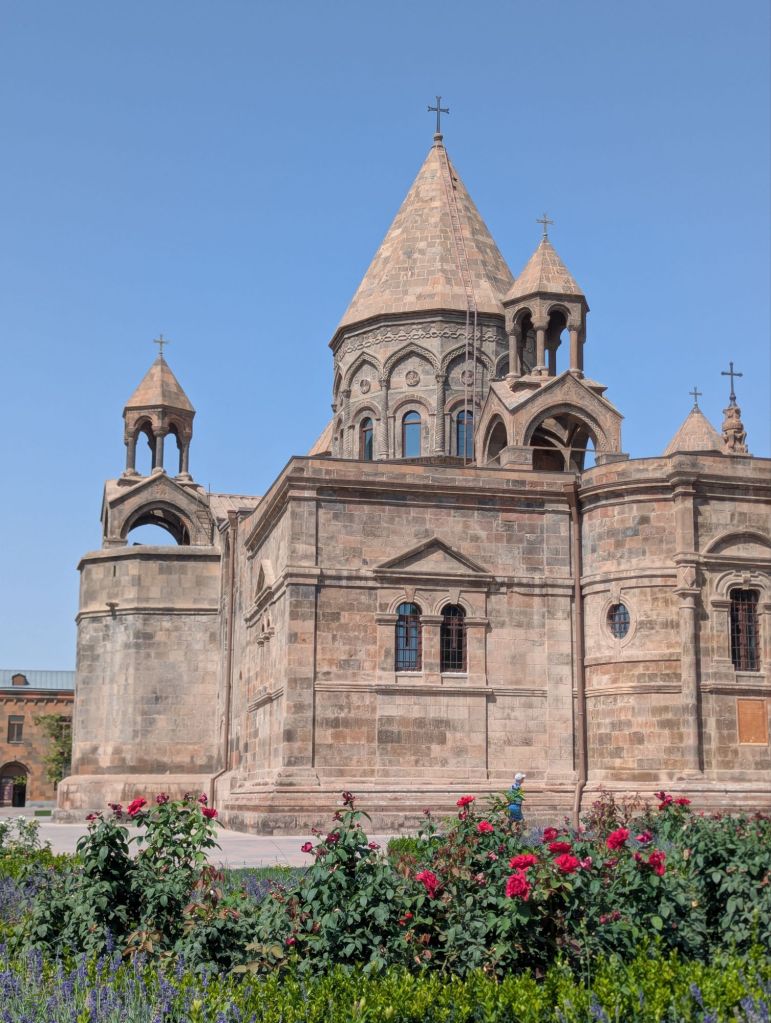
    Vagharshapat used to be known as Etchmiadzin, which is worth remembering if you’re easily confused like me. This is where the ancient Etchmiadzin Cathedral is located, often cited as the world’s oldest, although (as usual) the current building has been reconstructed, extended and embellished in various styles over the centuries.

    Well tended rose beds around Etchmiadzin Cathedral

    The cathedral sits within a large, peaceful courtyard, adorned with thriving flower beds.  Don’t expect a Durham Cathedral style ye olde cathedral experience when you go inside mind you, the interior is maintained to be the immaculate ‘mother church’ of  Christianity in Armenia. There are no flaking old frescoes in here.

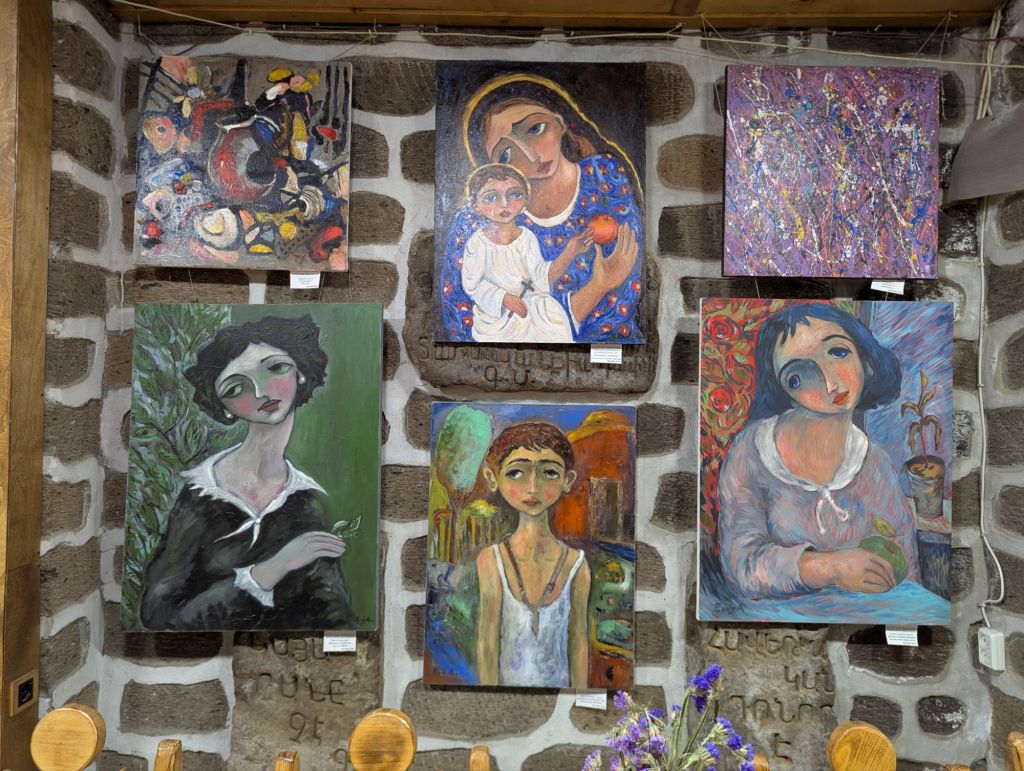
    If you do ever visit Vagharshapat then I encourage you to stay at Machanents House, especially if you’re an art lover. The venue is a social enterprise with small craft shops, art studios, and even a theatre, alongside the restaurant and guest house. Lovely people, cosy environment, and the food is top notch.

    Paintings for sale at Machanents House

    The cursed road to Gyumri

    The final Armenian city of this trip would be Gyumri, but unsurprisingly for this country there was a 25 mile wide volcano in the way – Mount Aragats (not to be confused with Mount Ararat…keep up!). My route would take me clockwise around the mountain following the main road, but not before taking a shortcut across a gravel track leading to the small town of Aragatsotn.

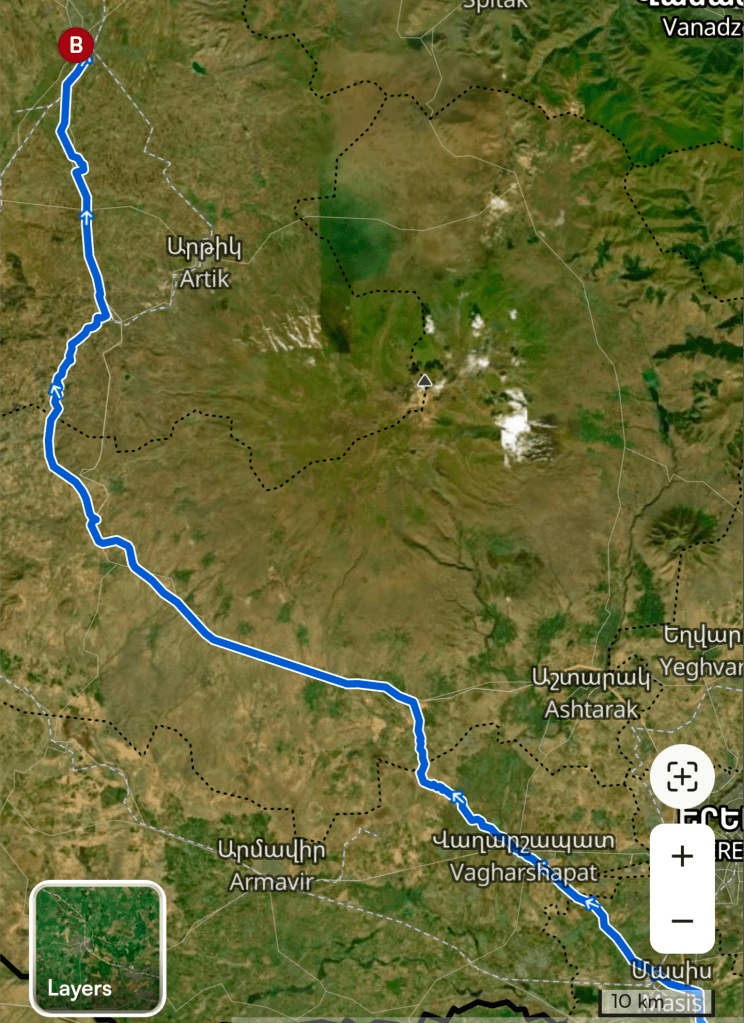
    The planned route from Vagharshapat to Gyumri (source: Komoot)

    This is where things began to go a bit pear shaped. As I cycled out of the village of Aragats the houses and farms gave way to derelict buildings, piles of rubbish and an incoherent local drunk wandering around aimlessly. A small white car driving the opposite direction stopped and the driver’s window opened.

    “Just to let you know mate, if you go any further down that road you’re going to be arrested by the police.”

    Quite the bombshell, and to make things even more strange: delivered in a thick Ozzy accent.

    “Arrested for what, exactly?”

    “That’s the road to the nuclear power power plant. I should know, they arrested me three years ago and I spent the next four hours being interrogated at the police station!

    So here’s the thing. There was a nuclear power station along the road, but my route went absolutely nowhere near it. If I was creeping around the perimeter fence or flying drones I could understand, but the prospect of being nicked on my route just seemed, absurd.

    “I’d turn around and take the main road buddy, all you’ll find up there is my farm.”

    I thanked my Ozzy friend (of Armenian heritage) and bid him farewell, then – ignoring his advice – continued on my planned route. In fairness to the guy, he did suggest there wasn’t much along this way and he was right: the tarmac quickly turned to gravel track, which slowly disappeared into the dusty, rocky strewn, dessicated landscape. Before long I was out of the saddle and pushing the bike up steep gradients between jagged, watermelon sized boulders. Every plant that grew seemed to have spikes, spines and prickles just waiting for a chance to bite into my tyres.

    Looking towards the hills where my route was heading, I could see a intensively vegetated grid of crops, the dark green standing in stark contrast to the 50 shades of yellow that characterises Armenia’s landscape in late summer. It was surely my Ozzy friend’s farm – if there’s one country that has refined the art of growing industrial scale fruit & veg in this climate, it’s Australia. And I do mean industrial scale, this farm is huge – and located slap bang on top of my route.

    My theory is matey was a bit embarrassed to confess his shiny new farm now completely blocked off the old path to Aragatsotn, and that they hadn’t bothered building an alternative path around the perimeter. So instead he spun me the old ‘turn back or you’ll get arrested‘ yarn, that old chestnut!

    I wish he’d just fessed up because I would have turned straight back around if I’d known what was in store. It seemed the least horrid route around the farm was to go clockwise, seeking out the path of least resistance across the wild landscape. Within minutes there was a loud crunch and the bike ground to a halt..

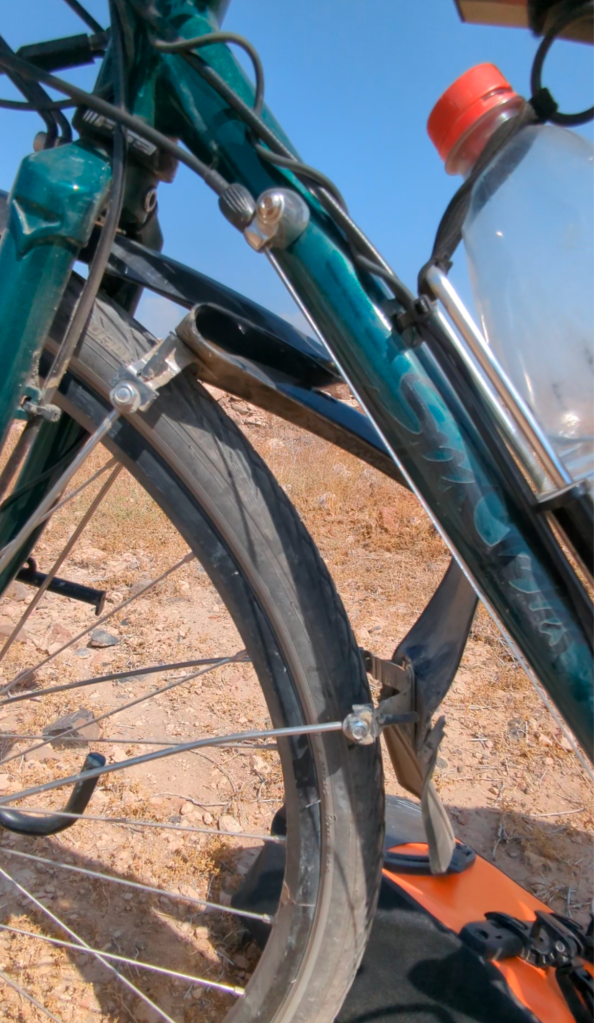
    This is not how SKS mudguards are supposed to look

    A fist-sized rock had been scooped up by a piece of tumble weed that was caught in my spokes, going straight between the wheel and mudguard and crumpling the latter. If it hadn’t been 30°C that day the plastic may well have shattered rather than deformed; I did my best to straighten it all back out and carried on, thankful I hadn’t just been launched over the handlebars face first into a cactus.

    At around the half-way mark the farm’s 6ft tall perimeter fence suddenly disappeared and I could get into the farm’s grid-shaped system of internal gravel roads. Realising sneaking back out again would be too much hassle, I simply rode to the main gate, gestured to the security guard I was lost, and exited to freedom before getting tangled in conversation.

    Worst. Shortcut. Ever. At least the rest of the journey would be a straightforward main road – and it was, for a while. In the late afternoon a dust-filled headwind picked up, it began to rain, and a distant bolt of lightning lit up the slopes of Mount Aragats. Suddenly, straddling my steel lightning rod of a bike didn’t seem like the best idea, and I waited out the storm under a small concrete shelter and booked into the nearest guest house. By the time the rain subsided my front tyre was flat – the spiky plants had left a parting gift in the form of a slow puncture.

    It can really feel like bad luck comes in waves. It doesn’t usually, you just notice it more the rare times that it does bunch up together. But when it does it’s best to try and stay calm to avoid a spiral, because that’s when luck goes out the window and bad decision making takes the wheel.

    Gyumri

    There’s nothing like arriving at a good guesthouse after a tough day. Maybe it’s partly because I ride solo, but arriving to a veritable feast in the company of jolly landladies and inquisitive cats can really rescue an otherwise rotten day in the saddle. This is the beauty of Armenia, you are rarely far from a good B&B for under £20.

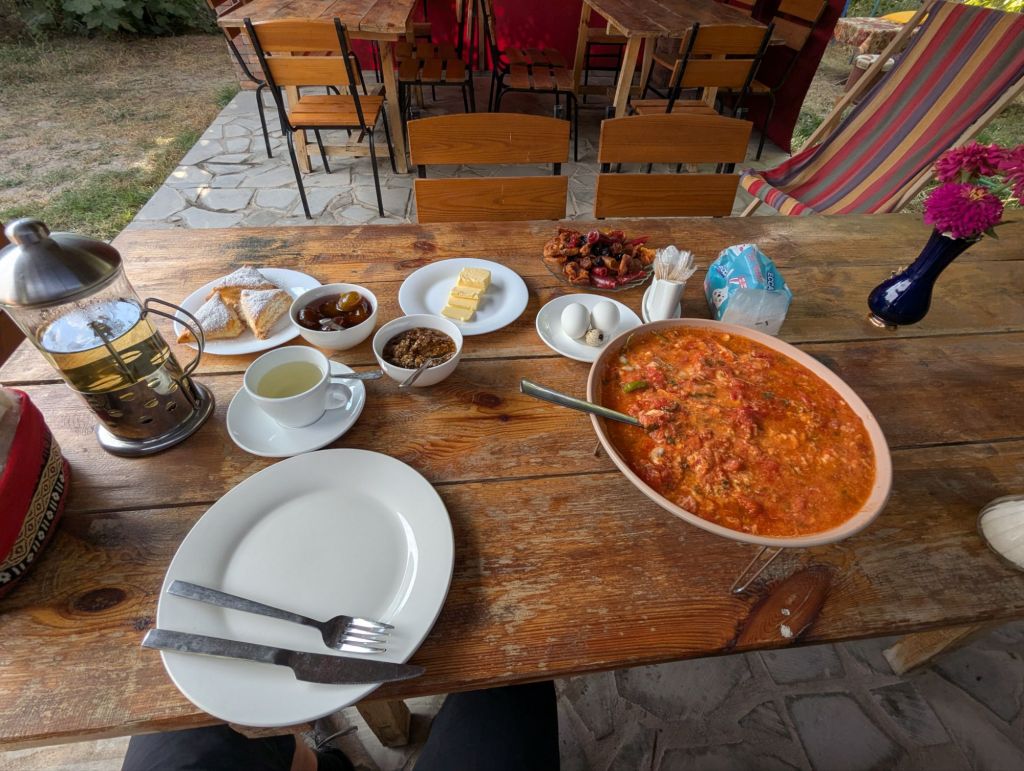
    Scrambled eggs with tomatoes is a staple Armenian breakfast – this was the best I had

    The next morning was spent nursing the bike back to full health before pressing on to Armenia’s second city, Gyumri. Apart from getting utterly drenched in a torrential downpour, it was all rather uneventful.

    For me, the story of Gyumri was one of illness. I’d only planned to stay one night then carry on, but a suspicious burger had struck me down with the runs and tanked my energy levels. Rest was the only option, so I bunkered down for two more nights.

    The bad luck turned good again when I was feeling better and a fellow cyclist – Eric, an author from Chicago – walked over to say hello. Apparently he spotted me on the highway on the way to Gyumri, and kindly bought lunch at his favourite café, just what I needed after feeling like crap, cheers Eric!

    Gyumri is an attractive city with cobbled streets, elegant lamp posts, independent shops…all of which is a lot easier to appreciate without food poisoning.

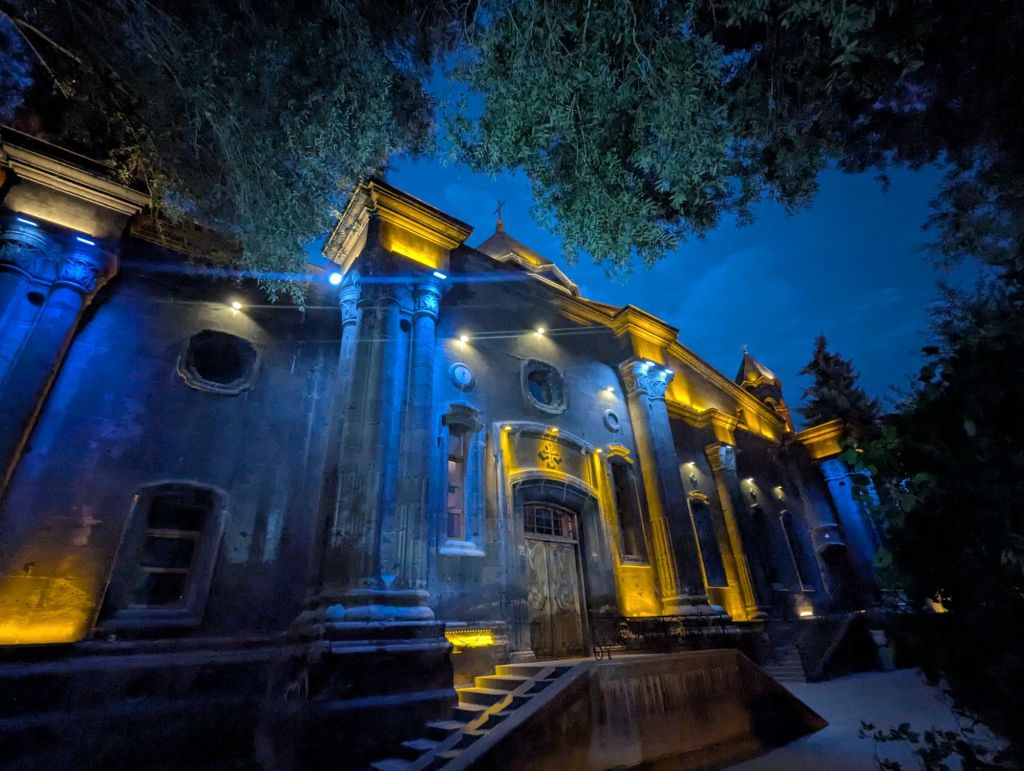
    Mood lighting on the 19th century Cathedral of the Holy Mother of God, Vartanants Square

    Armenian Georgia

    I’m going to close this blog out with my brief journey through Javakheti – the small region of Georgia bordering Armenia and Turkey where the overwhelming majority of residents are ethnic Armenians.

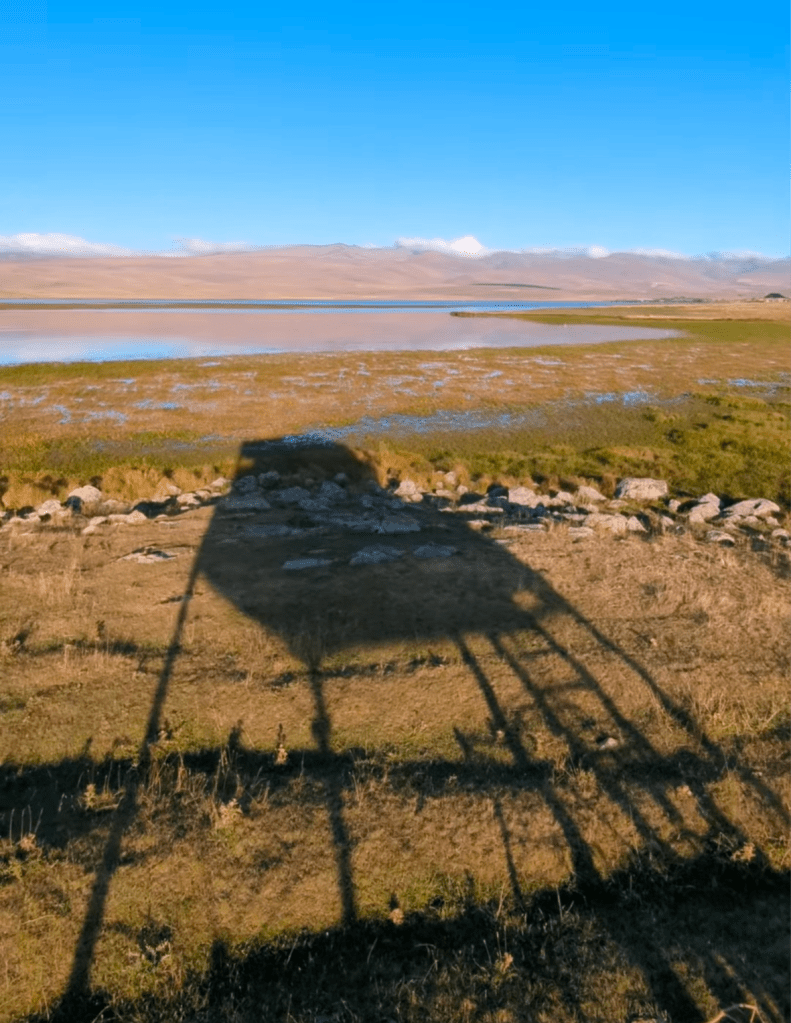
    As soon as you cross back into Georgia the Madatapa Lake nature reserve reveals itself on your right hand side, which has an observation hide on stilts along the west shore. Favoured by birds, the lake was occupied by a quite noisy colony of pelicans when I arrived.

    The bird observation hide at Madatapa Lake

    I spent the night at a guesthouse in the nearby town of Ninotsminda. One of the fellow guests was an Italian who was shifting his career from travel photography to documentary film making. We hunted down the one restaurant that was still open and dined on kebabs and Georgian beer. Making documentaries didn’t sound easy, but you could see genuine satisfaction in his eyes when he spoke of adding the finishing touches to the project that had been his life for the last year.

    ———–

    I was planning to cross into Turkey at the Lake Aktaş border crossing, where almost every Google Maps review complains about the state of the road on the Georgian side. However it is known to be a quick crossing with not much traffic, and the road should be far better on the Turkish side.

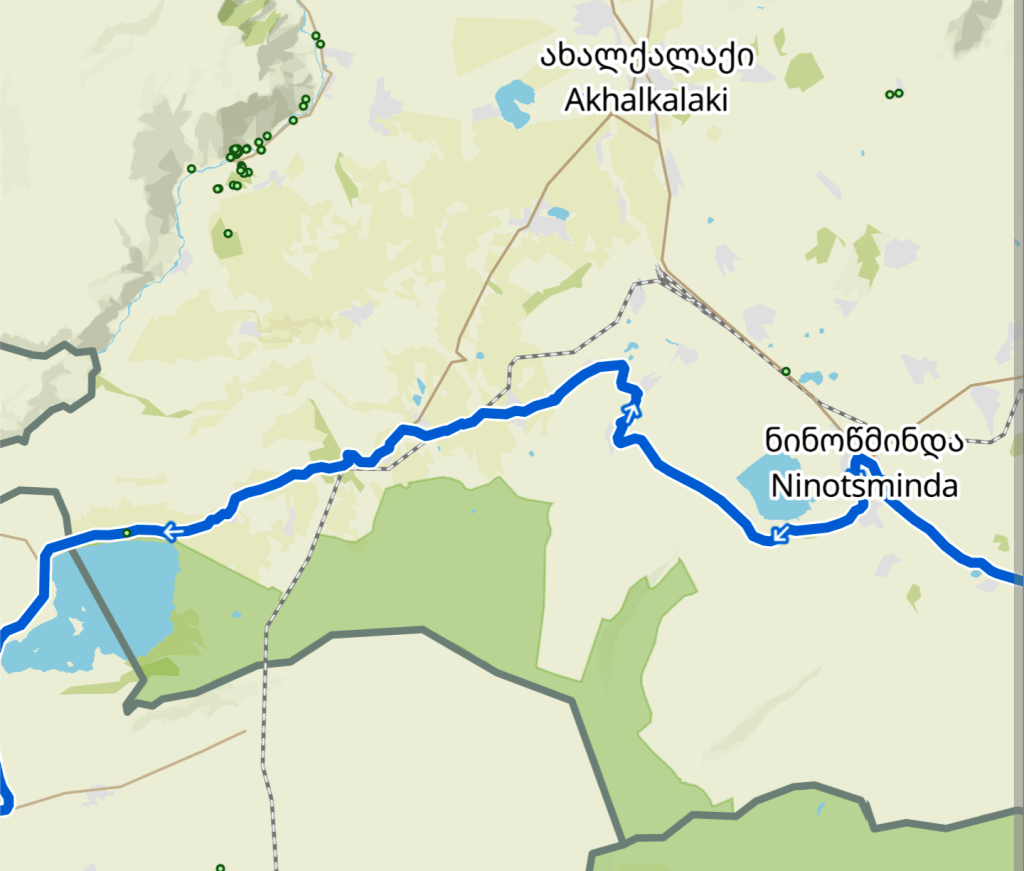
    The route through Javakheti into Turkey (source: Komoot)

    My plan was to cycle along the west shore of Khanchali Lake and follow the back roads through various villages before rejoining the lorries on the main road to the border crossing. I’d heard from several people that the villages in this part of Georgia felt like peering back in time, and I see what they meant.

    Some of the agricultural systems in Javakheti were closer to medieval than 21st century. A lady dressed in black was stooped over in a field, piling scythed hay into small stacks with a pitchfork – she must have been in her late 70s, still doing it the same way her own grandmother did. It wasn’t all as manual as that of course, but you got the sense that farming was the main industry here, with lots of small family run farms…there was no sign of self-driving tractors or automated milking parlours out here.

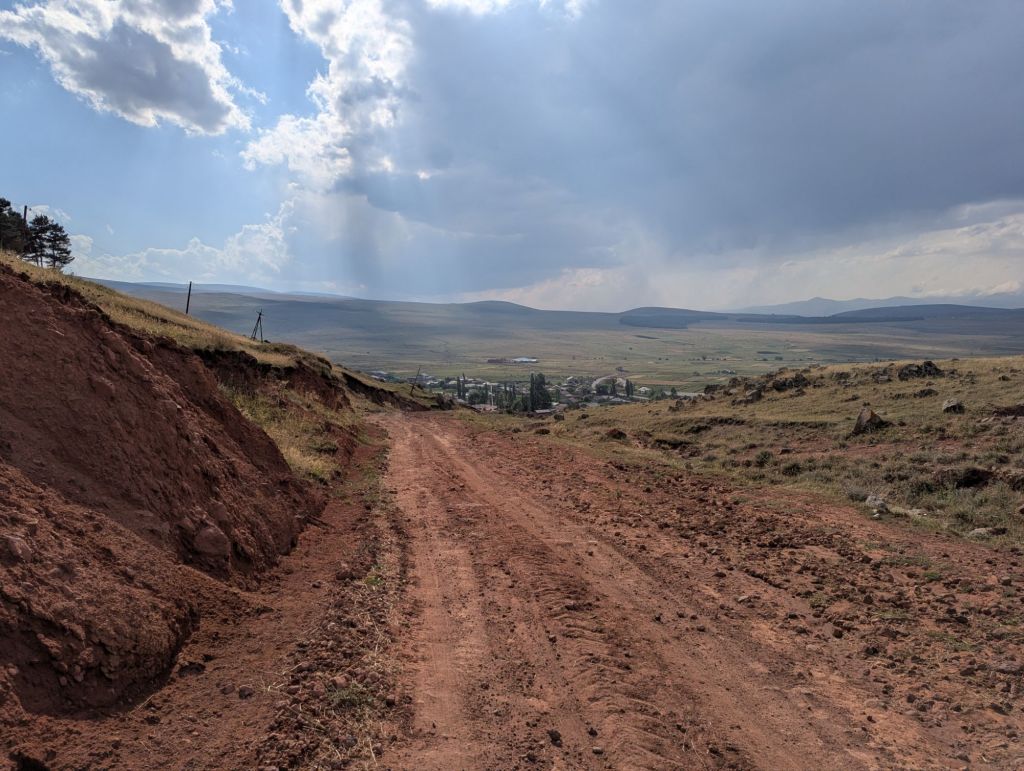
    The road to Dilipi, deep in rural Javakheti

    The dirt track I was on taken on a rich red-brown hue and the loose soil contained a few more boulders than is preferable for cycling. I was pushing the bike up a tricky section when I noticed a group of people gathered around a metal shelter at the side of the road ahead. Expecting the usual exchange of barev before continuing on, I was soon ushered to join them in the shelter for a lunchtime feast.

    The group was composed of around ten men in their 30s to 50s, who were clearly good friends and in high spirits. Meat was the main course, provided by the lamb being roasted slowly beside the shelter entrance, served alongside fresh bread, smelly cheese (which I managed to dodge), juicy tomatoes, pickles, watermelon and all washed down with a drop of liquor…most were on the vodka, but I went for the iconically Armenian (and slightly less alcoholic) Ararat brandy.

    We managed a bit of conversation here and there, sometimes with the help of Google Translate, but I was quite content feasting away and observing the social dynamics around me. At times there were clearly serious matters being discussed, but it was never long before the tension was punctured by roaring laughter. As soon as I finished a plate or glass it was promptly refilled. After 45 minutes or so of feasting, the chap sat next to me (who spoke a bit of English) turned and pointed to the man sat on the end of our bench..

    Singer!”

    Folk singing in its purest form

    Music has this tremendous ability to precipitate emotion and activate memories. All the things I had seen and learned about in Armenia started washing around my mind as the man in an Adidas top soared his way through melancholic scales of an Armenian folk song. I didn’t know exactly what he was singing about, but I knew it would be one of the most precious memories I take away from this trip.

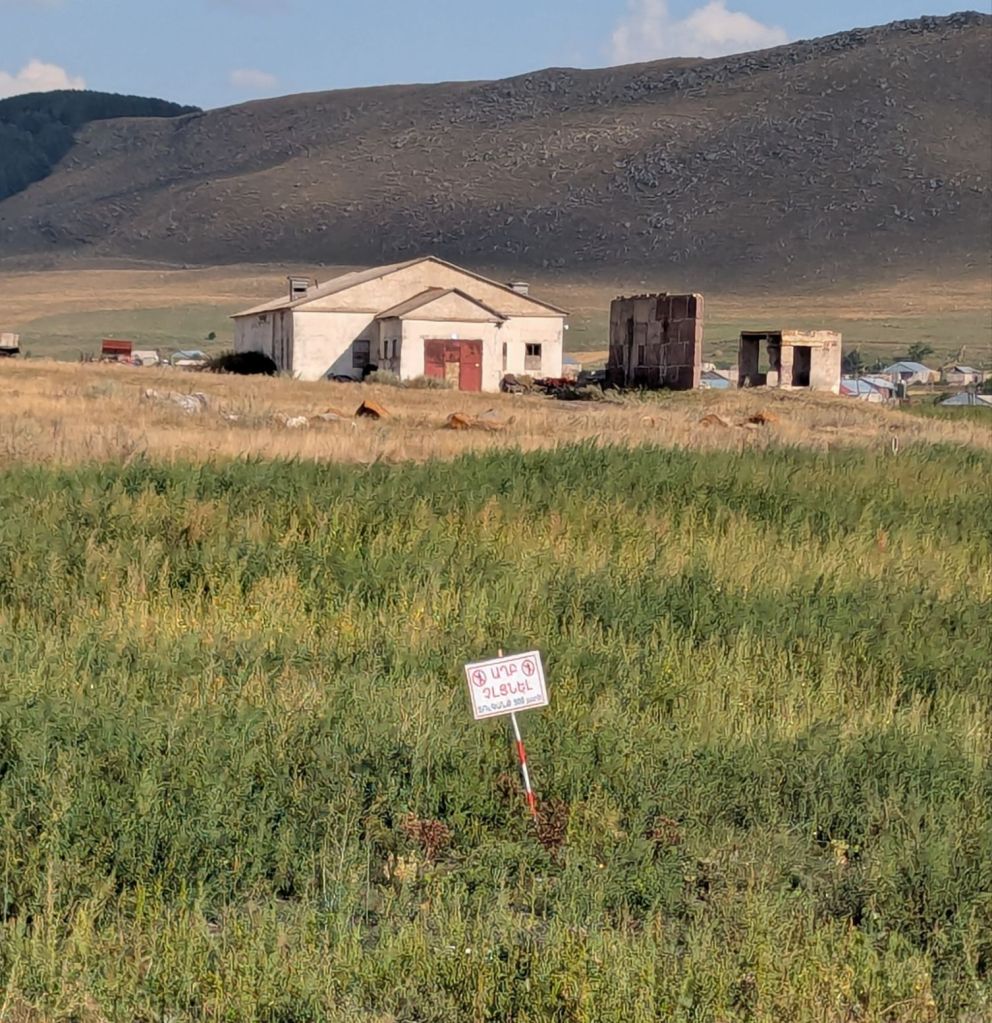
    Danger sign on a patch of derelict land

    As I moved further towards the border there were occasional patches of uncultivated land with warning signs written in Armenian. The country does have a significant landmine legacy from the wars with Azerbaijan, although most of these are in Nagorno-Karabakh, and this was technically in Georgia and nowhere near Azerbaijan. I still have no idea what danger I was being alerted to, but decided to find an alternative spot to have a wee…just in case.

    My short journey through Javakheti was capped off with a well-timed invitation for a cup of coffee by a man in the small village of Sulda, which came just as a rain shower was about to unleash. His name was Ararat!

    We sat in the corner of the family kitchen. Ararat’s father walked extremely slowly with the help of a stick. His wife was bundling clothes into the washing machine, a chore that would be delayed to get a round of coffee in. His c.15 year old son joined us at the table and asked me a question translated on his phone:

    “Why have you come here?”

    It’s quite a simple question, but not all that easy to answer. Why had I come here? This time last year I was living a comfortable life as a professional in Shropshire; now I don’t even know where I’ll sleep tonight. I paused for a moment, before typing my reply.

    ———————–

    PHOTOGRAPHY: Armenia

  • Update – 26th September 2025

    Greetings all,

    I hope you’re keeping well and have been enjoying the blog. It has been a great privilege to spend my time this year cycling through all these different countries and attempt to document my experience.

    I had hoped to maintain the c.fortnightly publication schedule which seems to be where things have settled, but for various reasons I’ve not quite had the time needed to complete the writing of my time in Armenia just yet. It will be coming though, so watch this space.

    I will then have to think about the best way to write up Turkey, which – as I am currently finding out – is a truly enormous country! It’s also a great country for cycle touring too…

    So go steady out there, and I hope everyone’s been keeping good care of the UK whilst I’ve been away.

    All the best,

    Martin

    I resisted the urge to knock on the door and ask for a cup of tea
  • 16. Mutts, Mountains and Mental Driving in Georgia (aka საქართველო)

    When you search for guesthouses around the northern Azerbaijani/ Georgian border crossing you get virtually no results on the Azerbaijan side, for some reason all the B&Bs seems to be over the border in Lagodekhi. So although I would be entering the country after 9pm on a Sunday evening, confidence levels were high that I could find somewhere to stay.

    The immediate barrier was a familiar one – I had crossed another border without sorting out my mobile phone data beforehand. No internet, no online booking. I would have to resort to the old fashioned way and bang on the door.

    As it turned out the door banging wasn’t needed: I walked straight through the back gate of the ‘Old Wall’ guesthouse and poked my head into the open door, offering the only Georgian word in my vocabulary:

    “გამარჯობა!”

    What do you mean you can’t read Georgian? Ok me neither, got to love that script though.

    Gamarjoba!

    There was a lady recumbent in her comfy chair watching a small TV with an even smaller dog in the dimly lit outbuilding. It became apparent she wasn’t anticipating a Brit to appear out of nowhere because the poor woman almost jumped out of this life and into the next. I assured her I meant no harm and simply wanted to stay the night, and we agreed on 100 lari. I had zero lari, but convinced her I was good for it in the morning.

    The Old Wall guesthouse at Lagodekhi – equipped with bowler hat lampshades and a Beatlesmania poster

    It was partly down to the guesthouse owners happening to be fans of The Beatles, but the contrast between where I found myself and where I’d come from was stark. It was like cycling out of Azerbaijan and into a leafy suburb of Oxford…with a few key differences of course.

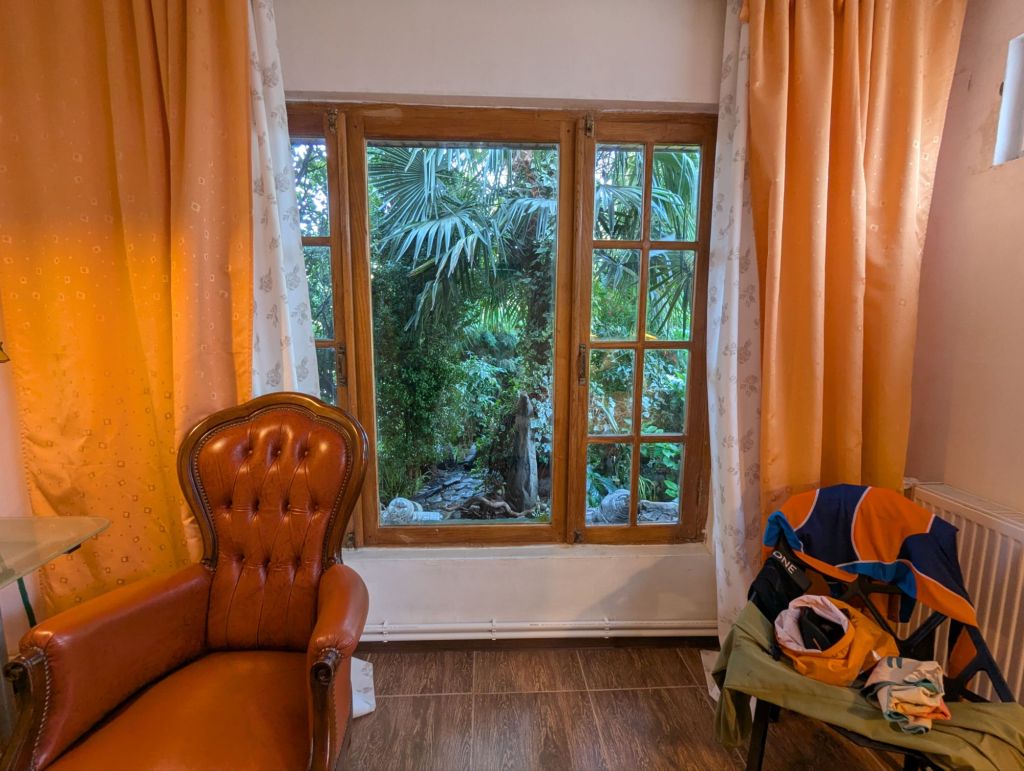
    The chair looks French, but the garden could be tropical

    There was a knock on my bedroom door, it was the landlady’s husband.

    “Welcome, welcome! Would you like tea or coffee?”

    It had gone 10pm by this point, so I went for the moderately less caffeinated option. He led me out to the patio seating area, where above our heads hung dozens of bunches of red grapes.

    “Two more weeks and we will make our wine.”

    I had entered Georgia in Kakheti, the country’s most prominent and historic wine producing region. I still hadn’t finished my cup of tea before my host poured me a glass of red, on the house. I got the feeling I was going to like this country.

    Going steady

    Azerbaijan was an incredible experience, but the heat and dehydration had pushed my body to its limits, so it was time to take it steady and allow my body to recover.

    I spent the next week or so slowly meandering across Kakheti, first to a hostel in the picturesque hilltop town of Sighnaghi, then to the town of Kvareli that sits just below the foothills of the Caucuses, before settling in the small town of Kvemo Alvani (which seems to have almost as many street dogs as human residents).

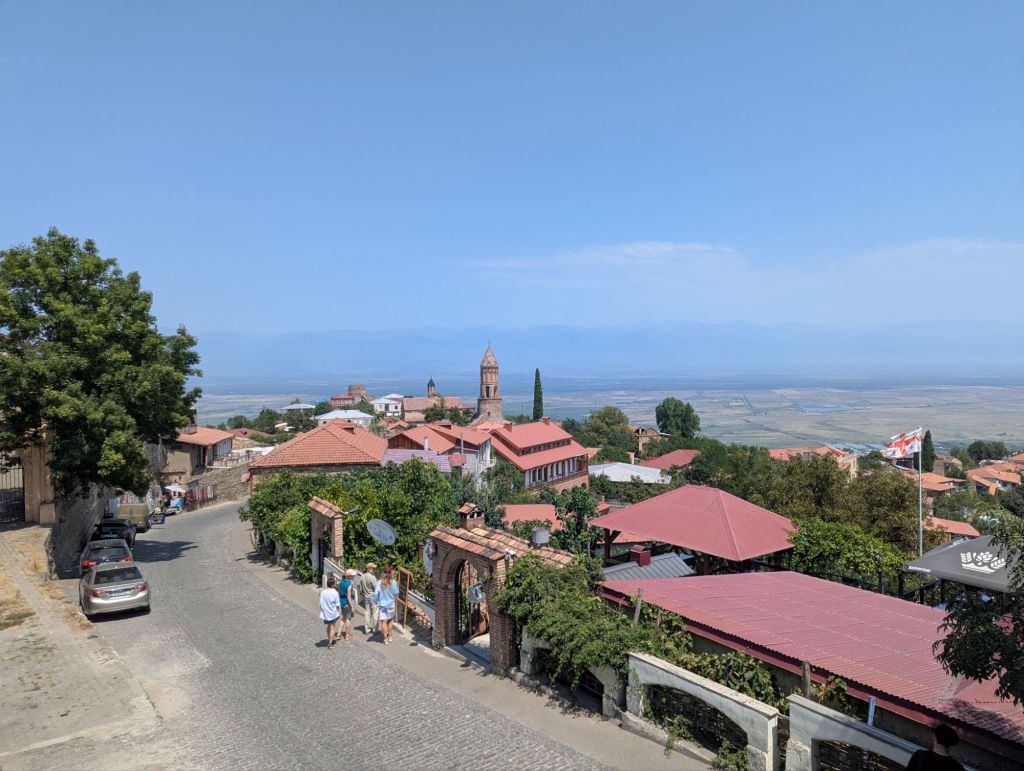
    Rooftops in Sighnaghi, looking north towards the Greater Caucuses

    It was good to be back in a hostel again – the first since Lithuania – and Nato & Lado at Sighnaghi is a particularly sociable one, helped in part by the free flowing glasses of local wine (and for those brave enough, the 60% ABV homebrewed brandy, chacha). Wine might not have been the ideal tonic to aid for my recovery, but at least I had my feet up in the peak afternoon heat rather than pedalling through it.

    Upon entering Georgia it soons becomes apparent there is no shortage of churches and monasteries. They look quite understated from the outside, often with a rounded central tower capped with a conical roof, and are built in stone or brick with little in the way of exterior decoration. The magic of these buildings is hidden away on the inside: frescoes, often painted on every available square foot of wall and pillar.

    Sadly, at least from what I saw, these frescoes can be in poor condition and in need of restoration – a complex and potentially controversial endeavour based on the shit show at Gelati Monastery – but even with the paint peeling off they are still well worth seeing. The churches are generally active places of worship, with orthodox priests in black gowns keeping an eye on proceedings. I never quite worked out if it was strictly prohibited to take photos inside the churches, but it didn’t feel like the environment to be getting the smartphone out.

    Sign at the foot of Gremi Archangels’ Complex
    View from the bell tower at Gremi
    Georgian’s are capable of smiling, but it’s not their default expression

    The museum at Gremi is worth popping in just for the small collection of paintings of kings and queens. The portraits are painted more stylistically than their western European counterparts, making them look remarkably modern. All of the paintings had something in common: there was an almost gloomy seriousness about them. This same feeling could sometimes be felt out on the streets of Georgia too.

    From foes to friends – the ubiquitous street dogs of Georgia

    If you ever visit Georgia then you will quickly encounter the street dogs. They are unavoidable, whether you’re a dog lover or not – if you fall into the latter and are a bit worried about visiting Georgia because of the dogs, maybe hearing about my experience will put your mind at ease.

    A forlorn looking street dog in Sighnaghi

    On a bicycle the roaming dogs can feel like your foe since half of them are usually barking at you. But for pedestrians the vast majority of street dogs behave like well behaved pets. They can be mostly found flopped on the floor in the shade, until they muster the energy to get up and have a sniff around the vicinity for some food. Sometimes they will walk up to you, but you don’t have to engage – if you simply ignore them they soon move on. You could always toss them a bit of food, but they might not leave you alone if you do!

    I’ve never had a street dog invade my personal space by jumping up or licking me without invitation. If they ever get a bit too close (occasionally they look quite diseased) I just raise my voice and they back away.

    It’s probably best to avoid petting them, although I sometimes do so with the most good natured (and relatively clean) ones, and remember to wash your hands if you do have contact. Avoid touching any animals when you have open wounds on your hands, and if a dog does ever scratch or (god forbid) bite you: go to the hospital, regardless of whether the dog has a ‘vaccinated’ ear tag or not.

    About the least threatening multi-dog encounter you could hope for

    Like I wrote about in the Azerbaijan blog, when you’re on a bike it’s a slightly different dynamic. It is common for them to bark, you simply have to get used to it. Sometimes they will run alongside you at high speed, not because they intend to maul you, but because dogs love to run. In running they are expressing a primal instinct and it can be spectacular to behold – I’ve had shepherd dogs bounding across the field alongside me over rough and uneven ground whilst I motor along at over 50km/h: they rarely even stumble.

    This English Pointer was giving my Snickers bar the side-eye

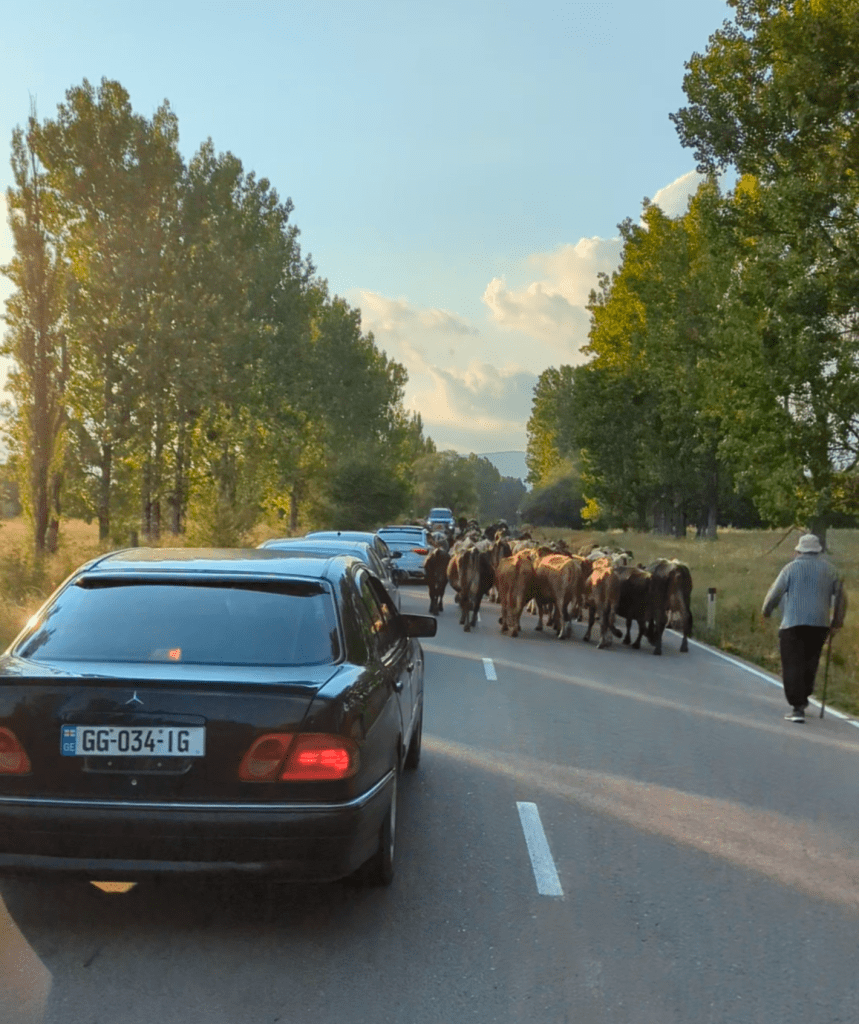
    The highest risk dogs are those that are trained to protect something: guard dogs and shepherd dogs. Sometimes you will pedal past a property with an open gate and the resident dog will greet you with a barrage of hyper-aggressive barking. Similarly with shepherd dogs, sooner or later you will encounter modern day cattle droving: the cows will be wandering along the road and it’s up to you to navigate through the herd. If there’s a lot of cows this isn’t always straightforward, and soon as you find a route through the beasts (ideally without being trampled or gored) the bipolar shepherd dogs who previously had no qualms suddenly decide you’re public enemy no.1 and make chase. Arseholes.

    Georgian cattle droving near Tianeti – the shepherd dogs are hidden amongst the herd

    I grew to genuinely enjoy the company of Georgia’s street dogs, especially the ones I got to know a little when staying somewhere for a few days. The dogs have become embedded into the roadside environment and I rarely see the locals show ill will towards them (other than yelling at them to stop barking when trying to have a lie in). I know they will always bark at me when I ride past on a bicycle, and that’s fine, we can still be friends when I get off.

    Tusheti – pushing the envelope of heavyweight cycle touring

    The Greater Caucuses have some seriously chunky mountains, the chunkiest being Europe’s highest peak – Mount Elbrus at over 5,600m. I wanted to ride somewhere into the high mountains but didn’t have any intel on where would be best to go with my setup.

    My research consisted of looking for squiggly mountain roads on Google Maps and seeing if any took my fancy. There were a few candidates, but one in particular had the benefit of being just up the road from my base at Kvemo Alvani – the road to Tusheti.

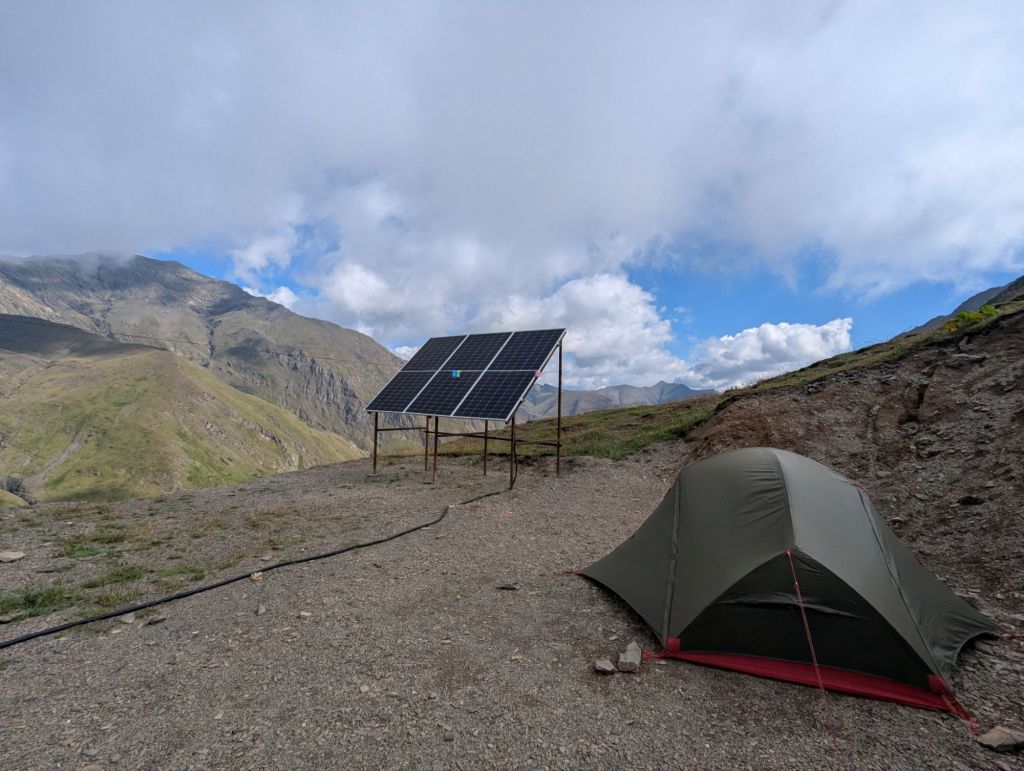
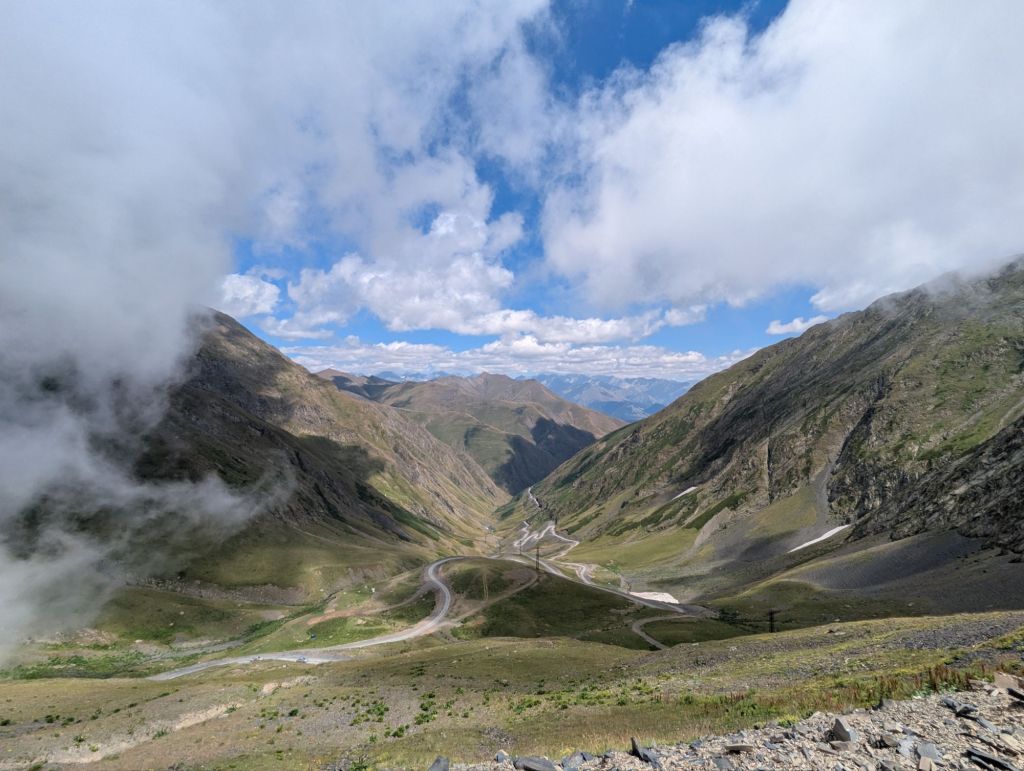
    Tusheti is a remote region of Georgia nestled deep within the Greater Caucuses, bordering Chechnya to the north and Dagestan to the east. There is only one road in and out: 70km long, largely unpaved, often treacherous, winding its way through several climatic zones up to 2,826m at the top of Abano Pass.

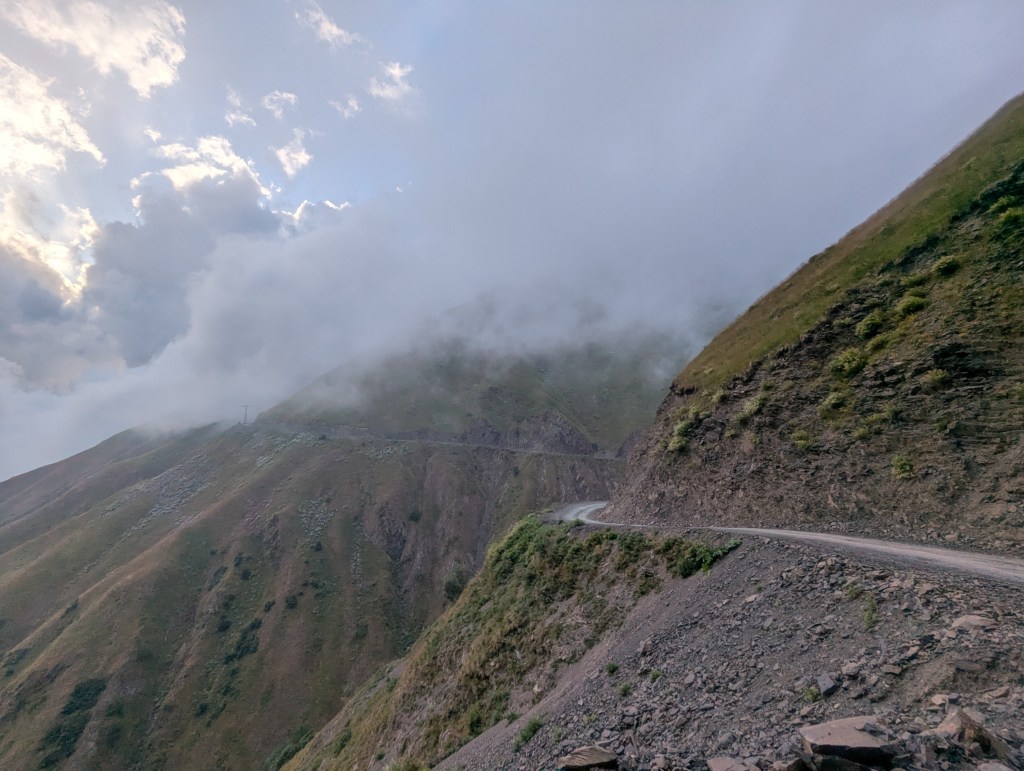
    Wiggly lines of doom – switchbacks on the upper sections of Abano Pass

    The road is notoriously dangerous to drive on, with tourists recommended to pool together and use the local ‘marshrutka‘ taxi drivers rather than attempt the drive themselves. These marshrutkas usually take the form of a fourth generation Mitsubishi Delica, which has enough space for several passengers and their luggage whilst still being narrow and nimble enough to deal with the road’s narrower sections – plus they are probably quite cheap. Mind you, they look a bit on the top heavy side for my liking, and it’s good practice to satisfy yourself of your driver’s sobriety before you get onboard for the white knuckle journey.

    One of several shrines to casualties of the road to Tusheti

    But I hadn’t come here to get in a taxi, I wanted to cycle there. Why? Good question! Well partly because on a bicycle you are the one in control, not the marshrutka driver you just met. Bicycles are also relatively narrow, which takes away some of the jeopardy associated with passing other vehicles on the narrow stretches. But mainly because I’m cycle touring and this was an opportunity to really push the boundaries of what can realistically be achieved on my setup.

    Modest beginnings

    You’d be forgiven for thinking the Abano Pass is a walk in the park when you start off. After a 9km warm up (half of which was dodging JCBs through active roadworks) I reached the base of the climb at Pshaveli where the smooth tarmac road barely scrapes above a 1% incline. This flood plain is the end of the River Stori’s mountain adventure, but very much the beginning for Tusheti travellers.

    The road heading north out of Pshaveli

    The braided river channel was mostly filled with grey pebbles and boulders, the flow of water clearly at the lower end of its capabilities. Above the riverbank, large deciduous trees dotted the flat grassy plains as if I was making my way up the long driveway to a stately home in Shropshire, except I wasn’t about to be charged £12.50 for a coffee and a panini at the café.

    As you move upstream and pass the final settlement of Lechuri the valley walls – covered in lush green broad leafed woodland – begin to move closer. The gradient begins to ramp up, the river sinking deeper and deeper into the valley floor below. Occasionally I would turn a corner and see the towering buttresses of rock that lay ahead – I still couldn’t even see the treeline before the mountain disappeared into cloud, and I knew the Abano Pass would rise above the trees. I couldn’t afford to dwell on what lay ahead though…not this early into such a long climb.

    There is an ongoing government funded project to upgrade the road to Tusheti. I heard somewhere that they expected to get this finished by 2026, which seems a little…ambitious. There has been some good progress made on the lower sections to date, but if it’s anything like the A9 dualling project in Scotland they will leave the hardest bits until last, and take 10 years longer than expected.

    Steepening valleys along the upper asphalt section – note the small electricity pylon

    Leaving the tarmac

    On passing a roadside clearing full of beehives I wondered how easy it would be to tap some emergency honey if I ran out of food. Realistically, running out of food was never going to happen: I had enough provisions to last probably five days, but the possibility always lingers at the back of your mind when you enter somewhere remote.

    Just beyond the beehives the road kicked up into a sequence of steep hairpin bends, or ‘switchbacks‘. It was the first properly steep section, and there was an increasing sensation of vertigo when glancing down into the valley below. Without warning, the smooth asphalt disintegrated into a well-compacted gravel road, and the real work would begin.

    The GPS was guiding me, but you’d do well to get lost on this road.

    What followed was the most challenging physical endeavour of my life, and that’s coming from someone who did an ‘Everesting‘ on a turbo trainer during the Covid lockdown. Riding up a pass like this involves a lot more than just the cumulative elevation gain:

    • 🚦Traffic: this is not a quiet country lane in Northumberland. The road can be alarmingly busy at times, with the marshrutkas and motorcyclists often arriving in waves. You need to remain vigilant, especially on the blind corners…you might even meet a Soviet truck with a cargo full of boulders!
    • 🪨 Dodgy surfaces: The good news is that there are no significant sections of deep sand, but be prepared for a lot of loose rocks. The bedrock cuttings are rarely reinforced making the road extremely prone to rockfalls and even landslides. The fresh rockfalls often leave jagged lumps of slate sitting proud upon the road surface, ready to chomp into your tyre, or even break your wheel.
    • 💦 Water hazards: I was worried these might be completely unrideable, but with the relatively dry summer conditions you can often walk the bike along the shallower edges. Sometimes though you just have to go through the middle…it is possible, just keep away from the edge and be prepared to get your feet wet if things start to go a bit pear shaped.
    • ⛰️ Gradients: The majority of gradients I found to be just about rideable, albeit very slowly. There were quite a few short steep sections where I would ‘go into the red’ before easing off the gas again, but my ability to do this diminished as the day went on. Eventually I just got into the routine of pushing my bike up the steeper bits, but I never had to resort to removing panniers and doing a section in multiple trips.
    • 🌡️Altitude: This one’s a double whammy as both the temperature and oxygen levels begin to fade. One benefit of my setup is it has all the clothing to survive spring in Scandinavia, so when I eventually decided it was wet and cold enough to dig out my waterproof jacket it was a big psychological boost. The depleted oxygen is a different matter – I seem to start feeling it around 2,000m, which made the next 800m quite an ordeal..

    So those are the sort of things you’re dealing with. But it is also one of the most extraordinary landscapes I have ever set foot in. You can never really see where the road begins or terminates, it just seems to endlessly wind its way up a precarious mountain perch in both directions. Occasionally you get a glimpse of where you have been and the scale of it all, it is quite an experience.

    Overhang on the inside, a steep drop on the outside 
    Brown streak – fresh rockfall on the opposite valley slope
    A wagon making its way slowly up a steeper section
    Looking back
    Looking ahead

    Attempting the summit

    So in a nutshell: I set off quite late (c.11am) intending to camp around two thirds of the way up, but just never found a camping spot that looked remotely appetising…it was all so, steep. Instead, I pushed on. The problem with this strategy is that I could no longer rely on the midnight sun of Norway in June for infinite daylight – by 8:30pm the sun had vanished beneath the hillside and it was properly dark.

    I wasn’t overly concerned about darkness on its own, but coupled with the onset of thick fog from the rapidly assembling clouds, visibility had taken a nose dive. This isn’t really a big deal on the ascent because the pace is so slow, but eventually I would crest the Abano Pass summit and descend into the valley below – all it would take is one optical illusion and critical misjudgement before suddenly you find yourself cycling over a precipice, and a shortcut to an early grave.

    To minimise this risk my plan was to sacrifice the break pads and descend less like Vincenzo Nibali and more like your grandmother; it would be painfully slow but I should reach the bottom alive, the benchmark of a successful descent.

    A bull dozer and sign on Abano Pass summit plateau

    At around 9pm after what felt like the longest steep section of the entire ascent (it wasn’t just the fatigue, it actually was), the road began to level off and I could start to make out the blurred edges of buildings. A motion sensor light flicked on and a warmly dressed young woman appeared in the door of a small kitchen.

    “Oh my gosh, are you alone? It’s so late!”

    “Yes it’s just me, is…is this a café?”

    Café above the clouds is run by Daji, a remarkable local woman who lives at the summit of Abano Pass for half of the year selling drinks, snacks and various handmade garments to the dozens (even hundreds?) of people who stop by every day on their journey in and out of Tusheti. But in that moment, Daji was more than just a hardy café manager, she was my mountain top guardian angel.

    “You mustn’t go down into the next valley, there are shepherd dogs there. If you try and make a tent they will get angry.”

    With this new nugget of local intel, who was I to argue? I wasn’t quite out of the woods yet however.

    “I will show you where you can pitch a tent here, do you have a head torch?”

    I did have a head torch – but the batteries were flat. I don’t know if it was the altitude or the 10 hour climb I had just ridden, but I couldn’t remember where my spare AAAs were stashed.

    “Don’t worry, you can borrow mine. Just give me it back in the morning.”

    Relief personified – the stove-heated hut at Café above the clouds

    So I took a seat in the cosy warm seating area, ate a huge slab of plum cake, and drank a sugary cup of black tea before putting up my tent on a flat (if somewhat stony) shelf of land just behind the café beside their solar array. It was dark, windy, raining, and I had to use boulders as hammers to get the pegs into the ground…but once up it was solid, dry, and actually a little nostalgic to be back in my canvas home for the first time since Lithuania. And besides, once you’re on the airbed you can’t feel the stones anyway.

    The tent – back in action at 2,826m
    The way down, into Tusheti

    I treated myself to a solid 9.5 hours before getting out of the sack and handing my borrowed head torch back to Deji. Not before another mega slice of cake of course, that stuff is seriously moreish.

    The rest of the ride was really quite enjoyable, mainly due to the assistance of gravity. After negotiating the high altitude switchbacks the valley narrows and you follow the Chabalakhi River as it cascades through the gorge further into Tusheti. The broad leafed trees had been replaced by forests of pine, it was very much a different ecosystem; Tusheti looks and feels different to the other side of the pass.

    The valley leading to Omalo

    Omalo

    Omalo is the largest settlement and effective capital of Tusheti. In the photo above it actually sits on the other side of that hill on the left. There’s no bridge, ropeway, or zip line across the gorge though – you need to descend down to the river and pedal your way back up a final set of switchbacks before reaching civilisation.

    Horses grazing around the hilltop oasis of Omalo

    I’m unsure of the geology behind why Omalo is so much flatter and more hospitable that the steep mountain slopes that dominate the Greater Caucuses (glaciers presumably?), but it is a bloody good feeling when you emerge from the claustrophobic valley roads onto those big open plains. With its free roaming horses, rustic villages, and hilltop stone towers – surrounded on all sides by a skyline of high mountain ridges – Omalo is about as close to a fairy tale village as you can get. Maybe that will change when the road is fully upgraded, but I hope not.

    Making friends – one from Leuven, the other more local

    Omalo is a popular starting point for the adventurous hiker. A popular route is the 5-day trek to the village of Shatili, and there are new routes being developed by the Trans Caucasian Trail and their network of volunteers (I met two of their staffers as they were recovering from an episode of food poisoning during a route reccy, the poor sods!). But after the exertions of merely getting to the place, I was quite happy just pottering around the local area.

    The restored stone towers above Upper Omalo – the place you would go to escape marauding Mongols

    On the morning I was planning to leave Omalo I met Mike and Callum – a Kiwi and Aussie – who had been riding bikepacking setups along some even more extreme routes. They were clearly going to be faster than me so we agreed to meet up the next day, that way I could get an afternoon’s head start.

    I camped at the foot of the first major set of switchbacks leading out of Tusheti, only to be woken two minutes before my alarm by the unmistakable bark of a shepherd dog.

    “Go away dog” I muttered under my breath, more of a prayer than a command. It seemed to work though; the dog moved on, and my morning routine could be carried out in peace.

    Mike starting to feel the cold outside Café above the clouds (more within the clouds on this occasion)

    I ended up getting about a 10 minute headstart on my friends from down under on the climb, a gap which they soon closed. We met at the summit where they were ready to order a second round of cake.

    The descent from Abano Pass heading out of Tusheti is not to be underestimated. You just can’t maintain the same sort of average speeds that come with asphalt roads, and if you share our luck it might just piss it down for the duration.

    One of the more slippery patches on our Abano Pass descent

    I think it took me around 2.5 hours or so to reach Lechuri, by far the longest time I have spent descending, ever. It might be physically easier than going up, but that is a long time to be in full-concentration mode – the hazards come at you faster on the way down, and you’d best keep an eye on that 200ft drop into the canyon below.

    There was a phrase that kept cropping up in my mind on the descent, which maybe gives some insight into the downhill experience:

    “Like driving a double decker bus down Mount Doom on a rainy day in Mordor.”

    Out of the frying pan and into Tbilisi

    Tusheti had taken its toll on my body, bicycle and even the panniers. My muscles were aching, bolts had come loose, and everything was coated in a film of beige mud. Just to top things off, when I was away from the bike for 15 mins an opportunistic street dog got its head into my ‘food pantry’ pannier and snaffled the contents, leaving a mixture of cake crumbs and slobber.

    After a full deep-clean and calling by at a roadside hardware shop to find a missing mudguard bolt replacement, I began to head west on a two day journey towards the capital. Day one was a little more hilly than I would have liked but otherwise ok, ending in a very homely guesthouse at the village of Tushurebi. Day two was to be mostly downhill, so surely that would be easy going, right? Right!?

    Sunset on the road to Tushurebi

    The attack plan was to avoid the busy roads going into Tbilisi, and instead approach from the north following a gravel trail that would wind through Tbilisi National Park.

    If you ignore the fact my GPS thought it was January 2006 and was getting itself in a right old muddle, everything was more or less going to plan…until entering the National Park. Within minutes I was heaving the bike inch-by-inch up a desperately steep case of hike a bike.

    The wall – there is a good reason roads are built to follow switchbacks going uphill

    At least I could push my bike up the first hill. After a small stretch of rideable gravel the trail took a beeline over a sequence of hills (see photo above) and I had met my match. The extreme gradient meant it was simply impossible to push the bike anymore; I removed every pannier except for the handlebar bag and began the process lugging everything up in batches. At least when I did this back in Norway it wasn’t like an oven!

    After an awful lot of heavy breathing and heavier swearing, I summited the final hill and immediately re-routed to the nearest way out of Tbilisi National Park. Due to the GPS malfunction I was relying on the Google Maps ‘walking’ route, which got me out of the hills ok, but around 15 minutes after entering the city itself I found myself cycling down a slip road towards the centre of a six lane motorway. Not wanting to end it all just yet, I pulled onto the embankment, turned around and called into service a brand new mode of transport for the tour: a taxi.

    Tbilisi was the first major pit stop since Baku, and at seven days the longest so far. I felt more like a short-term resident than a tourist, taking the opportunity to get my bike serviced, do laundry, and catch-up on blog writing & video editing.

    I did have a good wander around the city though, and managed to achieve my sole cultural objective of attending the cathedral’s Sunday morning service, where the resident choir sings ancient polyphonic Georgian hymns. The soft harmonies resonated gently around the immaculately frescoes walls of the 21 year old cathedral; Orthodox worshipers stood listening side-by-side with visitors in the pew-less nave & aisles, the faithful occasionally taking time out to kiss one of the gold-leafed icons hung from the candlelit walls and pillars. I’m not a religious man, but I’ve sung in a western choir for many years where much of the choral repertoire is structured as a Catholic mass, so it was a novel experience to hear the eastern equivalent for a change.

    That’s enough rabbiting on I reckon, so let’s close out with a few photos from around the vibrant and occasionally bonkers city of Tbilisi.

    ——————————-

    PHOTOGRAPHY: Georgia

  • 15. Çay nədir, say nədir: Cycling across Azerbaijan in the heat of summer

    Salam! This is another bumper edition of the blog, documenting the biggest cultural and climatic shift of the journey so far. If you are a cyclist considering visiting Azerbaijan and have any questions, please feel free to get in touch with a comment or message me directly (e.g. via Instagram).

    Foreword on the Caucuses

    The somewhat fuzzy aim of this journey is to ‘cycle around the continent of Europe‘, making use of various modes of public transport along the way.

    So, is Azerbaijan in Europe? Well they compete in the Eurovision song contest (and even won in 2011), but so do Australia – maybe this is not the best metric. Where you draw the outer boundary of Europe is far from an exact science, and there seems to have been all sorts of proposals put forward over the years.

    Where to draw the line? Historic boundaries of Europe (source: Wikimedia)

    Geology doesn’t offer up a simple solution. Europe and Asia both sit on the same tectonic plate, hence the lack of a nice unambiguous oceanic boundary between the two. But apart from when colouring in the continents on an atlas in primary school, the boundary is ultimately, fairly meaningless. It’s the boundaries of nation states, rather than continents, that have material consequences, especially when differences of opinion arise.

    Ethnolinguistic groups of the Caucuses, as of 2007 (source: Wikipedia)

    The Caucuses are a bit like Eurasia’s central junction, a mountainous intersection between worlds. Their inhabitants have endured invasions from all directions over the centuries – the Mongol, Persian, Ottoman, and Russian empires to name a few – with the republics of Azerbaijan, Georgia and Armenia emerging as sovereign states following the collapse of the Soviet Union. There exist long-standing territorial disputes amongst the region’s diverse ethnic groups, at times escalating into all out warfare – something I would be frequently reminded of when travelling across Azerbaijan.

    Looking at the map, it was starting to dawn on me how far east I had manoeuvred. Baku is east of Moscow, Syria, Ukraine, Iraq, Kuwait, and every country in mainland Africa except the pointy end of Somalia. Then there’s the heat, with forecasts hovering around 39°C in the late afternoon – that is just cruel.

    With my bicycle successfully re-constructed in Heydar Aliyev Airport car park, it was time to start meandering my way in the only direction that didn’t lead straight into the Caspian Sea: west, towards home.

    Escape from Baku Airport

    It’s amazing how dependent you can become on technology when traveling. I use my smartphone for all sorts when out and about, but especially for navigation and translation. Upon landing in Baku I received this slightly tepid welcome message from my mobile provider, EE.

    £15 for the privilege of using my data plan…for one day?

    EE’s generous offer is you can pay £15 a day to continue using your data plan, which equates to around £450 a month…eye gougingly pricey. What I needed was to install an ‘eSIM’ to get mobile data at a fair price, but having never installed one before I could feel it in my bones the process wouldn’t be straightforward – I just wasn’t in the mood for mucking about with tech problems, I wanted to get to my Airbnb in Baku’s Old Town and sort it all out there. So I logged onto the airport WiFi, looked for the key roads I should be heading for on Google Maps, drank an iced coffee, and headed for the airport exit.

    One of the more obvious ‘paths’ adjacent to Airport Road, Baku

    In cycling your way out of Heydar Aliyev Airport it doesn’t take long to realise that cycling safety was probably not a high priority in the transport network design matrix. I had to cross six lanes of traffic just to get out of the place, and there was absolutely no way I’d be cycling on the traffic saturated mega-motorway into Baku. Mercifully, there was a concrete path running alongside the highway, or at least to begin with there was.

    My route into the centre of Baku could probably be best described as ‘indirect’. Less as the crow flies, more like a hedgehog sniffing its way around the garden to find a suitable hole in the fence. A common design feature of Baku neighbourhoods is the absence of a through road – many districts seem to have only a few key roads leading in and out – so I kept finding myself going around in circles looking for an exit, usually to the bemused looks of local men as they sat smoking cigarettes under the shade of trees.

    Entering Yeni Ramana district on the outskirts of Baku

    It felt like a milestone getting away from the motorway and into residential districts, but this came with its own hazards. Slippery patches of a mystery liquid leeched onto the road from roadside markets, occasionally flowing into open drainage channels that could be two feet deep. Potholes are a constant threat especially on downhill sections, and the constant coming & going means you really have to be on your guard to avoid a dreaded car door encounter.

    There were a few roads that felt just a bit too busy, fast and narrow for my state of mind, where I opted to push the bike on the pavement instead. Normally this is a slow but easy option, but in Baku the kerbs are rarely dropped and often rise 12+ inches high meaning you have to actively lift up the bike to avoid the sound of chain ring grinding on concrete – repeat this lift manoeuvre every time you pass a driveway in a residential area and, suddenly, riding along that busy road doesn’t look like such a bad option after all?

    The aftermath of a ‘coming together’ of cars on Babak Avenue, heading towards central Baku

    After some painfully slow progress where I (barely) pushed the bike up the world’s steepest footpath only to spend the next hour going in the wrong direction and having to retrace my steps, I finally got myself heading towards town on the gloriously straight Babak Avenue. This is by all accounts a busy road, but it is flanked by a bus lane for the most part, which most of the cars stay out of, and as a safer alternative there’s often a nice wide footpath or side access road you can ride along instead. The road is also home to an endless supply of car show rooms and spare parts merchants, clearly there is plenty of demand: in my left ear there was a piercingly loud tyre screech and BANG – a black saloon had been rear ended by an SUV.

    It was all quite straightforward from Babak Avenue. I stopped at plenty of supermarkets for refreshments, shopping at a leisurely pace in the air conditioned aisles. I may have survived Day 1, but clearly I would need some specific hot weather clothing going forwards.

    Adjusting to Baku life

    My ride into Baku gave me a brief peek inside the ‘real’ Azerbaijan well outside the orbit of souvenir shops and tour guide sales reps touting for business. Not to take away from central Baku and its blend of historic and ultra modern buildings, it’s just that 99% of Azerbaijan isn’t furnished with neo-futuristic buildings designed by Zaha Hadid, triple sky scrapers shaped like burning flames, or public gardens with mock Venetian boat rides.

    The Flame Towers, as seen from Little Venice

    I spent four days in the city altogether, plenty of time to recover from the flight, ease myself into the hot climate, and drill a few elementary Azerbaijani phrases into my monolingual skull. You don’t have to walk far out of Baku city centre before the English speaking drops rapidly, especially amongst older folk who learned Russian under the USSR.

    One of Baku’s good natured street cats

    Inside Baku’s Old City walls is a well preserved labyrinth of narrow pedestrian streets. It is quite fun to just wander aimlessly through the maze and see where you end up, usually at a souvenir carpet shop but occasionally an ancient palace or tower. The city is home to a healthy population of street cats, who I was a bit cautious of at first, until realising their default mode is to ignore your very existence – better to be shunned than scratched.

    The population of cats that roam the streets of Baku is exceeded only by that of police officers. In fairness Baku feels like a safe city in terms of street crime and the police presence probably helps in this regard, but it’s hard not to wonder what some of them actually do all day other than cruise around in flashy patrol cars at excessive speeds with the beacons flashing. Actually, I do know, occasionally they remind tourists to not take photos of cats sleeping on the steps leading up to government buildings (I’m unsure what the security risk was supposed to be exactly, but I sensed this wasn’t a moment for debate).

    An online search led me to a couple of small outdoor clothing shops just beyond the city walls. They were more hiking than cycling focused but that didn’t matter, they had clothing to survive in hot weather: loose-fitting thin trousers, a long sleeved jersey, and a (faintly absurd looking) cap equipped with UV rated neck flaps.

    Catching a bus from Baku to Lankaran

    I was curious to visit the mountain communities in southern Azerbaijan, which would take me about as close as possible to Iran without actually crossing the border and waving goodbye to my travel insurance (yes I could probably get a separate policy to cover Iran, but I doubt a certificate of insurance is much help when you’re banged up in a Tehran prison on fabricated espionage charges). The Talysh Mountains also looked quite green and lush on the satellite image, so perhaps a bit more cool and fresh than bone-dry Baku.

    The rough route plan – blue by bus, red by bicycle (credit: Google Maps)

    The coastal road heading out of Baku never seemed very appealing to me, so my plan was to get a bus down to the city of Lankaran and cycle across the country, exiting at the Lagodekhi border crossing into Georgia.

    The bus is very cheap and you can purchase tickets using the Biletim app. If you have a bicycle I recommend choosing one of the larger coaches (you can see how big the vehicles are by the seating plan) and make sure you give yourself A LOT of time to get to the bus station, it is an absolute pig of a journey by bicycle. Even once you arrive it can take a long time to figure out where your stand is.

    The different departure zones around Baku bus station – the Lankaran stand is in the green zone, on top of Baku Outlet Park shopping centre

    I was so bamboozled by the bus station layout I ended up having to catch a later departure, not a big deal though given you can cancel tickets on the app for a small fee. Around 30 minutes before departure the driver opened up the luggage compartment and gave me a hand loading my bike and panniers inside. There is no formal fee for bicycles, but I gave the driver a 5 Manat tip (around 75% of the fare) since he helped me out and the ticket only cost around £3.50.

    I honestly don’t know if it would be possible to get the bike on one of the smaller buses, but the coach was convenient and reasonably comfortable. The driver’s mate handed out free cartons of water which felt like being back on a school trip, and we stopped at a service station to stretch the legs and top up on snacks.

    If you do visit Lankaran by bus I can highly recommend the Xan Lənkəran Hotel. It was under £25 a night and just feels really cosy inside with all the solid wood fixtures, friendly staff and a decent restaurant…plus you only have to walk 20 metres from the bus stop!

    Lerik – the town on a mountain

    After a tasty meal that made the palms of my hands and soles of my feet itch (this is walnut country, luckily my allergy is fairly mild these days) I logged into Komoot to plan a route from Lankaran to the towns of Lerik and Yardimli. I was keen to get off the main road where possible, so I pieced together a circuitous route of unpaved gravel tracks linking the surrounding villages.

    Businesses in Lankaran – I wonder what discount you get on the car park sofa?

    The road through Lankaran was buzzing with commercial activity. You can walk into a furniture store to collect your shiny new glass dining room table, cross the street and pick up a whole sheep (dead or alive). One vendor ambitiously tried to sell me a slaughtered lamb, not exactly the most convenient cycle touring food option; I politely declined.

    The R48 road linking Lankaran to Lerik gets quieter once you cross the motorway junction, but there are still plenty of cars and the odd lorry. The road is fairly wide and rarely steep, so as far as main roads go the riding isn’t bad. After an hour or so I took a left at the village of Piran and swapped tarmac for some rather dusty looking gravel.

    The dirt tracks were ok at first; my legs were still fresh and the surface was uneven but rideable. It was a short honeymoon though, before long my back wheel began to lose traction on the deep sandy sections, and there were some brutally steep ramps where I simply had to get off and push. To make matters worse, for some reason I was wearing my civilian red suede shoes (don’t ask) which just slid across the loose gravel, getting me nowhere. At least I could actually push the bike when I swapped back into suitable footwear: the question was, how often would I need to?

    The back roads south west of Piran

    My reward for this hard work was a downhill section that brought me alongside a small stream, which had been few and far between so far. Spotting a café sign pointing to a nearby property, it seemed like a good time to stop and cool down, even if I’d barely made a dent in the planned route to Lerik.

    Fair play to the family who run this café. You come in for a cup of tea, and before you know it they’ve sold you an off-road tour in a Lada 4×4 to a waterfall 10km up the mountain. I was mildly concerned it was some kind of scam at first – and wondered if the chainsaw my driver loaded into the boot was for sawing through logs or bones – but the warmth exuded by the family felt too genuine. The waterfall was clearly a tourist hotspot for locals, and my little excursion included more chai and lunch with an older couple who were based at a shack next to the waterfall carpark. The chainsaw was for cutting firewood for the wood burning stove, thank God.

    Two 38 year old men – me and my very skilled Lada driver

    I ended up spending most the afternoon on this little detour. When I returned a group of young men in their 20s turned up for a round of tea, insisting I join them for a few cups. They reminded me of my friends at that more care-free age when life seemed to be more simple. There is more wisdom and self acceptance in your 30s, but it can be harder to corral a big group of friends together for a cup of your favourite brew.

    My hosts confirmed my suspicions that it would be a very bad idea to try and cycle to Lerik following the back roads. I turned around and headed back from where I had came, onto the asphalt of road R48.

    Dusk on the R48 looking towards Lerik

    As the evening set in I could see the faint twinkling of lights on a hill in the distance. I knew that this must be Lerik, but my brain was failing to comprehend the magnitude of what I was looking at. Evening turned into night, and around 5km outside the town walls I detected red & blue lights flashing in my peripheral vision, followed by a brief siren instructing me to pull over. I had passed dozens of cops all day without issue, but for some reason these chaps pulled me over – they were friendly enough and mainly just wanted to check my passport. They didn’t stop me for that long in fairness, but it was starting to get late and I had no accommodation lined up.

    I failed to find any hotels that could be booked online or that even had a phone number. The address of Hotel Lerik on Google Maps brought me to the Ministry of Finance (helpful!), so I placed my faith in a group of enthusiastic young boys, the eldest of whom spoke impressively good English. After wandering the streets for 20 minutes we eventually found Hotel Lerik – it was closed. I decided to cut my losses and camp in the woods.

    I pulled up at the side of the road to inspect a patch of land where I could camp for the night, only to be accosted by another police passing police officer. This one was working solo and seemed more grumpy than the last duo, insisting to inspect my bags for any dubious materials. I explained my predicament and he recommended another hotel which I was certain was full (it was on booking.com but showed no rooms available).

    I don’t know if it was a language barrier or he just didn’t want me to camp for some reason, but he insisted I go to this other hotel. I agreed to give it a try: it was full, and I was fed up. Given that in some sense I was following police orders, I just setup the airbed & sleeping bag on the hotel’s outdoor patio and fell asleep to the chorus of Lerik’s amateur canine choir.

    Lerik to Yardimli, the short way?

    To get to Yardimli from Lerik you could descend all the way back to Lankaran, take a relatively flat road up to Masalli and hang a left onto the main road up to Yardimli. But that would be 140km, why drag it out when you can just ride the 45km driving route advised by Google Maps?

    In fairness I did see a few cars along this route, so you can technically drive it, but be warned: with 20/20 hindsight, I do not recommend this route on a heavy touring bicycle.

    The 45km route from Lerik to Yardimli (the climb was second only to the previous day’s effort into Lerik)

    It was a glorious morning, and the benefit of sleeping on a porch was that I was up and away by 5:45am, with the cool morning air and a stunning sunrise. Much of the first 15km or so was downhill which was great where the road surface was still intact, less so on the bumpy subbase.

    Sunrise near Lerik

    The high-pitched drone of insects was in constant surround sound up in the mountains. Maybe it was the grasshopper/ cricket creatures that jumped in all directions when I wandered onto the verge to take a photo? It was a stunning landscape, but away from the forested areas the land was looking extremely dry. I just prayed nobody was going to toss a smouldering cigarette butt out a car window – the grassy areas looked like they would light up in a flash.

    Mother & foal on their morning walk

    There were at least two occasions where upon the sounding of a deep, throaty “woof”, I looked up to see a large, angry looking Kangal Shepherd Dog on the roadside up ahead. Some of these dogs are truly enormous, much bigger (and slower) than Border Collies, and I did not fancy taking a bite from one if possible. As it happens, there was a recurring pattern that emerged: they stand and bark, then as you get near they begin to chase – keeping the speed down so they never quite catch you – following until you pass the property and their job is done. You could get bitten but it’s quite unlikely; I mainly just try to avoid direct eye contact and ignore them. If they appear on a steep climb I sometimes opt to push instead since they don’t tend to harbour the same grudge against pedestrians.

    After a few hours I rolled into a village large enough to sustain a small shop where I shovelled down an 8:30am ice cream. I always greet the people I come across with a “salam”, including on this occasion two men sat outside of the shop entrance. One of them asked if I would like a cup of “çay” tea, showing me around the corner to where the serious tea drinking takes place.

    Next to the shop were several long tables and a dozen chairs, arranged so that those seated could look out towards the road and watch their little corner of the world go by. They seemed to know exactly who every single person was who drove past, with most cars stopping to stock up on freshly baked bread and often joining the çay session. In Azerbaijan they have a saying:

    “Çay nədir, say nədir”

    I’m told it translates to something like ‘no amount of tea is enough’. I had four cups, which felt like a lot in one sitting, and they even plied me with bread and cheese, refusing to accept any money in return. I can see how easy it would be to let the hours pass by sitting in that shaded corner of the village, watching the charcoal fire crackle as another pot of tea came to the boil, but I wanted to reach Yardimli by lunchtime and put my feet up after a night on the patio.

    This is where the route became challenging. I descended into a small village where one of the locals pointed out the road to Yardimli. I rode right past it the first time around, resembling more of a stony walking path than a road – I was about to head back onto gravel, and it was getting seriously hot. As usual, it started off ok where the path ran adjacent to a dried river bed, but then it all changed. The path rose up into what would be one of the most unpleasant climbs I’ve ever attempted with a bicycle. I say ‘with’, because I was rarely ‘on’ the bike for this section, it was just too steep, too sandy. Discounting the ride into Lerik the day before, this would be the biggest climb I’ve ever done in my life – and I’ve ridden up some good size mountains before!

    A still from a piece to camera, where I have a good moan under the shade of a twig

    The difficulty was amplified by a lack of shaded rest places. Sometimes I would have to dump the bike and walk down the hill to a lone tree where I could shelter for five minutes, it may not sound like much but these short breaks make a huge difference. The hat was a life saver, I may have spontaneously combusted if the sun was on my neck and face that day.

    But all hills have a summit. The road surface returned to tarmac and I reached another small store where the kind shopkeeper gave me tissues to clean the sweat from my face. After 7.5 hours since my departure I reached the Arena Hotel in Yardimli by 2:30pm: it was the hardest 45km of my entire life.

    Traversing the Iranian borderlands

    I basked in the comfort of my air conditioned hotel room in Yardimli. The hotel was part of a modern sports complex with Olympic rings plastered on the front. I couldn’t recall the Yardimli summer games, probably because they never happened – it is one of a network of ‘Olympic’ government funded sports centres built since the year 2000 to provide access to decent quality facilities in the provinces, and most of them have a reasonably priced hotel attached.

    —-Driving in Azerbaijan —-

    The hotel manager had offered me a lift to the local supermarket so I could stock up before my departure. A Russian gymnastics coach who was working with the Azeri team was in the front passenger seat, so I climbed into the back and began to try and release the seatbelt which was trapped under the seat.

    “No no no, don’t worry – you don’t need those in Azerbaijan!” my driver reassured me, as if my main concern was being told off by a traffic cop for not wearing one.

    “Well promise me you won’t crash!”. Good job our shop was only around the corner.

    The standard of driving in Azerbaijan was an eye opener. They drive fast and loose, and don’t always let inconvenient things like rules of the road or speed limits hold them back. There is no shortage hazards out there on the road – potholes, drainage channels, cows, pedestrians, cars manoeuvring without indicating – so expect a certain amount of swerving on your way from A to B. My Yardimli friends would probably think I was the squarest of squares if they saw me drive, and I’m perfectly happy with that.

    —————-

    My planned route would send me down the main road out of Yardimli, only to hang a left and go straight back up another chunky climb. I was fine with this on the condition it was tarmac – and the aerial photography suggested it was – so I stuck with the plan and headed for a road that would take me to within a few hundred metres of Iranian soil.

    There was no early bird 5am rise this time. Nope, I set off at noon, fully rested but straight into heat. It was a strategy I would continue across Azerbaijan: ride in the heat, then rest in a hotel where I could have a shower, wash my riding clothes, and get a good night’s sleep. Ride hard, rest hard. In many ways it worked well, but mistakes were made too..

    Molten bitumen on the road

    I found myself weaving between molten sections of road, hoping the black liquid wouldn’t eat into my tyre when I inevitably veered into it. It was clearly a hot day, but it didn’t help that the bitumen was freshly laid. After passing through several eerily quiet villages I reached the summit plateau and got my first glimpses across the border.

    Looking towards Iran, circa 3km from the border

    I can’t say the snippets of Iran I managed to peep into looked all that different from Azerbaijan, other than maybe the fields being slightly different shapes. Would it feel like a completely different country if I rode through a town on the Iranian side? The area was historically known as Iranian Azerbaijan after all, largely inhabited by ethnic Azeris, but the systems of governance have diverged radically since each side of the border was all part of Persia in the early 19th century. Maybe one day I will find out, just not on this trip.

    The mountain descent was hampered slightly by an unrelenting headwind, but I was just happy to have a breeze on my skin. The ambient temperature was slowly rising as I lost altitude, and I stopped at one of the roadside drinking fountains to rehydrate.

    Azerbaijan has a network of public drinking water stations at the roadsides, often on remote stretches of road where there are no nearby shops. They’re easy to find since they are invariably housed within shrines dedicated to Azerbaijani soldiers killed in conflicts over the long disputed Karabakh territory, usually with a prominent photograph accompanied by the Azeri and Turkish flags. As it happens, I actually met two war veterans in this particular shrine who I had bumped into previously on the road. They seemed like genuinely nice guys even if they did try the ‘would you like to swap mobile phones‘ trick. They were clearly very proud of their military associations, and maybe they knew some of the people the shrines were in memory of, the war was only a few years ago after all.

    Those sunglasses look familiar

    Personally I always filter this water – as I did with all tap water in Azerbaijan – but you might want to consider disinfecting for viruses too if you’re being careful. Thankfully I never got a case of the green apple splatters, but the water tasted pretty unpleasant to be honest, usually quite salty, and I would be wary about consuming such tap water for a prolonged period. A lot of people still rely on bottled water in Azerbaijan for their primary consumption and most shops sell whopping 19 litre bottles to service the demand. I struggle to wrap my head around how an oil rich country can have such poor drinking water provision outside of the capital, but maybe I’m just being naive?

    The mountain communities up here are a long way from any major urban centres and sometimes look like they operate in ways unchanged for hundreds of years, living off of the land and utilising local materials. It is a stripped back, traditional way of living, but it never looked like an especially poor quality of life, not at least from my superficial perspective.

    A house and outbuildings made using mud bricks

    Heating up in Azerbaijan’s pan-flat centre

    Going fast downhill on a bicycle is always refreshing on a hot day, until you reach the bottom that is and the A/C gets switched off. The centre of Azerbaijan is remarkable in its flatness, and the air masses seem to just sit there, creeping up in temperature until they approach roasting-point at around 5pm each day. This place is absolutely baking in mid-summer, and it was about to kick my arse (in a more literal sense than you might have bargained for when you started reading this blog).

    One good thing about leaving the mountains was I was back onto consistent tarmac, despite the best efforts of my GPS trying to take me back off again. This was a recurring theme – the route I had mapped out from the comfort of my hotel room would often take ‘shortcuts’ along unpaved roads.

    I rolled into the small town of Üçtəpə (Uchtapa), where halfway through my planned route diverted off the main thoroughfare onto a gravel track that led into the vast expanse of agricultural land surrounding the town towards the city of Bilasuvar.

    The Google Maps summary for Üçtəpə – I didn’t see the castle (or any mermaids..)

    Üçtəpə was my realisation that there is real poverty in 2025 Azerbaijan. It was the first time I’d seen open sewers along the road, or ridden through plumes of toxic fumes from piles of burning rubbish whilst children played games in the street. It felt different to the mountains, the environmental problems exacerbated by a higher density of residents. I don’t know if Üçtəpə technically qualifies as a shanty town or not, but it is the closest thing I have seen to the images conjured up by that phrase.

    Just to be clear, I am not seeking to slight the town or its residents, I just want readers to know that – like many places – the wealth in Azerbaijan is unevenly distributed, and this inequality can be quite extreme in places. I stopped right in the centre of Üçtəpə to double check my navigation, where I was immediately mobbed – first by the curious local children, followed quickly by the more skeptical adults. A broad, muscle bound gentleman of substantial mass who seemed to be a ‘man of local influence’ walked over to me, so I shook his hand and repeated my usual spiel of how I was cycling to Istanbul. He didn’t seem overly impressed, and it was suggested to me by one of the children that now might be a good time to leave; I took the child’s advice and followed the main road to Bilasuvar.

    The next few days blur into one in my memory. I made my way across the country following the longest and straightest roads of the tour to date, they put Finland to shame out here! I could be riding for 30 minutes and see nothing but a few spiky shrubs and a telegraph pole for shade.

    No escape – riding Azerbaijan’s open air oven at 40°C

    I thought I was drinking plenty of fluids but with hindsight, perhaps not enough. I also didn’t use hydration tabs too to keep my electrolytes in balance (which you can easily purchase from chemists), so that’s something I would change next time around. By the time I reached İmişli my belly was beginning to feel bloated and my energy levels were down. My digestive system had gone into water conservation mode, and it was becoming difficult to ‘pass solids’ on the toilet. This culminated in a minor (but nonetheless unpleasant) internal tissue tear and the oh so pleasant symptom of ‘bloody stools‘. So please, learn from my mistakes people and STAY HYDRATED IN HOT WEATHER, your arse will thank you for it.

    The temperature rollercoaster from Zardab (in the flatlands) to Sheki (in the mountains)

    Looking at the temperature chart above (recorded by my GPS), the 50°C temperature spike was probably from parking the bike in the sun on a lunch break, but you get the idea – daily temperatures could fluctuate between fairly hot and full incineration.

    Digestive woes put to one side, there were some things I got right. I took regular breaks (ideally in the shade, but sometimes just using my headgear for shelter), and stopping for cold orange juice and a 40p ice cream at village shops became a sacred cool down ritual, where the shopkeeper might hand me a tissue to wipe the sweat, dirt and salt crystals from my brow.

    There was no wild camping for me in Azerbaijan. It was just too hot, too sweaty, and apart from in the mountains there weren’t all that many places tempting me to get out the tent. Since Azerbaijan doesn’t have formal campsites, one option might have been to ask the restaurants and tea houses with enclosed gardens if I could camp for the night, away from the roaming street dogs – the chances are they might suggest to stay in their house instead.

    Since I was staying at the local hotel instead, there was always a moment of jeopardy as the receptionist showed me to my room – would it come with my very own Persian-rug equipped living room (Zardab), or would it resemble a 32°C squat where the only running water was from the bidet (İmişli)? I had a bit of everything, but they were mostly fine, A/C equipped and never more than £25 a night. Importantly they gave my body a little haven to recover from the extreme heat of the day, so I started each day well-recovered.

    Sheki and the border crossing

    Zardab to Sheki was my final major ride in Azerbaijan, and for some reason I decided to do it all in one day rather than the more sensible option of two. I knew it would be longer than my other rides, but Sheki is located up in the foothills of the Greater Caucuses, so there would be a hefty climb before reaching my guesthouse.

    Evening sun over the treeless steppe grasslands, south of the Greater Caucuses

    It was ambitious and inevitably resulted in a late (10pm) arrival, but I was just glad to be staying somewhere up in the hills and out of the baking hot flatlands. My guesthouse didn’t even have air conditioning, but with cool evening air and fly nets on the windows, it didn’t matter.

    Goldfish living in one of the guesthouse’s outside tap basins

    Sheki was the perfect place to spend a couple of days and recover after the exertions of crossing the country. My guesthouse – Ilgar’s Hostel – is listed as a homestay, and it was one of the most peaceful environments I have ever taken lodging. The lady who made me breakfast and cups of tea throughout the day was the epitome of calm, and could often be found tending to the house’s flourishing rose and vegetable garden.

    Sheki was a prominent town on the Silk Road and it was the first town I had seen tourists in Azerbaijan since leaving Baku, where they come to visit the well preserved old town with its caravanserai and the impressive frescoes and stained glass of the Palace of the Shaki Khans.

    I was ending Azerbaijan on a high. I flirted with staying in the country for one more evening until I discovered the main hotel in Balakan is currently closed for renovation. The alternatives were limited in Balakan so with the evening drawing in I decided to take my chances and head for the border and find somewhere in the Georgian town of Lagodekhi.

    The first sign I was approaching the border was the tail end of a 3km long line of parked lorries. There is a tremendous amount of roadside litter along the road leading up to the border as well, not the most attractive corner of the country that’s for sure.

    The beauty of a bicycle is you can easily glide past queues of lorries and see what the situation is at the front. The two Azeri soldiers checked my passport and gave me the knod. The Georgian soldiers took a little more time, but took pity on my disheveled appearance and showed me to the tap where I could freshen up. Within 30 minutes I was over the border and into Georgia.

    ———————-

    A word on the people of Azerbaijan

    I have never cycled through a country like Azerbaijan before. I don’t know if it is partly down to the absence of cycle tourists or foreign visitors in general, but I received the warmest welcomes I have ever experienced from strangers in the street. People would constantly wave from their cars or the side of the road, sometimes even pulling over to say hello and get a photo together. Thank you to everyone who welcomed and helped me on my journey through Azerbaijan, it was an experience I will never forget.

    ——————————

    PHOTOGRAPHY: Azerbaijan

  • 14. The Flight

    I’ve never flown with a bicycle before. The prospect has always seemed daunting to me – it can be bad enough sometimes just getting on a train. With flying, get the packaging all wrong and you could be in for extra charges or even having the bike flat rejected at check-in. Then there’s the prospect of damage – we’ve all seen the footage of luggage being hoyed across the runway and bashed around by over zealous conveyor belts and ground crew. There’s a lot that could go wrong, or at least in my head there was.

    LOT Polish Airlines provide online guidance on how to fly with a bicycle (Image credit: LOT)

    The packaging

    By 3pm Saturday afternoon I was off the FlixBus and in Warsaw, where my flight would be departing from 11pm Monday evening.

    My main anxiety was getting hold of some kind of box to both protect the bike from damage whilst satisfying the airline’s rules. I was flying with the Polish operator LOT, who specify a weight limit of 32kg and maximum sum of all dimensions as 230cm (e.g. 130cm long + 30cm wide + 70cm high).

    The weight limit had room to spare, but the dimensions…230cm didn’t sound like much to me. It should be just about doable when removing the front wheel, at least according to my dodgy tape measurements. I just needed a box.

    The coach ride from Vilnius was more than long enough to comb through Google Maps for bike shops near to the hotel and see if any would still be open when I arrived. There were two candidates, so I headed straight to Reakcja Łańcuchowa opposite Ogród Saski park, a 15 minute walk from the hotel. They’re more of a maintenance workshop than a new bike vendor, but the helpful chap on shift took the time to go out back and have a rummage, returning with a large cardboard box for an E-bike. The staples had been pulled out so it was no longer in true ‘box’ form, but that could be solved with duct tape. About to close for the weekend, he stashed it under his car so I could return and collect at my convenience…top bloke!

    “This is normal”, a useful mantra

    It’s hard not to feel a bit eccentric walking through central Warsaw with a huge slab of cardboard on your head, but it’s the best way to carry such awkward objects, and on a cycle tour you have to embrace the fact there will be times when you look conspicuous, even outright strange. It’s a bit like day two of a music festival, there’s a point when self-consciousness goes out the window.

    So I had a box, hooray! I celebrated by wandering down to the Old Town for a beer, and for the first time on my trip the sudden urge to get to a toilet ASAP washed over me. I think it was the hotel tap water that ran warm whichever way you turned it. Whatever the cause, I didn’t shit my pants in the centre of Warsaw so I’m striking that down as a win, even if it did cut the celebrations short.

    Boxing day

    It’s all good and well getting your hands on a box, but you still have to get the bike inside, and in my case I had to reconstruct the box itself from a cardboard shell. After cleaning the bike as best I could without caking the entire hotel room in oil & dirt, I got to work.

    The box shell – does that look a little on the large side to you?

    For a while I couldn’t even work out how the box fit back together. It seemed so enormous that I was trying to fold it in a way that halved the size – which didn’t work – before the penny dropped and it all made sense: it was just a lot bigger than I’d anticipated. There was a lot of unused space inside once the bike had been dropped in with the front wheel, handlebars and pedals removed. In fact it was nearly 50% over the maximum dimensions specified by LOT. Time for some modification, then.

    This is where getting a bike shop to do the packing would have helped me. My attempt at cutting the box down to size was frankly piss poor: I used the serrated blade on my knock-off Leatherman knife which made cutting straight lines difficult, and my space saving idea to have one end tapered just didn’t really provide any bankable savings, instead making the whole thing look like it’d been cobbled together by class 4 at the local primary school.

    Packaged bicycle v.1.0

    I did manage to reduce the height of the box, and the width in places, but the length was still obscenely long. My tinkering had jeopardised the structural integrity and the box was still way over the size limit. I pinged a WhatsApp message to LOT customer services to see if there was some leniency on the dimensions – they simply reconfirmed the 230cm limit.

    Plan B

    I knew that if my bike was simply wrapped in some kind of plastic film it would easily be within the size limit. Bubble wrap seemed like the best option to keep it safe in transit, so I tracked down the nearest ‘B&Q’ style hardware store and – with my bike now dismantled in a box – hopped on a Lime electric scooter and joined the Monday morning Warsaw commuters. It was c.15 hours before take off.

    E-scooters ready for action outside Leroy Merlin hardware store

    I bought two massive rolls of bubble wrap and a fresh duct tape (it’s a good job you can ride a scooter with a roll of bubble wrap under each arm). The new plan was this: get back to the hotel, reconstruct the bike, ride to the airport, deconstruct the bike and wrap everything up there.

    One benefit of Plan B was that it avoided the ordeal of getting a taxi to the airport. I still needed to carry the bubble wrap though and didn’t fancy the under-arm technique on a bike. Instead, I pulled out the trusty duct tape and taped them to the rear panniers, creating some kind of Blue Peter style homemade artillery unit.

    The best way to transport bubble wrap by bicycle, maybe

    There was one final bit of faff before I could go to the airport: dispose of the (now redundant) cardboard box. Obviously I could have just left it in the hotel room, but that could draw attention to the fact I’d been messing around with the bike in there and risk being hit with a big cleaning bill, so I headed out on foot to track down a suitable bin. Resisting the temptation to fly-tip, I quickly gave up and just took it back to the bike shop.

    Warsaw Chopin Airport

    Apart from stopping to re-tape the bubble wrap two or three times en route to the airport, the mission was on course for success. I picked out a space against a glass wall next to a bench in departures and began the process of dismantling then wrapping the bike.

    The airport workshop – front rack, wheel, handlebars and pedals all removed

    It was quite slow going, but with over seven hours before take off at least I had time on my side. During a brief pause to sit down for a bit of lunch on the nearby bench I noticed in the corner of my eye a couple of security personnel inspecting my bike.

    And that was it really. The bike weighed in at 20kg, well under my 32kg limit, and the dimensions were never even measured in the end…maybe I could have used the box after all?!

    “Don’t worry, that’s all mine”

    “Do you know this is not ok? You must be with luggage at all times. If we evacuate the terminal it is very big fine.”

    I assume they didn’t bother to ask me first because there was an empty space between me and the end of the bench (where someone had been sitting), but you’d hope they would at least speak with the eye in the sky – who could briskly verify me as the owner – before evacuating the thousands of passengers and staff who were in Terminal A that Monday afternoon. But let’s face it, probably not worth the argument.

    “No problem, my apologies.”

    Perhaps this was not an optimal time to raise the fact I was carrying explosives? Nothing sinister of course, just my camping stove gas cylinder – I knew it wasn’t allowed on the plane but I needed to know where I could safely dispose of it. Rather than poke the bear in front of me, I asked the information kiosk instead who confirmed the oversize baggage area has a special bin for such items.

    That’s a wrap

    It was an awkward task to wrap the bike without a rotating platform to stand it on but I eventually applied what looked like a reasonable amount of padding. My panniers would effectively go as a single checked-in bag, so they needed to be all wrapped up together – for some reason I bought a roll of brown parcel paper for this purpose which was utterly useless, it would tear into pieces on the conveyor belt before it even left sight of the check-in counter. Instead I hatched a new plan: go to check-in, confirm they are happy with weights, sizes etc., then get the professional luggage wrapping kiosk to securely finish the job.

    I was now faced with a dilemma: how to get to the check-in desk located 100m away with two massive pieces of luggage? The trolley I previously collected must have been yoinked when I nipped to the information desk, and if I left one piece of luggage behind and security clocked me that’d be their golden opportunity to fine me…I needed another trolley.

    I discovered the majority of airport staff do not view fetching trolleys for stranded solo passengers (trying to maintain security of the airport) as part of their job description. And why should they? These people are employed to solely perform much loftier duties, e.g. to give one passenger every 25 minutes a 10 second tutorial on how to use the self check-in machine – nothing more, occasionally less.

    I was close to asking random passengers for help before a high-vis clad hero came to my rescue. Maybe I should have asked random passengers from the outset, but that’s not my nature…I like to test if the system works before opening the floor to the kindness of strangers. Now suitably trollied, I received my long awaited knod of approval from check-in and the wrapping kiosk man (who was a keen bikepacker) finished the job. The airport luggage wrappers essentially use a strong grade of cling film (and a lot of it); it didn’t fill me with joy to see so much single-use plastic being used in one go, but it does give confidence that the whole thing isn’t going to unravel along the way.

    From there on it was just like any other late night flight. I tuned out my surroundings with noise cancelling headphones and got in a few hours of something that loosely resembled sleep. I would need the rest, it wasn’t long before I’d be fending off prospective taxi drivers and rebuilding the bike in Baku airport car park, then riding into the city centre – wherever that might be?

    Kudos to the taxi driver who gave up on selling me a fare and eventually lost patience watching me agonisingly unwrap the bike by hand. I didn’t want to publicly brandish a knife in my first 60  minutes on Azerbaijani soil but my new friend had no such qualms, pulling out a 4 inch blade from his glove compartment and making short work of it. I was just glad he didn’t accidentally slice my finger off in the process.

    And a final kudos to the motorcyclist who couldn’t bear the pain of watching me try and reattach the front rack on my own. Sometimes all it takes is a second pair of hands to turn a difficult task into something quite straightforward – within 30 minutes I had gone from feeling surrounded by sharks trying to sell a (potentially overpriced) taxi to feeling supported by strangers willing to help me. It was a good first impression of the people of Azerbaijan.

    Packaged bicycle v2.0
  • 13. Finland, the Baltics and an impending visa expiry

    I was about to enter my final Nordic country of the tour, but unlike in Denmark where I felt as free as a bird to hang around the nice places, take long diversions, and generally not give time a second thought, that luxury was now a thing of the past. Any time spent straying from the planned route would have to be done sparingly, and an opportunity to do so arose before I even reached the shores of Finland.

    The Moomins of Bergö

    Getting up at 5am after four hours sleep doesn’t really come naturally to me. Having arrived at Umeå ferry terminal ridiculously early I was first in line when the check in attendant arrived for her morning shift. Her name was Maja and, little did I know at the time, she would change the course of my journey through an act of kindness.

    I’m going to put my hand up here and confess: before this trip I had no idea there was a significant Swedish speaking community in the west of Finland. The main hub of this community is the autonomous region of Åland which forms a large part of the archipelago between south-west Finland and Sweden – although I had no idea they were speaking Swedish there, I did studying this area on Google Maps before the trip and the incredible mosaic of islands and islets in their thousands. The land here is emerging from the sea as the earth’s crust continues to ‘rebound’ ever since the enormously heavy ice sheets and glaciers which covered the region melted away.

    Contours of the post-glacial uplift. Source: National Land Survey of Finland

    There is another cluster of Swedish-speaking islands around the central city of Vaasa – where I would arrive in Finland by ferry – and it is around here that Maja recommended I should visit: the island of Bergö. What surprised me was the instruction that any visit should include calling by her parents’ house for a cup of coffee. It was pretty much the opposite direction from my original route, and of course the clock was ticking on my 90 day visa, but this was a unique proposition.

    Our exchange took place in the time it took for the kiosk computer to load, and with a few mouse clicks I was checked in and heading for Finland. I sat in the ferry’s dining room eating a bowl of jam with a splash of porridge [sic] looking out over the Gulf of Bothnia, around 85% certain our conversation had actually just occurred and was not the fabrication of a sleep deprived mind.

    Maja had warned me about an incoming storm. I initially shrugged it off as just another dose of wet riding to deal with, but after seeing sheets of rain on the morning I was due to leave my I rapidly negotiated another night’s stay at my B&B and waited this one out. Besides, surely it would be better to see Bergö in the sun.

    The ferryboat to Bergö

    The ferry to Bergö was by far the smallest of the dozens I had taken so far, and by the look of it maybe the oldest too. I wondered what the pursuing seagulls were anticipating, maybe the odd invertebrate propelled to the surface amongst the turbulence, or were they just hoping I might toss them a crisp? Upon arrival at the southern end of the island there is a single road that leads into the centre of the c.500 strong community. Maybe it was the strong afternoon sun light, or just in contrast with a flawless blue sky, but the trees seemed to be more vividly green here. I followed the road and headed for the centre.

    You would do well to get lost on Bergö, but they have a few signs just in case

    My instructions took me through the sleepy central village before turning off the ‘main road’ along a shaded dirt track, and it wasn’t long before I arrived at a detached wooden house nested in an opening in the trees. I half expected to be greeted by the blank expression of someone opening the door to a complete stranger, but that’s not what happened at all, far from it.

    For the rest of that Friday and well into Saturday I was welcomed as a guest into this family as if they had been expecting me for years. First at Akiko and Bo-Henrik’s house (Maja’s parents), where within minutes I was on the sofa relaxing with a cup of tea, absorbing the homely surroundings I had found myself in. Don’t get me wrong I do love my tent, but there’s nothing quite like a house that has been a family’s home for decades, with all the furnishings, trinkets and paintings that accumulate over a lifetime. Akiko explained she was born in Nagasaki and still has family in Japan; the Japanese influence was all around, including the delicious sit down meal we ate together along with their well mannered granddaughters Kira and Stella.

    I was invited to give the sauna a try, so Bo-Henrik led me across the garden to a conical wooden outbuilding and gave me some instructions. There was an emphasis on the importance of adding logs to the wood burning stove to maintain heat, and he explained that I can use the extra basin of water to have a wash whilst in the sauna. I’d never heard of washing in a sauna but it is quite therapeutic, especially if the temperature is running at c.100°C – normally that would be way too hot for me, but the trick seems to be: go easy on the steam and occasionally flop a wet flannel over your face.

    I was invited to a garden party at Maja’s sister Erica’s home the following lunchtime, where I could also camp for the evening on the lawn. Stella and Kira hopped on their less laden bicycles and led the way as we moved towards the island’s west coast. I didn’t even use the tent in the end, instead sleeping in what may be the cosiest wooden ‘shelter’ yet, more of a wooden summerhouse equipped with comfy seats and candelabras. I think I had taken over Greta the cat’s favourite hang out spot, but she didn’t seem to hold it against me.

    Candlelight and the midnight

    The next morning I had a wander down towards the local marina and bathing spot. Most of the buildings were painted in that iconically Swedish ‘Falun red’ paint that I’m told traces back to an abundance of cheap iron oxide byproducts from the copper mining industry, still just as popular today even with the original Falun mine now closed. As you approach the water’s edge the trees give way to lush beds of tall reeds that sway back and forth in the sea breeze, a perfect hiding place for bird life that wants to be heard but not seen.

    Reed beds on west Bergö, along with the Mount Fuji of cloud formations

    Akiko and Bo-Henrik arrived, the food was served up and we feasted on the variety of offerings, including some of Stella’s own handiwork. Maja and her husband Tim even called by to say hello on their way to the unenviable task of chopping up a large pile of logs into firewood, albeit a job made slightly easier if you rent a semi-automatic chopping machine.

    Moomin author Tove Jansson was a part of the Swedish speaking community in Finland. I have fond memories of the Moomins, albeit from watching the early 90s TV series that was produced in Japan and dubbed in English – there was something very calming about it all: the beautiful house, the natural surroundings, their soft rounded faces, but most of all their demeanor and how they treated each other, whether it be family, friend or stranger. Who knew that one day I would actually meet them.

    Fresh bags of Yorkshire (Gold) Tea – a parting gift from real life Moomin Erica

    Ostrocised

    After saying my goodbyes and packing a punnet of very ripe strawberries into my handlebar bag (thanks Maja) I studied the map pondering my next move. Helsinki was mandatory because that’s where the ferry to Estonia departs, and I still wanted to see some of the Finnish Lakelands rather than simply follow the coastline, as tempting as that was after Bergö.

    I had generally heard good things about the city of Tampere, so this became the new intermediate target. Upon setting foot (tyre?) on the mainland again I began to cycle broadly east towards the small city of Seinäjoki.

    What surprised me was how flat Finland seemed to be. It was approaching Netherlands level flat in this agricultural corner of Ostrobothnia. Just to be clear, Ostrobothnia is a region of Finland which lies to the west of South Ostrobothnia, Central Ostrobothnia and North Ostrobothnia. Almost as unfathomable as splitting Northamptonshire into West Northamptonshire and North Northamptonshire, the latter being east of West Northamptonshire [N.B. feel free to take notes].

    Heading east at sunset in Ostrobothnia

    The roads were more gravelly than in Sweden, sometimes decaying into pebbles that would be more at home on someone’s driveway. The variable surface meant the riding was often quite tough going, despite the gentle gradients.

    As I rode along my surroundings slowly oscillated between forest plantations and vast expanses of completely hedge-less farm fields. The absence of hedgerows dividing fields was one of the first things I noticed in the Dutch countryside and the theme has continued. I’m sure there are hedgerows in some parts of Europe, but I doubt to the extent you get in Britain, they really are a defining characteristic of our landscape. With so much of Britain’s countryside devoted to agriculture the hedgerows provide a critical network of habitat for wildlife, all while making what would otherwise be just a bunch of old fields look so distinctive and bucolic. Seriously, have a look the next time you hear someone describe something as bucolic and I bet you there’s a hedgerow in there, somewhere.

    Swapping hedgerows for rainbows

    My first camping experience in Finland was beside a small manmade lake near to a church-run tea room that opens only on Sundays. The next day being Sunday, it was a good opportunity to have breakfast by the lake, pack up, then have second breakfast before setting off. I was around halfway from the coast to Seinäjoki at this point and made good progress that afternoon, treating myself to a coffee in the city centre, but by the time I was ready to leave and keep going the heavens opened and a strong rolled in; I took refuge in a nearby campsite, where I attempted to do laundry (the washing part is easy, but drying clothes in a tent when it’s 12°C and pissing down at night – not so much).

    Deeper into the Finnish forest

    I was in awe of the volume of forests that carpet Sweden’s landscape, but Finland somehow has even more. Once you’re out of the agricultural areas heading inland you get that sense that Finland doesn’t just have forest, it is a forest.

    From a cycle touring perspective, there are definitely some downsides to riding through vast swathes of Boreal forest. The trees block your view, and in a relatively flat country like Finland that can start to feel quite claustrophobic after a while, especially compared to somewhere like Norway where the towering buttresses of rock that surround you can be seen almost perpetually, constantly shape-shifting with the change in perspective as you make your way along the valley floor.

    I would often find myself cycling along painfully long straight roads with endless trees on either side, the type of road where you lose all sense of perspective and feel like you’re stuck on an enormous treadmill. Then when you decide to take a short break, you might want to consider pushing on to the next town or village because I was hounded by more mosquitos in Finland than any other country I’ve been to…ever! In fairness this is partly my own doing: I didn’t use any bug repellent whatsoever, and wore shorts at all times on the bike (meaning I still had shorts on when I stopped to eat, wee, build my tent, etc.), rookie errors in a particularly wet Finnish summer.

    But enough whining, the forest brings plenty of benefits too, not least a good barrier to protect you from the wind. There’s also a peacefulness about forests, the trees act as a natural sound barrier from noisy things like busy roads or construction sites, creating your own little soundscape bubble of birdsong, creaking tree trunks, and the whir of a bicycle transmission (if the latter closer resembles a squeal, please add lubricant).

    A patch of well-spaced Scots pines

    Keeping my eyes peeled for a good camping spot I noticed the pointed peak a pink conical construction poking out above the roadside shrubs not far from the town of Kihniö. It was a teepee: the frame was solid wood and the exterior a very sun-bleached canvas, it was a bit haggard but seemed sturdy enough.

    The inside felt surprisingly cosy until I realised the mosquitos could get in. I tried to set up the flynet of my tent as a little room-within-a-room sanctuary, but the fireplace – a viscously sharp rusted wheel in the centre of the teepee – was threatening to slice my tent into pieces at any moment. I retreated to the patch of grass outside the front door.

    The teepee at Kihniö

    Continuing the theme of chancing upon quirky little cafés, I came across a museum dedicated to the history of the area’s peat industry. I don’t know when the museum was built but I get the sense they haven’t changed too much since then, except maybe adding the DVD player which I watched a cracking little video on. For many decades peat provided the main source of employment in the village, but not anymore. Peat became a major source of fuel in Finland following WW2 and the Finns came up with all sorts of weird and wonderful contraptions to extract it from the bogs. Although the Vapo Oy site at Kihniö is no longer in use, a lot of the old machines have been arranged in the woods as an open air exhibit with post apocalyptic vibes.

    ̶T̶h̶e̶ ̶m̶i̶n̶i̶n̶g̶ ̶s̶h̶i̶p̶ ̶R̶e̶d̶ ̶D̶w̶a̶r̶f̶  One of the more unusual peat extraction machines on display

    The Lakelands

    I don’t recall there being a distinct boundary, but as I drifted further into the country and entered the Pirkanmaa region the terrain was no longer pan-flat like in the west. We’re not talking mountains here, or even big hills really, but the ground was undulating and it takes a good bite out of your average speed.

    Finland is known as the land of a thousand lakes, but Wikipedia puts the total a whopping 180,000 including the small ones. If you got a job at 18 years old to wander around Finland taking photos of all the lakes, you’d have to average 17 a day if you want to retire at 65 (assuming you work a five day week with seven weeks holiday, if you were wondering). I photographed far fewer than 17, so I guess that means I failed the interview..

    Lakeside views, from afternoon to evening

    At one stage my plan was to take the steamboat from Virrat to Tampere along the fractal-esque body of water that intricately weaves its way from north to south. Forgetting I was no longer in Norway, where most ferries run all day every day, when I checked the timetable the next departure wasn’t due for another four days. Maybe next time eh?

    Despite having relatively few lakes, one of the highlights of lakeland Finland was riding through the Seitseminen National Park. A bit like at Berge in Sweden you could see the forest was old growth, and it all just felt more like the proper wilderness. If I ever go back to Finland I would certainly prioritise riding through national parks; although you can’t just camp anywhere, the national parks have designated areas for tents that are well sign posted and probably guarantee a nice patch of flat grass to pitch the tent.

    My final camp in Finland was beside the large lake that runs to Tampere. I’d spent part of the evening taking the rare opportunity to unwind on a sofa (under an alcove) that was part of the outdoor seating of a closed café, resisting the temptation to just lie down and sleep there. The conditions were perfect for the tent though, and the next morning’s ride into Tampere was an hour at most.

    The escape plan

    I mentioned earlier that my visa clock was ticking. Well that ticking was getting louder – I needed a plan to get out of the Schengen area before my 90 day allowance expired or risk a three year ban (and a fine). Now a three year ban isn’t exactly the end of the world, but I could do without the black mark against my name if it can be avoided. So what to do?

    After much head scratching, map reading and journey planning, I concluded that trying to get to Istanbul over land was going to be more stress than I could handle. It would be an epic enough journey getting so many coaches and trains in a row just with a backpack – but with my fully loaded touring bike it was a recipe for pain. One missed connection and the whole thing falls apart if there’s no space for my bike on the next available departure.

    So I booked a direct flight from Warsaw to Baku. I’ve never taken a bicycle on an aeroplane, so that was bound to be fun & games, but with twelve days before my flight Warsaw was well within comfortable reach, with a little help from public transport.

    The ‘fag packet’ plan of action. The south eastern waypoint in Latvia is Daugavpils

    A tale of seven cities

    Tampere – TRAIN – Helsinki – FERRY – Tallinn – BUS – Riga – TRAIN – Daugavpils – CYCLED – Vilnius – BUS – Warsaw.

    Not a great deal of cycling was achieved in the Baltics then. Those twelve days were a bit of a cultural bonanza, and quite a nice break for my body from all the cycling. Maybe one day I will find time to write about some of these cities in a bit more depth, they were certainly quite different from one another.

    What I do want to mention is that I bumped into another British cycle tourist in the Helsinki-Tallinn ferry queue – Jake, from some village in the home counties – who I would end up meeting again on separate occasions in Riga and Vilnius. After being out of the UK for so long it was like a little taste of home, and I got plenty of tips from his experience of exploring the ‘stans’ in central Asia. Cheers mate, hope you manage to get out exploring again soon.

    Tampere – waiting for a tram
    Helsinki – Tove Jansson fresco (spot the Moomin)
    Tallinn – costumes on the square
    Riga – big screen highlights of the Latvian School Youth Song & Dance Festival (Jake on the left)
    Daugavpils – Rothko Museum
    Vilnius – frontage of Vilnius Cathedral
    Warsaw – McDonald’s (I don’t think it extends to every floor..)

    The final ride of Northern Europe – Daugavpils to Vilnius

    I did manage one decent ride in the Baltics, from Daugavpils in south eastern Latvia to the attractive capital of Lithuania, Vilnius.

    After a night in a cheap hotel in a less salubrious corner of Daugavpils I decided to give the city another chance and headed to the old fort complex where they house the Rothko museum. Rothko was born in Daugavpils before moving to the US at a young age, but they are clearly proud of the connection (a bit like Shrewsbury and Charles Darwin) and have managed to secure several original Rothko paintings and sketches on loan.

    After getting in some shopping I didn’t set off until around 4pm. The road quickly turned to gravel and clouds of dust were thrown into the air with every passing car. The Lithuanian border is not very far from Daugavpils and I was soon across it, eventually reaching the small town of Visaginas where I got marooned at a Lidl waiting for the sudden downpour to ease off. I gave up on making good progress that day and camped in a nearby lake, where mosquitos there were many, as well as the biggest fly I’ve ever seen.

    There’s nothing for scale, so you’ll just have to trust me: this is one seriously big fly

    The weather was more settled the next day, and as I was riding along I passed another cyclist on the road who had stopped, giving the customary wave and hello as I passed. He was going the same direction as me and soon caught up. Nick is an Italian living in Copenhagen, and was celebrating the completion of his studies with a cycle touring adventure. We agreed it would be fun to continue riding together, so we headed for Vilnius.

    Within about 15 minutes we passed through the small village of Naujasis Daugėliškis, where a group of ladies stood at the side of the road gesticulating at us to stop. They were wondering what brought us to this corner of Lithuania and were keen to understand what things they could do to bring more cyclists to the village.

    We were happy to help, and with the promise of food we were led into a small community building opposite the village church, where we were plied with coffee, fruit and biscuits. We found ourselves sat around a large table which slowly filled up with more and more local people: we were attending the Lithuanian equivalent of a Parish Council meeting.

    There was a flip board with a long list of agenda items, and of course everything was in Lithuanian including the discussions. It wasn’t clear whether they were talking about the cycling agenda item or not, but we tried our best to give them a few tips on attracting cyclists – water points, café, seating areas, all on Google maps – and managed to slip out of the meeting so we could eat our proper lunch and get back on the road. It really was one of the most unusual experiences I’ve had on a bicycle, and the people were so welcoming it really made our day. So thank you to the people of Naujasis Daugėliškis, good luck with the tourism push.

    With perfect riding conditions we made a successful push for Vilnius, making my final ride in northern Europe the longest of them all, just shy of 160km (Nick clocked in at over 200km, a cracking effort on a tour). I almost ruined a good ride in the final few kilometres by catching my hand on a bolt when crossing a motorway bridge on the narrow footpath, but fortunately my gloves took the brunt and I escaped with just a graze.

    Thanks Nick, it was great meeting you and good fun hanging out in Vilnius. Good luck getting to Istanbul and ciao for now.

    Enjoying some evening sun before the lactic acid began to burn

    And that was that. I got a bus from Vilnius to Warsaw, where I would have to work out how to get my bicycle and panniers into a flight ready form that is acceptable to both me and the airline, oh the joy..

    —————————————

    PHOTOGRAPHY: Finland & the Baltics

  • 12. The pilgrim’s trail across central Sweden

    Sweden represented a bit of an unknown quantity for me. I knew Denmark had the shelters, Norway the epic mountains, but what about Sweden? In all honesty I didn’t really know much about the country at all.

    They’re not short on big brand exports: IKEA, Volvo, Spotify, ABBA. But I’ve never had a clear image in my mind of the landscape, the regions, or the Swedes themselves. I’m also not sure why turnips are called swedes in some parts of Britain – turnip is one of our lexicon’s finest and should be used at every opportunity – but we digress.

    Credit: Wikipedia

    A quick geography recap: Sweden sits at the heart of what this blog refers to as Scandinavia (i.e. Denmark, Norway, Sweden, and Finland). It’s the biggest of these four countries, extending from well into the arctic circle down to below Copenhagen, but without getting all skinny at the top like Norway does. It also has double the population of its Nordic neighbours, but most folk live in the southern and coastal areas leaving vast swathes of sparsely populated countryside, especially in the north west.

    Sadly for Swedish public finances they don’t possess a wealth of oil & gas reserves like their Norwegian neighbours, but on the plus side (for me at least) the cost of living is lower here – maybe that sharp stabbing pain whenever the price pops up at the till will subside?

    Sadly there would simply not be enough time for me to spend the best part of a month exploring Sweden as I did in Norway, so my plan was to cross the border at approximately the geographic centre then make my way east to the coast, entering through the historic province of Jämtland which once upon a time was a country of its own.

    Crossing the border

    My time in Trondheim was fairly short lived, where after my 4:30am bedtime it felt almost dreamlike. I rode down from the forest where I’d camped and into the city following a long gradual descent that seemed to go on and on, conscious I would later have to ride back up the hill to my out-of-town Airbnb.

    I spent my limited budget of spare time to check out the impressive façade of Nidaros Cathedral (Nidaros being the old name of Trondheim), the most northern cathedral in Christendom apparently. I was a bit late to go in and see the shrine of St Olaf (the Norwegian king credited with flushing out that nasty paganism and bringing Christianity to the Scandinavia), but I would later find constant reminders that Nidaros is the endpoint for pilgrims walking the St Olavsleden trail on their way from the east coast of Sweden.

    Nidaros Cathedral, Trondheim

    Rather than set off for Sweden straight from Trondheim I took a short train journey up to the town of Verdalsora (aka ‘Verdal’), which had a much quieter looking road over the border. I’d had visions of double-trailer logging trucks relentlessly passing by at high speed on the larger roads in Sweden, which I was keen to minimise where possible.

    As it happens there’s a quarry around 10km outside of Verdal, so I had the good company of double-trailer lorries full of crushed rock for this section instead. The roads typically have a bit of space on the verge side of the white line so you have somewhere to go if it feels a bit close – and if you run out of gap then it might be time to go off road.

    I met a couple of Norwegians in a layby on their way back from a shopping trip to Sweden. They’d filled the car boot with beer, pop and various other goodies that fetch an eye watering price in Norway. Part of me was pleased to hear actual Norwegians acknowledging the obscenely high prices in their country – after a while you start to wonder if this is just what things cost now? Maybe I’m just being nostalgic, like when folk tell you how cheap everything was before decimalisation, without doing the necessary conversations from imperial and adjustments for 50 years of inflation.

    Following the river Inna towards the Swedish border

    Eventually the farm land subsided and was replaced by hills cloaked in trees. The road was following a river that drained from the mountain range that separates Norway and Sweden, the gradients were never too severe, but I seemed to have been going slowly uphill for hours and hours which can grind you down. I tried to take inspiration from the salmon that make the same journey up the river as they migrate to their spawning ground, then remembered that they usually die shortly afterwards.

    At the village of Sandvika I had a choice to make – keep going along the ‘main’ road or go for something more off the beaten track. There hadn’t been much traffic to be fair, but I still liked the idea of the minor road so I took a left and headed for the Swedish border near the Skäckerfjällen Nature Reserve.

    Following the trend of recent weather the heavens opened and it began to absolutely tip it down about 5km from the border. I took shelter in what I think was someone’s driveway under a suitably bushy tree, cowering in the fetal position with my hood up. It might look slightly odd, but it’s a good way to stay dry and get some rest whilst the heaviest rain passes.

    The look of someone who heard Sweden is a lot drier than Norway

    I have no idea what the other border crossings in Sweden are like, but at the one I chose the beautifully smooth Norwegian tarmac road immediately crumbles into a brown assortment of compressed mud, gravel and potholes. It had been raining so much there was a film of surface water over the mud which made the going both slippery and slow.

    Spot the difference

    After 45 minutes or so of riding I became increasingly conscious of the absence of cars and houses, there wasn’t much before the border and absolutely nothing since crossing. I knew that Sweden had some proper wilderness but I didn’t expect to dive straight into it from the get go. The rain was getting heavier, and for the first time on the entire trip it felt like I was in a genuinely remote corner of Europe. It occurred to me that now would be a really bad time to break the bike and I took extra care to weave between the myriad of potholes, although if I did end up stranded at least I had plenty of food and water.

    The dense spruce plantations of Norway were replaced by a much less densely packed and natural looking forest, with plenty of dead wood on the ground and silver birch mixed in with the coniferous species. The wooded areas frequently broke out into wide open spaces where the ground was covered in low lying heather and small mossy knolls. There was no shortage of water up here; the landscape was scattered with deep black pools, occasionally breaking out into vast lakes surrounded by wilderness on every side.

    As I cycled along I was joined by dozens of small finches darting from the branch to branch with flashes of green and gold, whilst the larger thrushes hopped around in the grass verge looking for a meal. Norway sometimes felt a little lacking in bird life but here it was thriving.

    I turned a corner and saw something large up ahead. It was a deer-like animal standing on the verge about 100m away, but it seemed to see me first and quickly extracted itself from view by disappearing into the woods. I was convinced it was a moose, and sure enough the same thing happened again 30 minutes later, but this time the animal stood its ground whilst we stared at one another for a few moments.

    A rather soggy moose – looking at me, looking at it

    After a while the illusion of cycling into the last great wilderness began to fade as I was passed by the occasional car and came across houses here and there. On a sunny day it would have been incredible to find a camp spot in one of those forest clearings beside a vast lake, but I would have gotten absolutely drenched just trying to find a decent spot never mind put up the tent. I’d spotted a campsite about another hour’s cycling away in the village of Kallsedet – so with the weather getting steadily worse I shovelled down a few handfuls of dried fruit & nuts and went fully steam ahead.

    Around five minutes from the campsite it began to truly hammer down, so rather than set up the tent on arrival I just took shelter on a bench under the canopy of the (closed) reception building. I’d have been happy to sit and cook my evening meal there and then, but the owner soon returned from his evening dog walk and showed me to the central heated ‘camping kitchen’. It was as basic as a kitchen can get – two hot rings and a microwave – but a stark difference to cowering for cover in the pouring rain outside.

    Saved by the veranda – heavy rain at Kallsedet

    As I cooked up some pasta I got chatting to a Belgian couple as they battled it out over a game of Scrabble (Flemish rules – less points for a J). We were the only one’s daft enough to be in a tent that evening, but at least theirs was already constructed. I considered sleeping on a bench in the laundry room, but a brief gap in the weather allowed me just enough time to get the tent up one one of the few remaining un-waterlogged patches of grass.

    I would spend two nights at Kallsedet waiting for the rain to pass. It’s a great basecamp for venturing into the surrounding wilderness, as it was for the Belgian couple (they had brought a canoe and were keen bird watchers), but I was getting itchy feet and just wanted to move on.

    Options Paralysis

    If an organisation has a problem, and you give them a full toilet roll list of options to try and fix that problem, that’s a recipe for options paralysis. When you sit and look at a map wondering where to go next, if you have no knowledge about towns you’d like to pass through or things to see, the number of possible routes can be similarly overwhelming. I wanted to see a bit more deep countryside before getting to civilisation, so I settled on taking the back roads to the central city of Östersund, with a goal to find some well preserved rock art along the way.

    It wouldn’t be the first time I would feel paralysis begin to creep in. My ultimate Swedish destination was Umeå – where you can get a ferry across the water to Finland – but I was starting to doubt my original planned route, it seemed too long and most of it was in the more developed eastern areas which after my adventure through the wilderness seemed a bit…tame.

    There was another elephant in the room that was beginning to affect my decision making. Us Brits gets 90 days in the Schengen area before we have to get out and stay out (…for 90 more days). I hadn’t really let this impact any of my decisions until now, but I knew the deadline day would be somewhere in the latter half of July, which meant the 1-month countdown had begun; suddenly I was beginning to feel the light squeeze of time pressure.

    Bear anxiety

    The rain had subsided and the sun was back out, so I left Kallsedet along a gravel road that hugged the edge of a long lake heading east.

    Sweden seemed less intimidating in the sun, and knowing I could turn around and head back to Kallsedet was a reassuring plan B if things went belly up. I wanted to do a wild camp, but there was still one thing in the back of my mind: bears.

    A map of brown bear population density in Sweden, along with my rough trajectory. Source: Wild Sweden

    I knew there were bears in Europe, although I have to hold my hands up and admit that I initially thought they were black bears – you know the relatively small ones that are afraid of their own shadow. But no, Europe is home to a subspecies of brown bear, and although they are much less aggressive than their north American ‘grizzly’ cousins, adult males can weigh up to 650kg and stand 8’2″ tall…that is eleven times bigger than me (by weight thank you; I may be a little short, but am definitely taller than 9 inches). The average adult female is 150-300kg which is still a big unit, and one that is perfectly adapted to their environment.

    When you’re cycling through the deep forest sometimes the mind can wander, you begin to play out different scenarios and wonder how best to react:

    • RUN/CYCLE: bears can run at least 30mph, the only half-chance would be if there happened to be a convenient long dowhill escape route on the bike.
    • SWIM: bears love a good swim. I don’t know exactly how fast they swim, but it’s definitely faster than my shoddy doggy paddle, especially wearing clothes.
    • CLIMB: yup, that bear is going to put you to shame. Just look at those claws, it’s playing on easy mode!
    • FIGHT: Reckon you can take a brown bear in a fist fight? You better pray the bear backs down, because that’s a fight you will lose.
    • THE OFFICIAL ADVICE: the internet will tell you bear spray is the best protection against an aggressive charging bear. But Eurasian bears are less likely to charge you in the first place, so most advice I’ve seen is to remain calm upon a rare encounter and slowly back away in the direction you came from. The Finnish government provides advice on a dedicated website.

    So with bears lingering in the back of my mind, when I came across a perfect little camping area next to a hydroelectric dam in the sleepy village of Rönnöfors, I didn’t really mind that it wasn’t out there in the deep wilderness. I wasn’t’ a campsite, but it was certainly not ‘wild’ camping; the proximity to civilisation brought with it a psychological security blanket.

    The nearby wooden shack provided excellent midge-free dining, and

    The further I rode into Sweden I began to appreciate how rare sightings actually are in this country, especially from the road. It would be incredible to see one…maybe a well fed one, without cubs, from a distance.

    Rock art at Glösa

    I didn’t come into Sweden with a plan to seek out rock art, but it soon became clear there was plenty of it around in Jämtland based on the tourist information boards and maps scattered around. There was one site in particular that kept popping up: Glösa.

    The location helped with my route planning indecision, giving me a solid target and confirming that I would now definitely pass through Östersund. From my waterside camping spot I would head south to the satisfyingly named town of Kaxås, before taking the back road to Glösa and hopefully camp on the shores of the mighty (and curiously stag beetle shaped) lake Storsjön.

    I was basking in perfect sunny weather conditions and the ride to Glösa was about as relaxed and enjoyable as cycle touring can get. Kaxås had a quirky cafe / homewares shop that seemed to actively disguise itself from passers by, and I spotted what looked like a family of emus tip toeing through a field of long grass (I assume they were cranes).

    The road to Kaxås

    I was back on gravel roads and the terrain was getting hilly as the car park for Glösa approached. The site itself is on exposed bedrock at the top of a waterfall, surrounded by woodland. You wander down an idyllic farm track where well-groomed horses watch you intently amongst spring flower meadows.

    Equine fields along the path to Glösa

    The path leads into an area of pine woodland and you can hear the sound of cascading water emerge from an opening in the trees. The water has carved a sequence of smooth steps as it makes its way down the hill side, with an especially broad area of smooth bedrock exposed on the far side – this is the canvas our ancestors chose for their artistic expressions.

    The rock art setting at Glösa
    Detail of the rock art at Glösa. The red colour is a modern addition to enhance the viewing experience

    I’ve seen my fair share of rock art before where you really have to fire up the imagination to transform the scratchy squiggle in front of you into the subject matter, but not at Glösa. Well, they can’t quite work out exactly what species some of the figures are supposed to be, but they aren’t absurdly inaccurate like those medieval artists who seemed to paint from source material acquired via a long game of Chinese whispers. The central moose is unmistakable and looks to be next to a large net, possibly with another net on its back. It never occurred to me that hunter gatherers might use nets to catch large land animals rather than stalking them with arrows and spears etc., clearly they were a bit smarter than me.

    Östersund

    I decided to make use of the good weather and camp on the forested shores of lake Storsjön around 10km from the town, which was ok in the end but it took several attempts to find a spot acceptably far away from the forest’s abundant ant nests and their army of residents.

    Östersund is quite a small city but a pleasant and clean one. The high street is colourful and has a relaxed atmosphere, and there is an undeniably high quotient of stylish and good looking people (I think it’s a Swedish thing). There was a surprising number of big, shiny vintage American cars like Cadillacs and Chryslers on the streets, not just in Östersund but across Sweden, although to my delight there were even more old school Volvo’s and Saab’s kicking around of course.

    To celebrate being out of Norway I headed into town for a few beers on Saturday night, ending up in a rock/metal venue that opens till 3am. Given the late closing time I was waiting for proceedings to evolve from ‘bar’ to ‘club’ at any moment…but the music remained quiet, the conversation polite, and the dancefloor non-existent. It was pleasant an all, but a very different cup of tea to somewhere like Satan’s Hollow in Manchester – more Swedish, I suppose?

    Candle lit conversation at Jane Doe

    I stayed in a quirky hostel operated by the Nationalmuseum Jamtli, which has a significant ‘open air’ aspect where actors wander around in full 18th century costume, sometimes right outside my window. I was in some sense a part of the exhibit, although sadly they didn’t give me a costume.

    A couple of nights in hostels had given my body a break from cycling and a chance to recover, which for me is one of the main benefits of spending time in cities. With the help of some self-administered massage, the perennial tightness in my quads and iliotibial band softens up and the dull ache in my hands subsides.

    The wood amongst the trees

    Nearly 70% of the land in Sweden is covered in forest, and I’ve seen one source estimate the total number of trees at 87 billion. The UK by comparison has only 13% forest cover, but apart from when I crossed the border most of the forest looked like it was being managed for commercial logging. Ancient woodland in the UK is one of our ecological treasures and I was keen to find the Swedish equivalent, if there was such a thing.

    From what I can tell only a few percent of Swedish forest can be categorised as ‘old growth’. It seems that the best place to find these woodlands are in the protected nature reserves, and there happen to be one south of Östersund: Berge Virgin Forest Nature Reserve.

    Berge provided another way-point to plan my trip around, which helped finalise my plan to get through Sweden – I would continue to ride south east and reach the city of Sundsvall, where I could catch a train up the coast to Umeå and take the ferry to Finland. Time was beginning to tick, so the train was necessary.

    Old growth forest at Berge Urskogs Naturreservat

    Berge is not a large forest and at first I wasn’t sure if I would be able to locate the alleged footpath from the map, but if you look hard enough you’ll find a roughly 1km long path that starts from a small layby beside an information board.

    One thing the old growth forests have in abundance is mosquitoes. A face net would be well advised especially after a lot of rain. There’s a lot more life in that forest than mozzies though, and as soon as you walk in it feels different to the commercially forested sruff.

    There was deadwood in every direction: on the ground, standing up, or sometimes leaning over precariously. The tree species were still mainly spruce, Scots pine and birch, but there was a good mixture of sizes with a few whoppers mixed in there. Much of the older looking deadwood was coated in lichens and mosses, with solid looking bracket fungi growing straight from the trunks above and dozens of soft bodied little mushrooms sprouting from the forest floor. Up in the canopy was a bird making a sound I did not recognise – was it a three-toed woodpecker? I don’t think so.

    If you do make it past the mosquitos the path eventually leads to an opening in the trees where you are rewarded by a picnic bench. Worth a visit if you’re in the area, and quite different to the ancient woodland I’ve come across in the UK.

    Completing the (reverse) pilgrimage to Sundsvall

    The rest of my journey was propelled by a strong tailwind, which is superb until you try and put the tent up. I briefly considered the lakeside campsite in the small town of Bräcke but it had been transformed into a wind tunnel, so I headed back into the hills and found a sheltered spot next to a small outcrop of granite bedrock. It was by far the most ‘wild’ camp of Sweden to date, and whether the enormous moose skull that had been placed on the crown of a nearby plinth of rock served to ward off or attract evil spirits, perhaps I’ll never know.

    I was still on the St Olavsleden path and approaching the end (or the beginning rather). As I rode those last few kilometres through an increasingly agricultural landscape I wondered about the differences between Sweden and Norway beyond the landscape. One thing that was not different was their obsession with pic n’ mix: they both go nuts for it, and you often see Lördagsgodis deals in the supermarkets with price reductions on Saturdays…a good day to stock up on your riding snacks! (I had to stop buying the chocolate and fudge ones to manage the urge to demolish my ‘on the bike’ snacks in the evening back at camp.)

    Pic n’ mix done properly – a common sight in Swedish and Norwegian grocery stores

    Norwegian and Swedish seem to be mutually intelligible languages and many of the words phrases you learn in one will be understood in the other. You can in theory include Danish under that umbrella too, but I heard one Norwegian describe Danish to be spoken “like they have a potato in their mouth”, making it somewhat harder to dicipher.

    But there are of course many subtle differences you pick up on. On a few occasions in Sweden I was passed by slow-moving pick up trucks with red triangles displayed on the back – I presumed they were hunting moose, until it happened in the middle of a city. It was actually teenagers (as young as 15) driving modified cars limited to 30km/h under a peculiar sort of provisional license that can be traced back to the 1920s. I would have loved that at 15, but at 38 I’m quite happy this is not a thing back home.

    I kept seeing homemade signs for “Loppis” pop up on the side of the road in Sweden. Eventually curiosity got the better of me and I found out they were pointing to some kind of garage or yard sale. Now Loppis is a good word – maybe not quite turnip level good, but few words are.

    A Loppis sign, painted with passion

    My final camp en route to Sundsvall was at a small lakeside swimming area that is maintained to provide camping facilities for the St Olavsleden pilgrims, with a composting toilet, fresh water and even electrical outlets to charge up the devices. It was about as good as it gets, and I thanked the lady who maintained it as she came down for the morning tidy up – she was pleased I had camped because it meant the local Canada geese hadn’t spent the evening pooing all over her neatly mowed grass.

    Sunset at lake Stödesjön

    I spent the afternoon in Sundsvall doing absolutely no cultural activities whatsoever, opting instead to relax in the conservatory of a restaurant overlooking the square, doing my bit to bring down the average level of stylishness (and cleanliness) of their clientele to a more reasonable level. I got the evening train to Umeå and caught a few hour’s tent rest before a 5am start to catch the morning ferry to Finland.

    —————————-

    PHOTOGRAPHY: Trondheim to Umeå

  • 11. Norway III: the wet n’ wild coastal route to Trondheim

    I was given stern warnings about the weather in Norway before I left. First there was the cold – if I arrived too early in spring there could still be snow on the ground and subzero temperatures at night. The second (and more likely given my late-May ETA), was the rain. People say Norway’s west coast is the wettest place in Europe, but it hadn’t seemed all that bad so far..

    I was still riding the tail end of the 3-day long mini-heatwave, so it would remain warm and dry for my ride up Hjørundfjorden towards the sea before island hopping to the outskirts of Ålesund. It is one of the many fjords where large sections along the edge remain steeply forested with no roads, so a convoluted triple ferry manoeuvre was required to get from Urke to the village of Store Standal, including a chunky four hour wait at Sæbø. It was a good chance to do some bicycle maintenance and enjoy some ice cream in the sun (although I did feel for the local shopkeeper who was rushed off his feet trying to keep up with demand from sweltering ferry passengers).

    Ålesund sits on the end of a narrow island and is effectively surrounded by the sea. There aren’t really any camping options in the town itself, so the sensible option seemed to be to stay on a nearby island and get the ferry from Hareid in the morning. Hareid itself seemed a bit dodge (by Norwegian standards), so I headed north along the coast until the tarmac turned to a gravel path leading up to the Kvitneset WW2 fort.

    Remains of the fort at Kvitneset – you could camp in one of the old ammunition storage caves, if you like dark & damp sort of places

    I managed to find a nice patch of flat grass on what was presumably a former gun platform, where the grass was trimmed low by the resident flock of sheep. I wondered if they might infiltrate the tent to try and steal my food, but with the exception of some nearby bleating, chewing, and (uncannily human) coughing at around 4am, they otherwise kept well away.

    On Sunday I caught the late morning ‘fast ferry’ to Ålesund. Around half-way through the short journey I stood up to go to the loo just as the ferry hit the crest of a wave and jerked forward, propelling my thigh into the solid metal armrest, which was completely non-retractable. I swear the notion of Scandinavian design being the gold standard is one of the greatest PR stunts of all time, I come across bad design over here on a daily basis, so don’t be fooled into thinking the entire place is one big well-designed paradise. I stepped off that ferry with a solidly dead leg, and I hadn’t even done any exercise.

    Ålesund and an unexpected reunion

    I’d heard Ålesund was a favoured stopping point for the big cruise companies, and the closest major town to the famously steep Geirangerfjord (a place I decided to give a miss to avoid a grueling 600m climb in 25°C). Sure enough there was a beaming white steel & glass behemoth sat in the dock with a steady stream of tourists funneling out of the sole exit before scurrying in different directions around the town like ants. This was feeding time for the various tourist industry workers who were standing at the ready: scooping up as many as possible into gift shops, open-top buses and walking tours.

    It was surreal to be surrounded by so many non-Norwegian people all of a sudden – Germans in this instance – and although the cafés and restaurants must get plenty of cruise trade there is definitely something jarring about the sheer volume of people descending onto such a small town. It’s just a good job they didn’t all arrive on touring bikes because that really would be a mess.

    But hang on a second now, did we establish the cruise ship was from Germany? Let’s take a closer look at that boat…

    We meet again – the AIDA prima in Ålesund

    What a surreal moment. I imagined us racing neck-and-neck from Germany like Clarkson and Hammond in a carefully choreographed ‘Top Gear challenge’ segment. But that was far from the case: AIDA’s fjord tours last about 10 days and it was nearly 5 weeks since our last encounter on the outskirts of Hamburg, so I had probably been lapped, several times maybe.

    Ålesund is full of attractive art deco buildings thanks to the fire that ravaged the preceding wooden ones in 1904. There’s a museum about the town’s architecture which is good to escape the rain, and if it’s still raining when you’re all architectured out you can hop over to the fishing museum on the same ticket and learn all about how Norway pioneered salt fish and cod liver oil production (although the exhibition on modern fishing is only in Norwegian, so I don’t know to what extent they touch on how the industry is managing a historically overfished population of Atlantic cod).

    Tough gig – apparently these women would fillet up to 1,000 fish per shift

    Hung up on the walls in black and white were old group photos of the fish processing plants’ workforce, with not a great deal of smiles on offer. It was dangerous work out on the fishing boats at sea, but it must have been grim just standing there slicing and gutting hundreds of cold wet fish all day, especially in winter. I hope they had good soap!

    Wet, Wet, Wet

    The plan from Ålesund was to straddle the coastline and hop between the various island archipelagos via bridges, ferries and one unavoidable tunnel (on a bus) into Kristiansund.

    Credit: OpenStreetMap

    I waited for a break in the rain to depart and managed a few hours of dry riding, but it wasn’t long before the weather caught up with me. I would take strategic coffee breaks or just pull into bus shelters during the heavier downpours to delay the onset of total saturation.

    They say you shouldn’t mow your lawn when it rains, but I don’t know if that gets programmed into the robotic lawnmowers that slowly work their way around gardens right across Norway. I’ve seen one or two in Britain but here they are everywhere – and ok they might seem pretty benign, like someone taught Roamer how to garden – but when the robots rise up this lot will be right there on the front line, getting in our way and tripping us over whilst we battle against other Wi-Fi connected household appliances that have turned against us, wondering when it all started to get out of hand.

    I’m pretty sure that grass doesn’t need more cutting

    I lucked out that evening when I stumbled upon a large weather proof shelter in a small patch of woodland beside a beach, avoiding the ordeal of tenting in the rain. It felt great to be sleeping on a dry surface, and other than a deer making strange noises around 2am it was quite peaceful out of the wind.

    The next day didn’t really have heavy downpours, but the rain was more consistent. I glanced ahead to see two more cycle tourists going a little slower than me – the road was quite winding so I waited for a safe moment to pass. As I did so the chap at the back asked in a German accent where I was from, and before I knew it we were chatting away. It was a real pleasure to slow down a little and cycle alongside Hartmut and Beatrice that day, who were both kind at heart and stoic in the saddle, not letting their age or past health issues stop them from an attempt to reach the Nordkapp. Danke schön for the sandwiches and good luck on your journey!

    I think they thought I was a bit mad choosing to wild camp that evening – they would turn out to be right

    We reached the campsite where Hartmut & Beatrice settled down in the small small cabin they had booked for the evening and I took a short break before pushing on to find a camping spot of my own. I was feeling quite fresh after the reduced pace and my tent was bone dry so it seemed like a reasonable decision. However, the coast turned out to be quite limited in terms of camping options, especially ones that didn’t involve getting your feet soaking wet in long grass or risk puncturing the tent floor on rough vegetation. I came across a group of small islets connected by bridges and began to put the tent up at the end of the road next to a car park, only to be mobbed by mosquitos – the proper ones where it actually hurts and you get a bump – so I abandoned and found an alternative patch next to a tiny little harbour containing a single boat.

    Not ideal weather for taking down your tent

    That night the wind really began to pick up. The tent was pegged in ok but it’s hard to get a real solid anchor on gravelly ground, so I reinforced my fabric seaside cottage by attaching the windward facing guy rope to a heavy log. It was the biggest test to date of the tent in strong wind, and despite the customary wobbling everything survived intact. The problem was despite my efforts to stall departure it was still pissing it down when the time came to pack up and go; despite my efforts to shield from the rain the inner tent (i.e. my bedroom) was now soaking wet, which is where I draw the line in non-emergency situations.

    Foreseeing that such a situation might play out and that I would need a break from the weather that evening, I had booked an Airbnb the evening before, and with a relatively early check in time of 2pm the plan was now to cycle 14km between Askevågen and Farstad ASAP. I think because it was only 14km I didn’t bother putting my waterproof trousers or overshoes on – that was a mistake, I was absolutely dripping.

    Approaching full saturation

    The Oasis

    My Airbnb was by far the cheapest in the area, with the reassurance of plentiful glowing reviews accumulated over a decade. It was a recently renovated detached wooden cottage from the early 20th century which was also the landlady’s home, although given she was away that week I had the full place to myself…not bad for £22!

    Conditions outside were getting progressively worse but by the time I had showered and changed into dry clothes the foul weather just made my cottage oasis seem even more cosy. I put Bach and Hummel piano concertos on the well stocked CD player, drank complimentary tea in Moomin cups, and basked amongst the trinkets and quirky objects gathered by the owner on her own travels.

    My room was in the attic up the world’s steepest spiral staircase. It could sleep four or five, so I used the spare space to erect the tent and let it air out. By the time I left the following day everything was bone dry…except of course, the weather.

    The push for Kristiansund

    Kristiansund is almost exactly half way between Ålesund and Trondheim and a natural target for the day ahead. I learned from my previous mistake and went fully waterproof this time with trousers and overshoes. The main issue I have in this regalia is ventilation; it doesn’t take long to get quite sweaty, but it’s such a faff getting in and out of everything that I try and find other ways to keep cool. One method that works well is when descending after a sweaty climb, unzip your jacket and pull up your t-shirt to reveal your midriff: you might get puzzled squints from onlookers trying to rationalise the sight of someone cycling in a waterproof trousers and a tube-top combo, but it will dry off a sweat-soaked back in no time at all, give it a try!

    I crossed over the famous Atlantic Ocean Road sequence of humpback bridges that connect a chain of small islands between Vevang and Kårvåg. The bridges are impressive to observe with their steep and bendy inclines, but not particularly pleasant cycling with the abundance of traffic (especially motorhomes), so I was glad to get across onto the large island of Averøya.

    The Atlantic Ocean Road, which after nearly 100 years of planning was completed in 1989

    During a supermarket pitstop I picked up a litre of chocolate milk with the intention of attaching it to my bottle cage (as I have been doing with regular milk) but the bottle was a funny shape and wouldn’t fit, so I drank the full litre. Riding the sugar rush, I headed for what I thought was a shortcut across the island, but turned out to be a tediously winding climb on gravel roads. Mercifully the heaviest rain held off until I had safely descended into the southern village of Kornstad, where I immediately dumped the bike under a tree and ran for the sanctuary of Kornstad church’s eaves (I’ve found the actual church buildings to be invariably locked in Scandinavia).

    But even in the heaviest of rain there can be sunshine close behind.

    The passing storm
    Is that…blue sky!?

    I continued to push onwards, playing hide & seek with the heavy downpours along the way. It was slow progress, but with intermittent highlights such as the incredible light show following that storm and the village of Kvernes with its well preserved stave church and abundant ancient burial mounds.

    The weather finally improved around 10:30pm (which is still quite light) and I decided my best bet was to get myself to the lighthouse that overlooks the bay around Kristiansund. The path was gravelly and a little steep in places, but the decision was a good one: there was beautifully short well-drained grass just next to the lighthouse, and thanks to the wonders of mechanisation the old lighthouse keepers are a longtime redundant, leaving the place to just me and the gulls.

    Stavneset lighthouse, with an approaching fishing boat on the left

    It felt good to get a high quality coastal camping experience in the bag, most to date had been tainted by the bad weather. I felt a misplaced sense of importance being up there on that precipice, like I was the new lighthouse keeper watching over the trawlers and ferries below. Fortunately for them their safe passage was nothing to do with me, and I took a bus through the tunnel into Kristiansund to relax and eat pizza before carrying on.

    Lock-gate

    One thing I like about Kristiansund is on one side of the street you have the sea front commercial properties – cafés, bars, architects etc. – and on the other you have the dock. So if you’re in a good sized ship and want to park up for a pie and a pint, you don’t have to lay anchor in some distant industrial port and book a taxi into town: just rock up, lower the access ladder and you’re in amongst it. Now that’s a proper seafarer’s town.

    Crew of the Eidsvaag Polaris sussing out a parking spot in downtown Kristiansund

    Usually when I use Google Maps to do a quick route for me it works out fine, and it saves time over using dedicated cycling software (Komoot). When I used it to guide me to my ferry en route out of Kristiansund, it took me around the back of the airport on the steepest gravel path I’ve ever attempted to ride the bike up – it was a full gas effort just to move the thing forwards without tipping over: utterly exhausting. The route wasn’t wrong, it just took me an insanely difficult way because that route had a bit more cycle path and that’s what the algorithm prioritises. The lesson being sometimes it’s worth checking what terrain lies ahead before you blindly follow the nice robot lady’s directions.

    When the ferry rolled into port at Tømmervåg I felt pretty good. I’d had a good chat with an older Norwegian gentleman who I’d befriended in the passenger waiting room. He was being collected by his wife, and as I waved him goodbye and pedalled off into the evening light my legs felt strong – like a load had been lifted. Fuelled by a huge bag of dried fruit & nuts and a strong tailwind I was whizzing along at a rapid pace.

    Stopping for a brief rest in a bus stop between Nordheim and Ånes, I got the unsettling sensation in my bones that something wasn’t quite right. I recalled briefly contemplating at the last stop that my lock was not in its usual place strapped on top of my rear rack bag, assuming I must have placed it inside the bag (as I occasionally do). I always remember a colleague once saying to me “Never ASSUME, it makes an ASS out of U and ME” – well this was a prime example: the lock was gone.

    I actually stitched together a daft little video about this incident on the social media platform Instagram – which is not all that easy to access if you don’t have an account – but I will probably upload these little videos to YouTube at some stage to make these clips a bit more accessible. In short, I turned around and started cycling back in the direction I came from (into a savage headwind) hunting down my beloved Kryptonite D-lock. I prayed it had just been placed on the floor in the last place I’d stopped 17km away, but deep down I knew it wasn’t there…I distinctly remember taking it off on the ferry and had no memory of picking it up again.

    Not only did I end up retracing the full 35km back to the ferry but I was too late to board the last of the day to have a look, so I had to find somewhere to camp. In a bid to avoid pitching my tent I ended up following a footpath through a forest towards a hiking hut, before turning back again when the terrain became unmanageable. It was 1:30am on this footpath in the woods when I spotted a baby owl up in a nearby tree, screeching away whilst looking at me. It’s amazing how wildlife can lift your spirits in moments of hardship. I camped on some grass at the edge of a field beside the footpath.

    The next morning I boarded the ferry only to find no lock in sight. I had braved myself for this because the local shopkeeper had warned me there were actually two ferries on that route – I boarded the second and held my breath as I approached the cycle parking corner.

    My lock, in the exact place I left it 13 hours previously

    At that point it was not about the cost of replacing a lock, it was about not letting that time and effort go to waste. I had psychologically prepared myself to ‘let it go’ if the lock couldn’t be found on either ferry, because at that point I would have done everything I can within reason to get it back. But a successful mission is bloody good for morale, and it was only a few hours until I was beyond yesterday’s turning point and making new ground.

    One last rain dance

    I was making good ground but the forecast predicted a tremendous volume of rain from around 4pm: I needed a shelter. The small town of Aure has a pizza restaurant that is also a café and a bar, where I managed to stretch out a coffee, pizza, and bottle of pop over five hours without being asked to leave. I timed my departure for a break in the rain, and tweaked the route so that it would be a monster tailwind for the duration.

    Clearly not learning anything from my previous ‘shortcut’, the new route took me over a mountain pass rising well over 200m above the valley floor in just a couple of kilometres. The conditions were far from ideal but I had the wet weather gear and took it especially steady on the downhills. It was beginning to feel like I was up against the final boss of Norwegian foul weather: everything had been leading up to this battle, culminating in sideways rain under dark grey skies wondering whose idea it was to place a Hollywood-style “Aure” sign at the top of this hill? California can only dream of rainfall like this.

    Welcome to Aure – we hope you brought a coat

    I made my way to a roadside ‘rest place’ and pitched the tent as quickly as I could before the wind picked up again. It howled from around 1-3am, but then that was it. The rain stopped, the wind subsided, and the sun slowly began to show its face throughout the day.

    Riding the solstice

    Trondheim was finally starting to feel within reach just as the weather was picking up again. The landscape was saturated even more than usual from the relentless rain and one valley in particular seemed to have a waterfall cascading down every nook and cranny, they were everywhere.

    I turned a corner and immediately recognised the couple patiently pushing their loaded bicycles up the long incline – it was Hartmut and Beatrice! We must have been doing a bit of cat and mouse since our last rendezvous, although it sounded from the faint hint of trauma in their voices that they’d spent a good amount of time pedalling through heavy rain instead of hiding in restaurants nibbling on pizza in slow motion. They were happy to see the sun again though and we rode together for another hour or so before parting ways.

    Beatrice and Hartmut above Gagnåsvatnet, west of Orkanger

    It’s amazing what Beatrice and Hartmut have already accomplished on their trip, regardless of where it takes them next. I do wonder if they might find their next cycling adventure a little less arduous with a sprinkle of E-bike magic for those pesky hills…and at least one GPS!

    When I rolled into the outskirts of the attractive town of Orkanger my eyes were drawn to the golden arches of McDonald’s. Clearly not something you should eat every day, but at 10pm when everywhere else is closed and with no desire to whip out the stove and start cooking, it was a no brainer.  I even saw a couple of beavers play fighting in the river outside…that’s Norway for you!

    Not your typical fight outside McDonald’s – beavers in the river Orkla

    With my evening meal sorted and in perfect conditions on the longest day of the year 63° north of the equator, here was an opportunity for a memorable night ride. I decided to push ahead to Trondheim at an easy going pace and camp at a nice looking shelter & camping spot run by the Norwegian Trekking Association (DNT) at Rønningen, up on a hill in a forest just outside of Trondheim.

    I will finish with some pictures from that blissful evening ride. It was perfectly still, and the sun dipped below the horizon at 11:40pm before rising again at 3am – there was no real end to the sunset or beginning to the sunrise, just one continuous blending of burnt orangey pink light shifting slowly from west, to north, to east. My flysheet was wet from the night before but it was so sunny I didn’t need it, and by the time I got into bed at 4:30am the sky was blue. It was the shortest night of my life, and a special one.

    ——————————–

    PHOTOGRAPHY: Urke to Trondheim